Next in our series on horror/slasher films is the girl who kills for her own thrills.
Rich
* * *
Sometimes the typical killer archetype found in horror is flipped. Normally it’s a male killer; but a female is not out of the question. True, a woman murderer is a cheap shock, but some films break the mold enough to surprise the audience.
Take The Bad Seed (1956), for example. The movie focuses on eight-year-old Rhoda who appears to be a sweet, well-mannered, young lady when in reality she has affections for snuffing out life.
The theory of nature over nurture or a “bad seed” explains Rhoda’s behavior. Even more startling, especially for the time period, her mother tries to off both herself and Rhoda to cover up her daughter’s crimes.
The Killer as Child
The female child as killer trend continues with Kill Baby, Kill (1966), The Exorcist (1973), Alice, Sweet Alice (1976), and The Reaping (2007). While girls don’t have quite as many entries into the malevolent youngster subgenre as boys, they retain a strong early presence and a complex one at that.
A young male exhibiting an interest in death is written off, as “boys will be boys.” On the other hand, females expressing similar fantasies are cause for alarm due to society’s expectations for female behavior.
This gender difference means young lasses fascinated with death must be much more careful and methodical with their crimes.
In Friday the 13th (1980) Mrs. Voorhees’ son Jason drowns as a result of negligence. The camp counselors choose to have sex instead of doing their job. Though she sets out on a self-appointed mission, mom is not an archetypal mother. Rather she generalizes her murderous rampage to any counselor that chooses to have sex, drink, or do drugs even when children are not present.
Incidentally, though Mrs. Voorhees dies in the end, Jason returns later in the franchise concealed by a hockey mask, revisiting of one of horror’s fondest tropes.
Siblings
Ginger Snaps (2000) is an interesting example of young teenage sisters fascinated with death. Their actions are exclusively female and have no claim on gender neutrality though in some scenes puberty is addressed with phrases like “hair where there wasn’t hair before” that are relatable across genders.
In a film infused with a heavy fantasy element, Ginger is transformed into a mythical being, a werewolf, when she is bitten because the beast smells the menstrual blood from her first period.
By the way, this Canadian production is pegged as a dark comedy about puberty and ends with one sister stalking the other that brings the female killer full circle. Subsequent films in the franchise are more straightforward horror and look more like a typical werewolf flick.
In contrast to Ginger Snaps, a clear example of gender equality among predators is August Underground: Mordum (2003) and August Underground: Penance (2007). The films offer up two slayers, a male and a female.
While these films are far too graphic for many casual and even seasoned horror fans, they do highlight a balanced male/female on-screen dynamic, albeit in an obviously unhealthy relationship. The audience never senses that the girl is forced or manipulated in any way; she is an equal partner in crime.
The Archetype
Normally, a woman overcoming a male pursuer or torturer is the norm in horror. If she is a homicidal figure she sometimes exists with little to no explanation or what might be considered character development, though such a thing is often absent in horror across the board.
What’s more, the female killer archetype often challenges our assumption that a woman is unlikely to be a murderer and that she cannot overpower a man.
The idea of gender equality through violent films is a feminist concept and can leave a bad taste in the mouth of some viewers. Yet, there is little doubt that the horror movie is a cultural staple. Generations of teens and young adults have flocked to the theater for the newest slasher offering, indicative that horror is not going anywhere and will return soon to your neighborhood cinemaplex.
This is the third installment in Amy’s series on women in horror. Today, it’s the mother archetype.
* * *
In horror films, the mother archetype is similar to a lioness protecting her cub. Her maternal instincts kick in when she must kill to protect her children (which usually means she acts alone) and she’s willing to sacrifice herself if necessary.
Though her actions are altruistic, she often has a shortcoming of her own she must assuage, usually an affair or past dalliance of some sort.
If she must die, she chooses her own end and, therefore, cannot be considered a victim in the horror genre.
The Surrogate
Laurie Strode in Halloween (1978) and Jill from When a Stranger Calls (1979) are early examples of females who defend children not their own. In reality, they are teenaged babysitters who become mother surrogates by circumstance.
In Halloween, an escaped murderer stalks Laurie on that frightful night. She is watching the children, putting everyone in danger, and is forced to act urgently. She survives at the end, underlining once again one of horror’s favorite tropes; the final girl.
When a Stranger Calls is the old urban legend spin-off of the babysitter who receives bizarre phone calls asking if she has “checked the children lately?” The twist here is that the calls are coming from inside the house. Like Laurie, she is mostly on her own in protecting the children.
Variation
Though the films mentioned so far illustrate the baseline for the mother formula, a clarification is needed. Not all mothers in horror films fall under the archetype label.
For instance, Mary in The Purge (2013), a fantasy film about a society that legalizes an annual crime spree of killing and theft, is not in this category. Through most of the story she has help from her husband and the unnamed bloody stranger in defending her home, a deviation from the traditional mother who acts alone.
Donna in Cujo (1983) spends most of the film in a broken down car protecting her son from the repeated attacks of a rabid dog. Of course, her own safety is at stake because she also risks contracting the disease.
By the way, to keep the horror formula alive, Cujo is this film’s version of the stalker.
It can be argued that Donna’s struggles are also retribution for the affair she is having with another man, something that could potentially ruin her marriage and family. But it’s more than that.
While a mother in horror need not atone for her checkered past or ongoing dalliances, her actions do justify the ultimate sacrifice she’s willing to make. Remember, horror is often a morality play.
The Ultimate Sacrifice
The mother archetype is tinged with the ultimate sacrifice in a film like Candyman (1992). The protagonist Helen has no children and isn’t in a rush to change that. When her friend’s baby goes missing, she is blamed though she insists the mythical Candyman is the culprit.
In the end, Helen sacrifices her life to save the child’s, another example of a surrogate mother.
The same concept applies the Nancy Thompson from the Nightmare on Elm Street franchise. She makes a return in Nightmare on Elm Street 3: Dream Warriors (1987) this time as a mother and not a survivor girl. Now a therapist, she comes to a mental institution to help kids suffering from the same Freddy Kruger-induced sleep disorder she once dealt with. Like Helen, she ends up losing her life.
As mentioned earlier, it is important that the sacrificing mother choose her own end. Nancy’s death allows Kristen, the dreaming patient upon whom the story is centered, to become the new survivor girl.
Three Mothers
À l’intérieur aka Inside (2007) is the most intense and straightforward depiction of the mother archetype and actually references three of them in the story line.
The protagonist Sarah is not only pregnant but also a recent widow, having lost her husband in a car crash. Stalked by a deranged woman who wants her fetus, Sarah defends herself in a ruthless fashion even accidentally murdering her own mother in a moment of confusion.
We discover that Sarah’s attacker miscarried her own child as a result of the trauma she suffered as the driver of the other car that killed Sarah’s husband.
Though it’s a vital component of the horror genre, the mother archetype can be a confusing character at times because it doesn’t always follow a clearly outlined path. Nevertheless, the very nature of horror is death and rebirth existing in a setting that is often surreal (think Freddy Kruger), so encouraging the mother concept seems to be a natural.
With the next four posts, Amy takes a look at female archetypes in horror, specifically the modern slasher movie.
Not being a slasher fan, I must say I did learn quite a lot from reviewing her work and did a bit of investigating into the genre myself.
Rich
* * *
The “survivor girl” (or “final girl”) kills to make it through her perils. She is also the one most willing to save others. When her efforts fail, she grieves her loss, which often exacts an emotional toll on her.
If the survivor girl is in a group of that outlasts the killer she will return throughout the franchise (the follow-up films). Texas Chainsaw Massacre (1974) is an early popular example of this formula. Sally is the only one to escape Leatherface (he is masked) by flagging down a trucker. Leatherface flings his chainsaw around in frustration implying she is the first to escape him. Sally sets the tone for Leatherface’s defeats at the hands of women in the rest of the series.
It’s also worth mentioning that Chainsaw establishes another horror archetype, the psychological killer.
And while we are offering up side notes, Anthony Peraino’s Bryanston Films produced and distributed Chainsaw.
The Perainos were the mobsters who also financed Deep Throat (1972), the movie that initiated the modern era of adult film, and used Bryanston as a legitimate cover to distribute that film.
They jolted American culture with off-the-wall violence in one production and hardcore sex in another, forever changing how we regard free speech in film and slamming the door for good on the puritanical Hayes Code that dominated Hollywood from the mid-1930s to the late 1960s.
The Slumber Party Massacre films (1982, 1987, 1990) pits scantily clad girls against The Driller Killer. While this doesn’t sound like an improvement for the empowered female, the film series, written and directed by women incidentally, is actually meant to be a slasher parody though it was received as straightforward horror.
In that same vein, Nightmare on Elm Street (1984) includes a survivor girl who faces her fears and destroys the evil disfigured Freddy Kruger.
The Virgin Question
In these early films, there was one unfaltering rule every horror filmmaker followed: the virgin lives. If she doesn’t have sex with anyone and tends to abstain from drinking and drugs, she becomes a model “survivor girl” ensuring that our culturally programmed moral ethos emerges victorious.
A shift in the survivor girl archetype begins with Scream (1996) when the character Randy so famously recites the rules for a horror film. “Number one, you can never have sex. BIG NO NO! BIG NO NO! Sex equals death, okay?” So our heroine, Sidney, remains virginal through most of the film before facing the mysterious killer known as Ghostface. (He wears mask, of course. Freddy doesn’t need one, he’s burn victim.)
In a twist in the tale, Ghostface turns out to be her boyfriend.
By the way, Sidney’s deceased mother is referred to as a whore and the sexual conquests of the other survivor girl, Gale Weathers, are suggested as the film progresses.
These references are intentional. By outlining the rules of horror and then smashing them, Director Wes Craven makes it clear that the virginal archetype needs to be called into question and does so when Sidney and Gale become familiar faces in the Scream franchise.
In the 2009 production Laid to Rest, the main character Princess, who has amnesia, sees a videotape of her former life as a prostitute. When the murderous Chromeskull (you guessed it, it’s a mask) abducts her, she defies the whore stereotype and makes it to the end.
In other words, a checkered sexual pass is not a deterrent to survival.
The Good Girl Revisited
Currently horror is taking a more subtle approach to the survivor girl as the stereotypical good girl.
In the Hatchet series (2006, 2010, 2013), Marybeth is called poor white trash, suggesting that she may not be virginal. However, her sexual status is irrelevant to the plot so it’s not addressed. She rebuffs any advances because they interfere with her vain attempts to eliminate the deformed swamp creature, Victor Crowley (back to disfigurement as a disguise). Protecting her virtue is given little thought. After all, she has a series of films ahead of her.
As part of the slasher movie mystic, most survivor girls brush off unwanted advances due to lack of interest or wanting to stay a virgin. That’s fortunate because the narratives do stick to the old formula of anyone (male or female) being outwardly sexual dies.
But times are changing and perhaps the modern sexually active woman who sits in the audience is more accepting of the non-virgin heroine . . . and keep in mind that consumer dollars drive any industry.
The Purge (2013) deals with this in subtle fashion. The heroine Mary outlasts her tribulations. By the way, this film has a political message about the class system and how America treats its veterans. No one cares that Mary has had sex; they do care about her surviving Purge night because she has children to raise.
The survivor girl’s sexual history (or lack there of) is becoming more and more irrelevant. All we care about is her overcoming whatever obstacles are in her way.
Speaking of Mary, next we’ll look at another horror archetype, the “mother.”
I’m taking a break for the next few days and handing over to my social media person the treat, if you will, of posting her thoughts on feminism in film.
Amy’s been with me for awhile, initially as a research assistant and reader for my first book. She does some writing on her own and with the upcoming posts explores female empowerment in the horror genre.
Yours truly added a bit of editing and will introduce each of the posts over the next few days.
So enjoy and learn something new!
Rich
* * *
As Halloween approaches I’d like to talk about a film genre that is too often classified as misogynistic and anti-woman: horror.
At its core, the horror tradition holds puritanical values especially if the films have supernatural themes. For example, characters messing with black magic, Ouija boards, or other methods of contacting the dead will soon find themselves among them. Likewise, the mad scientists or magic makers reanimating corpses while ignoring local superstition will see the pitchfork crowd destroy their work.
And if that’s not enough, they often face death themselves as the film closes.
In other words, playing God does not work in horror because the message is clear: science is the downfall of those who use it. Mary Shelley’s classic Frankenstein is a prime example of this anti-science theme.
Not until the horror narrative blends with science fiction does the focus shift to science as savior, a trope that runs through much of horror cinema popularized in the 1940s and the atomic-age classics of the 1950s.
While these films use science for the horror element (aliens, giant bugs, etc.), the populace often runs to their local oddball scientist for help.
So science becomes good versus evil in an age of unthinkable annihilation. In other words, technology causes the crisis and can also solve it. The Invisible Man’s Revenge (1944), Them! (1954), and The Blob (1958) are famous offerings in this nuclear age subgenre.
By the 1970s and 80s, horror is modernized but still reflects the folktale themes popular in the pre-World War II days when Dracula, Frankenstein’s monster, and werewolves were standard fare.
This new wave of films means that the typical ghost story or evil powers tale like The Omen, The Blair Witch Project, and Rosemary’s Baby competes with a new element, the urban legend and the demented weirdo of the slasher film.
In the posts of this series, the slasher product is our central focus with a preference for the horror feminist and the archetypes that emerge around her.
The Dichotomy
Here’s how the slasher genre works using a frequently repeated theme. Young people, usually teens or college students, escape supervision so they can drink, do drugs, and have sex. Unfortunately, all this “partying” becomes an automatic death sentence, much to the delight of the audience. In other words, the puritanical values reinforced in Hollywood film from the 1930s through the 1960s are still around and deviant behavior that violates society’s conservative norms must be punished.
While at their core these anti-social activities conflict with society’s predominant religious values, over the years modern audiences have become younger and more progressive. To get a broader range of people into the theaters, things had to change. The emergence of the strong female character was a major update.
We normally don’t view the perversities in horror as conduits for pro-woman empowerment but that is the dichotomy of the genre. Though films like Blood Feast (1963), Bloodsucking Freaks (1976), and Snuff (1976) were condemned for their treatment of women, they became more enticing for moviegoers because of their perverse eroticism.
Some critics claimed women were there to die a violent death, which wasn’t completely untrue. To be fair it’s a horror film and most characters, male or female, die anyway.
Stereotype
Most of the time when a horror film focuses on a group of young people it is evenly distributed between the sexes so that “hooking up” flavors the story line. The result is men are more likely to exit the scene early when the slaughtering wacko shows up. The boys will always go check out the strange noise alone, for example.
This plays into the stereotype of the male ego as a counterpoint to the frail female as can be seen in the old urban legend about the hook-handed killer. The girl would not leave the car or fornicate because she swore she heard something eventually causing her frustrated boyfriend to check it out. For her it’s safety first. In fact, most horror films have a female survivor that lasts until the closing credits.
As a result, the “survivor girl” emerges as a catchall for any woman who lives to the end. While she is a modern staple in horror, she is not alone.
Other females designed to fit the plot line are the mother, the revenge killer, and the female killer, with some of them taking on the characteristics of feminism.
We begin with the “survivor girl,” a shift that starts in the feminist-oriented 1970s when the female fighting to live becomes commonplace. However, despite being updated, the survivor girl remains an oversimplification in an often-oversimplified genre.
Angie Rowntree and her husband Colin are leaders in the internet porn business.
Colin is the founder of Wasteland.com, a bondage oriented website and recently Angie increased her presence through Mindbrowse.com, a product of Sssh.com.
Mindbrowse is marketed as “a place where the adult entertainment industry’s ideas go to grow up.”
All photos are courtesy of Angie and Colin Rowntree.
* * *
In the second part of my interview with Angie Rowntree, I brought up Mindbrowse.
Podcasts
Do the woman-friendly podcasts contribute to the crossing over phenomenon?
“Encouraging crossover isn’t a goal of Mindbrowse events per se, but we do want to let the consumer see behind the ‘porn curtain’ and understand neither porn nor the porn industry is a monolith,” Angie says.
In following that approach, the podcasts reflect a variety of purposes or functions, she indicates.
“I hope to answer some of their (the viewers) questions while tackling real issues within the adult entertainment industry like performer consent and the ever-expanding leadership role played by women in the industry.”
Having written about the adult business for a few years now, I understand what Angie is doing. Women are finally moving to the forefront though not as fast as some would like. Tragically, the recent loss of Candida Royalle silenced a pioneering voice for female empowerment in porn.
The founder of Sssh.com gives us a little perspective on the strides women have made on both sides of the camera.
“I think a lot of people don’t realize just how much the industry has changed since the old days and how many women are writing, directing, and producing adult films these days, not just performing in them.”
So true. Jacky St. James, Mason, Courtney Trouble, Nicole Noelle, and jessica drake come immediately to mind as innovative women who are moving forward with their own brand.
Gone
Candida Royalle’s FEMME Productions started it all, setting a standard for production company ownership and shooting sex that laid the groundwork for the generation of women that followed her.
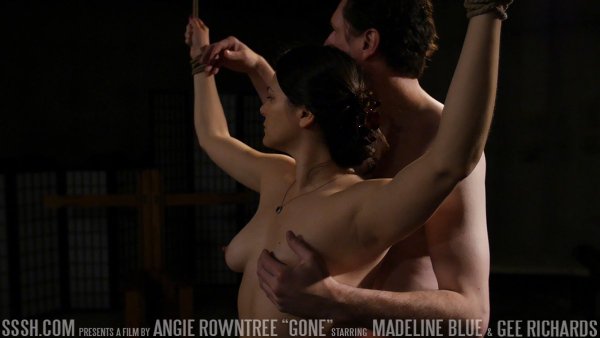
That thought leads me to bring up Gone, Angie’s award winning contribution to porn’s female-friendly Hall of Fame. The production stars Madeline Blue in an emotional performance and is the kind of film Candida Royalle would admire.
Cinema exhibitions such as the Swedish International Film Festival, Cinekink, the Los Angeles Film Festival, Wendy’s Shorts, and the Holly International Film Festival honored Gone in 2016 with an “Official Selection” for mainstream audiences.
Other accolades specific to the porn crowd were given out in 2016 by AVN and XBIZ.
Angie was also recently recognized as a ground breaker.
“I was the first person from the adult industry to speak at a Sundance workshop,” she says. The subject was “Creative Tensions: Sex.”
Obviously, Gone as a narrative has moved past traditional porn expectations into a more literary worthy realm. Has it created a compromise or midway genre between hardcore and mainstream?
Angie is unsure about that but she does know the film “represents an approach to merging a story with explicit sex [and] that’s a road much less traveled in porn.”
She mentions there are “a number of erotic films with strong plots and character, but the vast bulk of adult entertainment these days is ‘gonzo’ porn–meaning no story, no characters, essentially nothing but wall-to-wall sex.” That’s not her cup of porn tea.
“I like story, I like context, and I like the sex between characters to mean something within the story, rather than the story be nothing but a handful of disconnected sex scenes.”
Could that be the formula that punches porn’s ticket onto the mainstream stage?
Perhaps, but there is more.
Acting
Naturally, when we’re talking narrative with plot and dialogue acting has to step up. Is there a greater demand on porn performers to beef up their acting skills?
That depends according to the eras of porn you’re talking about, Angie asserts.
“Is there more demand for them to be able to act than in the late 1990s and early aughts when gonzo really started to take a dominant position in the market? Possibly. But if you compare it to the early days of porn, even if you think the acting in those movies was atrocious, you have to admit there was more acting on average than there is most modern porn.”
The director mentions films like those she shoots and the currently popular “porn parodies of mainstream superhero movies” do value acting. As for Gone, Madeline Blue and her co-star, Gee Richards, certainly pass the theatrical test.
On the other hand, acting is not an ingredient in gonzo where sexual frolics and “how someone looks while performing them” sells the product, Angie says.
Simply put, adult film is an opportunity for those who want to turn up their creativity a notch and for others who just want to play.
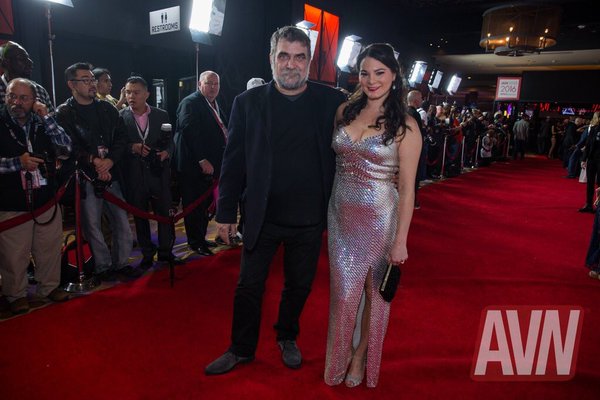
Colin Rowntree and Madeline Blue at the AVN Awards Show in 2016
Tighter Scrutiny
Finally, I inquire about crossing over as an influence how adult films are made.
“I can’t speak for other directors, but it’s a consideration for anybody who intends to distribute their work on platforms like cable or satellite which are subject to a lot more scrutiny and tighter standards than content produced strictly for internet and DVD distribution.”
It can stimulate rethinking on how to shoot a scene, though it doesn’t affect dialogue, she believes.
“I’m definitely mindful of needing to shoot in a way that the sex scenes will hold up and still be arousing and hot, even after being edited for penetration or otherwise altered for broadcast.”
We’re looking forward to more from Angie Rowntree. Another production like Gone that stimulates story and emotion is needed in today’s porn environment.
* * *
Colin Rowntree at work. You can follow him on twitter here.
Ever since I began writing in adult film, I’ve learned that creativity is broadly defined. Many directors and performers like the all-sex, or gonzo approach to filmmaking where innovation revolves around positions, penetrations, and hot bodies.
On the other hand, my preference is the feature where plot, dialogue, and acting complement the sex. In my mind, telling a story sets the stage for the film’s carnal adventures by giving them meaning.
Along the way, I’ve talked with movie makers who feel the same way. One of them is Angie Rowntree of Sssh.com, a female-friendly adult website.
* * *
I first sat down with Angie at the 2016 Adult Entertainment Expo in Las Vegas. At the time, I had reviewed her groundbreaking film, Gone, which in my opinion is the best adult film ever made. You can read the review here.
Recently we had the good fortune to talk about an emerging phenomenon in adult known as “crossing over.” Simply put, it means entering legitimate Hollywood while maintaining a porn identity.
Here is a sampling of our conversation.
A Legitimate Expressive Form
Is crossing over on rise?
Angie believes that “porn has become far more accepted, or at least tolerated, by the general public than it used to be,” a change she credits to the internet. Understandable, she says, since “porn’s prominence” has dominated “the commercial internet” since its earliest days.
“References to porn are now commonplace in pop culture and it’s a daily subject in mainstream news reporting and broadcast television,” Angie explains, citing “edgier” shows like “Game of Thrones, American Horror, Sons of Anarchy, and now HBO’s West World” as examples.
The feminist filmmaker maintains that most viewers see a “bright line” between HBO/Fox type entertainment that pushes boundaries and porn. Nevertheless, “the embrace of sexually explicit depictions by undeniably mainstream shows has certainly helped to legitimize sexualized content,” she adds.
The result is a huge step toward the acceptance of adult-like performances embedded within Hollywood narratives.
Agreed, but is there a generational influence at work here?
Youth does make a difference, Angie insists.
“To a lot of young people these days,” porn is “just another form of entertainment . . . to watch if you feel so inclined, like TV dramas, sports, or sticoms.”
Perhaps it is Millennials who are leveling the entertainment playing field and here’s why.
According to Angie, “the sense of shame long associated with watching porn is starting of dissipate,” which means porn is going through a “circular evolution.”
“As more of porn is made which bucks the traditional, typical male-dominated perspective, more people will accept it as a legitimate expressive form, leading to even more creative and innovative people coming into the industry.”
The result? “A more diverse and variegated industry” will lead to improved content benefiting everyone from performer and filmmaker to the consumer.
Viewed Differently
That leads us to the key question. Will porn ever be accepted as mainstream entertainment?
Angie hesitates to predict anything definite about that.
“I think porn will always be viewed differently from mainstream entertainment if for no other reason than people are going to continue to be conflicted in how they feel about sex. For something so central to our lives, humans sure seem to be uncomfortable with the subject of sex, let alone its depiction.”
As an afterthought, however, she hints that “always” and “forever” are not words to use when talking about porn.
“Back in the early nineties I never though I’d see porn become as accepted and tolerated as it has already become, so who knows what the future holds?”
Legally Acceptable
I’m not letting Angie get away without one more question.
Will the public accept hardcore sex if it’s integral to the story being told?
“I think there’s real merit to that notion, yes . . to a certain extent, at least,” she says, and mentions the 1979 film, Caligula.
“It was seen as one step more ‘legitimate’ than the hardcore porn movies being made around the same time.”
This legitimacy, she insists, emerged because the film “was perceived as a movie with hardcore sex in it as opposed to a porno with an unusual amount of dialogue.”
By the way, Caligula was made in the fading pre-video days of Porno Chic when adult films appeared in neighborhood theaters and emphasized a narrative with a semblance of acting.
The producer/director reminds us of an important change established in the 1970s concerning obscenity.
“Hardcore sex is more legally acceptable when it comes in the context of a story.”
That’s important because the court has to prove that the content and context of a film “lacks literary, artistic, political or scientific value,” she adds.
Of course, producers and directors can argue for a film’s merit, Angie insists, “if there is more going on within the story than just people having sex in several different positions.”
Well said.
* * *
Our conversation with Angie Rowntree continues in the next post.
She talks about Gone, her Mindbrowse podcasts, and we’ll learn a little about acting and a female director’s approach to shooting.
Heavy hitters in the female strong line-up of porn makers. Love this photo! Left to Right: Kelly Holland, (bartender in background), jessica drake, Angie Rowntree, Madeline Blue, Jacky St. James, Kelly Shibari. Photo courtesy of Angie Rowntree
B Skow believes a little political incorrectness teaches all of us an important lesson. In Color Blind, he attacks racial stereotyping in broader society while offering support for diversity in the adult film business.
* * *
Every Single Day
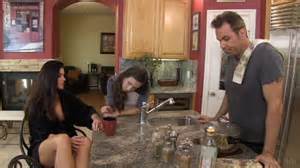
Meal time in the family kitchen opens Color Blind. Along with daughters Noelle (Kasey Warner) and Shauna (Adriana Chechik), Mom (Reena Sky) and Dad (Steven St. Croix) are watching the evening news . . . sort of. Noelle is unsighted; her vision is hearing and touch.
A small television is positioned on the counter behind Noelle and for the family, especially Dad, watching it means looking past his daughter. It’s an image that defines where this film is going.
The year is 1992 and rioting is devouring South Central Los Angeles as the African-American community protests the arrest of Rodney King. Clips of what we sadly see too much of today—looting, vandalism, and general mayhem—move front and center in the opening moments of Color Blind.
B Skow has set the mood. Dad and his daughters will ultimately clash like the chaos on the streets.
By the way, this is a working class family that doesn’t live in LA. Shauna flippantly mentions her all-knowing father should move to California to straighten things out.
Steven St. Croix in another B Skow film, Proud Parents
Dad goes through a litany of stereotypes, suggesting the modern large screen TV is the black man’s “forty acres and a mule,” a reference to the expectations of freedmen immediately after the Civil War.
To set the record straight, they got sharecropping and an unrelenting cycle of poverty instead.
Relying on a history he interprets only in sound bites, Dad, an angry replay of Archie Bunker, offers one of his own. He calls the rioters, “dumb shits.”
Later when racist language comes unexpectedly from a frustrated Noelle, he reacts with shock, wanting to know who “taught” her the nastiest of all words.
“You did, every single day without saying a word!” she screams.
Special
Color Blind pokes fun at stereotyping by using stereotyping.
Layton Benton
Fried chicken, corn on the cob, and iced tea, a favorite menu in the South, grace the family table. Dad reminds everyone that basketball and unprotected sex are cultural staples in the black community though, unbeknownst to everyone, he has an African-American stripper girlfriend (Layton Benton) on the side.
But in Dad’s mind, that’s okay. A little cheating never hurt anyone and don’t black women crave sex anyway?
Incidentally, he does her bareback in the movie’s third sex scene.
Fed-up with his tirades, Shauna sarcastically says she’ll iron his KKK shirt because he’d “make a great wizard” in a statement that carries a double meaning: the racist Grand Wizard and the 19th century Populist vision of the Wizard of Oz, who is nothing more than political hot air (Donald Trump, anyone?).
Adriana Chechik
Later Shauna mentions that her father caught her with her “pants down” using a dildo she affectionately calls “a big, black cock.” We see her frolic with the satisfier in a well-shot scene.
By the way, there’s more to come for Shauna when flirting with Tyson (Jovan Jordon) works to her advantage.
Skow takes one more shot at stereotypes when Dad speaks with Noelle. He mentions the word “special” and how God makes some people different from others, creating more than one interpretation of “special.”
Of course, it’s his way of telling Noelle that her blindness is her burden, making her “different” in a good way.
His attitude changes when she challenges him about the “different” people on TV. They are not special, he says, in so many words.
It’s the height of hypocrisy.
Kasey Warner
Reaching Out
What makes Color Blind a must-see film is its social statement. The groundwork is laid early when a pair of Bible sellers, Mathew (Isiah Thomas) and Tyson show up at the front door. They “are reaching out” to their neighbors, “extending the hand of friendship,” they announce.
The African-American brothers are a bit uncomfortable peddling the “Good Book” in a neighborhood that is alien to them. To soothe the way, Mathew remarks that “love is blind, color is only color, skin is just skin.”
Of course, Dad will have none of this and slams the door. But the girls are persuaded; the brothers have much to offer emotionally and physically (this is a porn film, after all) which is the narrative’s remaining journey.
Isiah Maxwell
Speaking of sex scenes, all are solid and three are interracial which carries a stereotype of its own as I have heard in the industry.
Two stand out. First is Kasey Warner/Isiah Maxwell. . . . not the usual porn fare. Tender and warm, it’s the sexual awakening of a girl for whom color is meaningless. Remember, touch is part of Noelle’s vision that makes this sex scene unique.
On the other hand, for gonzo fans Skow includes an extended anal romp featuring Jovan Jordan and the raunchy interracial sweetheart of this film, Adriana Chechik.
Jovan Jordan
Not a Single Color
The final ten minutes is the movie’s tour de force, but the resolution is traumatic and thought-provoking. Not surprisingly, the word “boy,” another stereotype, makes an appearance.
In an overwhelming moment, Noelle shouts at her father, “I’ve never seen a single color in my entire life,” deflating the central stereotype of Color Blind. What the eyes see is too often culturally programmed and not individually felt.
Simply put, everything is neutral until given meaning.
Reena Sky
Accolades are extended to Steven St. Croix who holds the narrative together with superb acting. He captures the Archie Bunker persona perfectly. Also, Kasey Warner handled a difficult role beautifully, perhaps learning a thing or two from Maddy O’Reilly who plays a blind daughter in another Skow production, Daddy’s Girls.
And let’s not forget that Reena Sky delivers an entertaining scene with Steven St. Croix and Adriana Chechik is as fine a gonzo girl as can be found, plus she can act.
* * *
B Skow takes chances with Color Blind. In fact, he’s courageous beyond any adult director I know. His work moves past the tepid political/social statements we usually see in porn while keeping the genre going with explosive sex scenes.
So where does this leave Color Blind?
Rodney King, whose arrest sparked the 1992 riots, said in retrospect, “Can’t we all just get along?”
That is the question Skow presents in this dynamic film and for those in our society who can’t, the consequences can be dire.
* * *
Color Blind is a product of B Skow for Girlfriends Films and can be ordered from the website.
Determining a magnum opus for any artist is a moving target. For Amy Hesketh, her definitive film is yet to be settled upon, though reviews of Olalla (2015) and La Marquis de la Croix (2012) suggest they are leading contenders.
However, Barbazul cannot be ignored. In fact, it may be better than all her films because of the deep psychological interplay within Bluebeard’s personality that creates the duality of character and killer.
Amy’s production is more than an “art film” or a melodrama designed to shock because the story speaks to our interpersonal relationships and the miseries they can cause. The fear of rejection and the pleasure of revenge . . . if just as a fantasy to even the score . . . haunts all of us.
Mop and Pail
“A few kisses in the night are not the end of the world,” Maga croons.
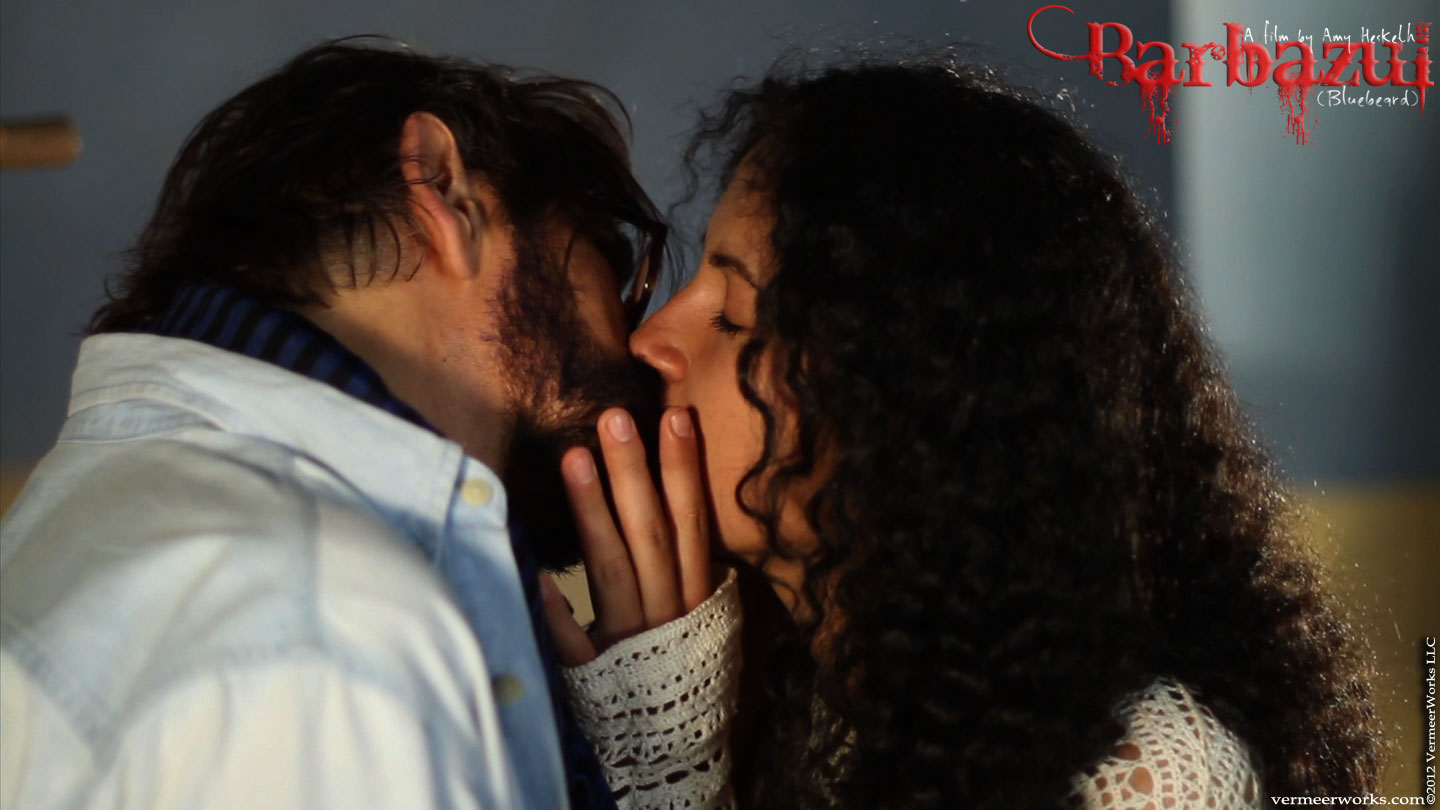
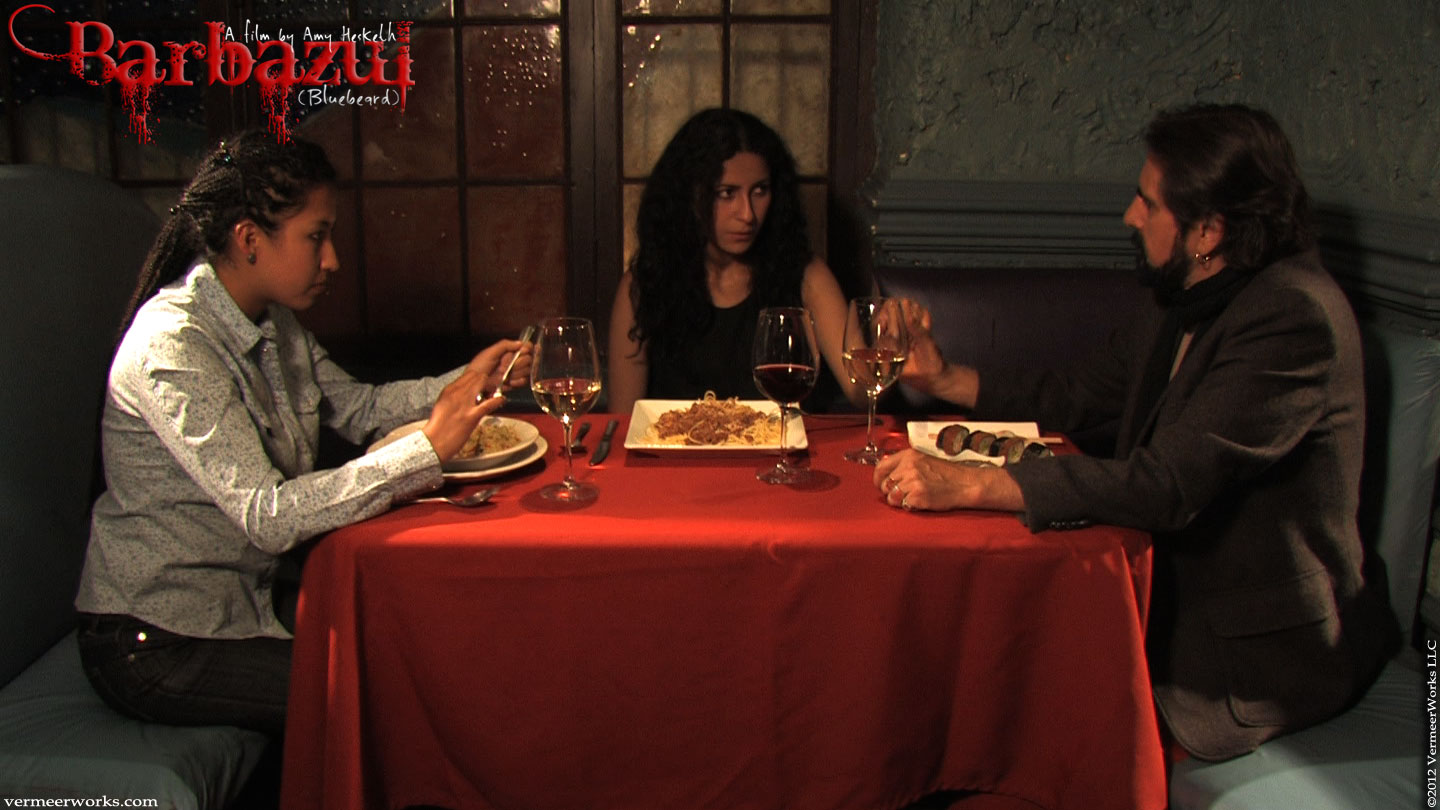
With a highly sexualized demeanor and eyes that promise attention, she’s smooth and silky. Spotting Bluebeard across the room, Maga casts her line. The band takes a break; they hook up instantly.
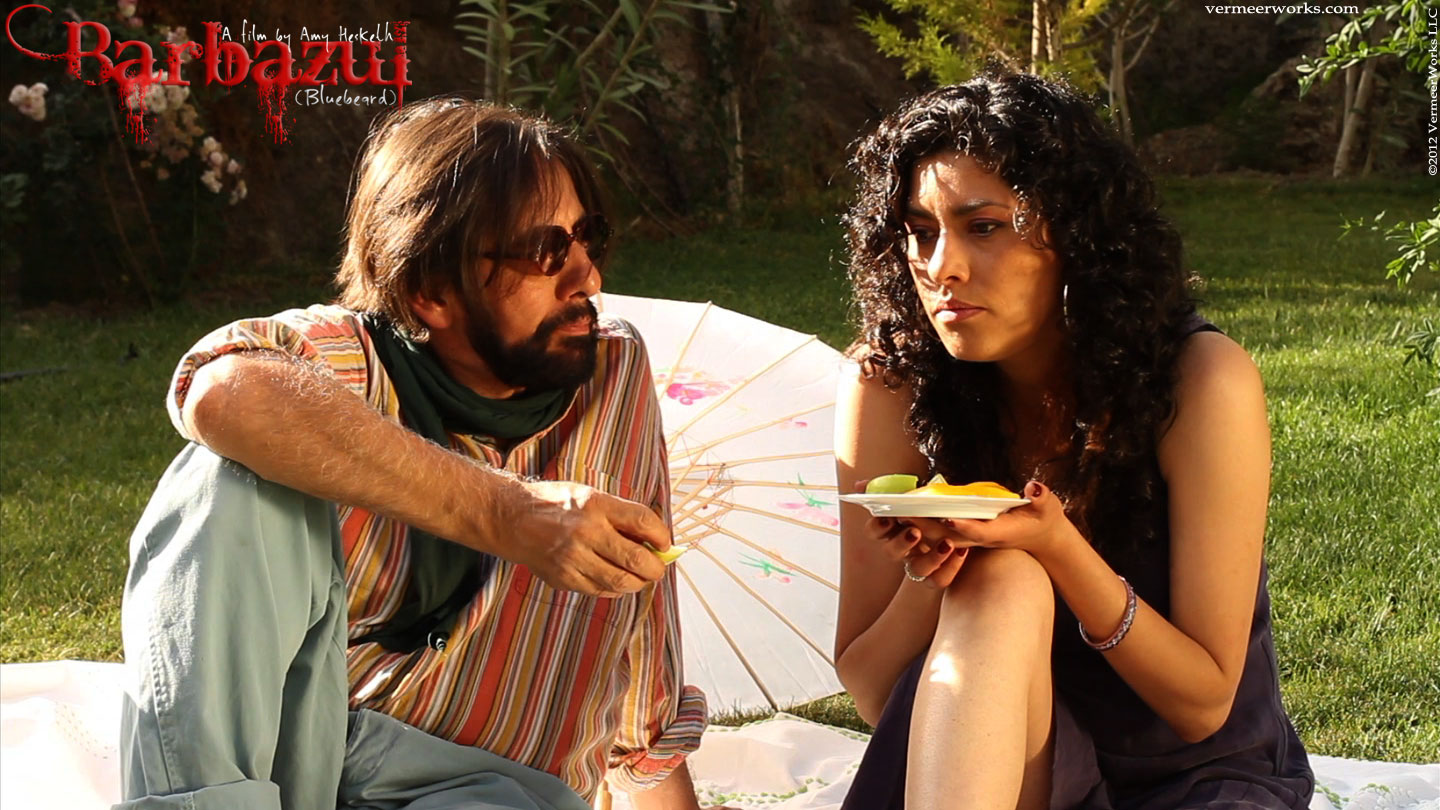
Later on a picnic, Bluebeard and Maga play a game: label the wine with a band. He suggests Led Zepplin (Stairway to Heaven, perhaps?); she counters with the Sex Pistols (Johnny Rotten and Sid Vicious, anyone?)
In a seemingly frivolous moment, Bluebeard says, “Enjoy your time here while it lasts.”
In other words, this is just a diversion, a fling, as Maga’s song tells us.
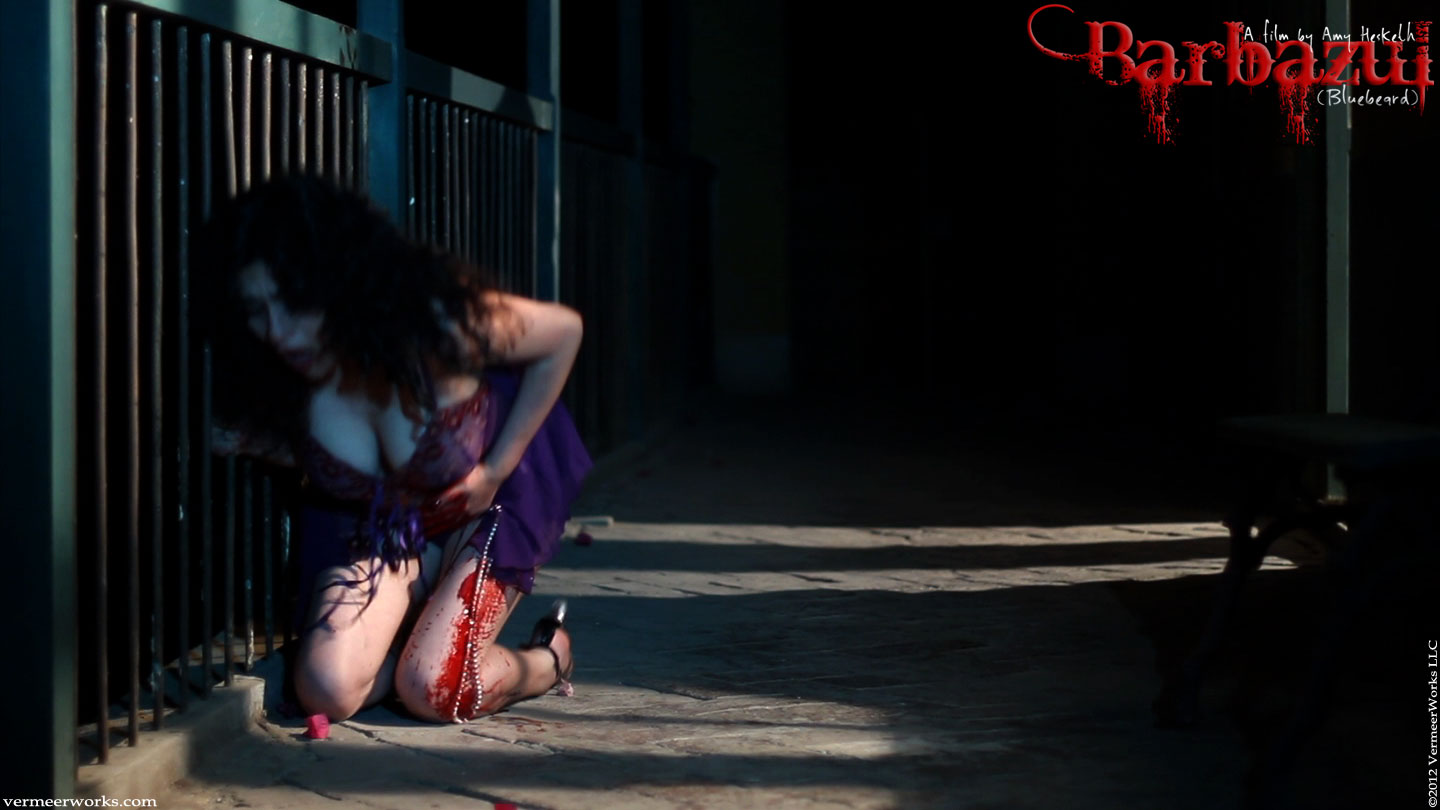
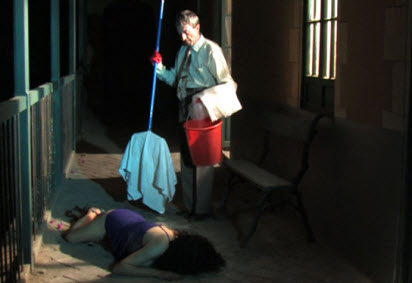
The singer likes the plantation as one would the Copacabana during a winter escape. But she must go back to the city, musical commitments to fulfill, you know. Bluebeard will have none of that and drives a knife into her gut while she dresses, an unexpected surprise.
Incredulous, the entertainer stumbles onto the porch. Bluebeard casually places the knife on the dresser, puts his hands in his pockets, and follows her. In a well shot scene, Maga’s unintended version of crawling undoubtedly amuses Bluebeard.
The blood flows.
He finishes her with the scarf.
Walter gets the mop, pail, and towels.
Maga is a nod to a frivolous side of Bluebeard’s personality he considers hardly worth a mention. There is no sex scene and no nudity . . . sort of, Bluebeard lets the blade relish the flesh.
Like Maga, it’s just a silly kiss in the night.
The Lady in Red
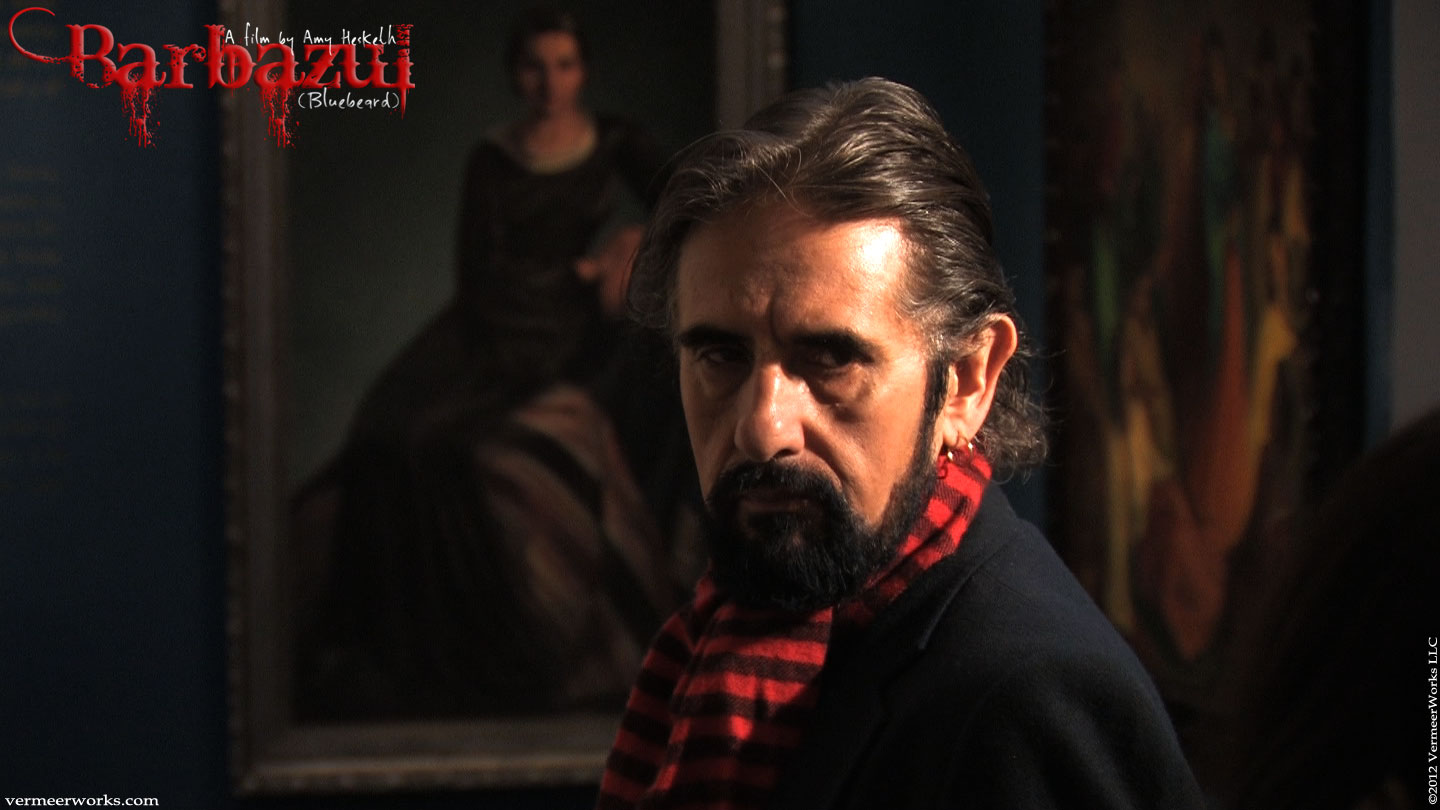
The next stop is a museum. By chance, Bluebeard meets the lady in red, Agata. The theme is huntress versus The Virgin as displayed in the artwork that winds its way around their conversation. She asks for his preference, prepared to offer him both. Her demise is a cruel joke because she is no Madonna and hardly a Diana.
Agata is the hunted from the beginning.
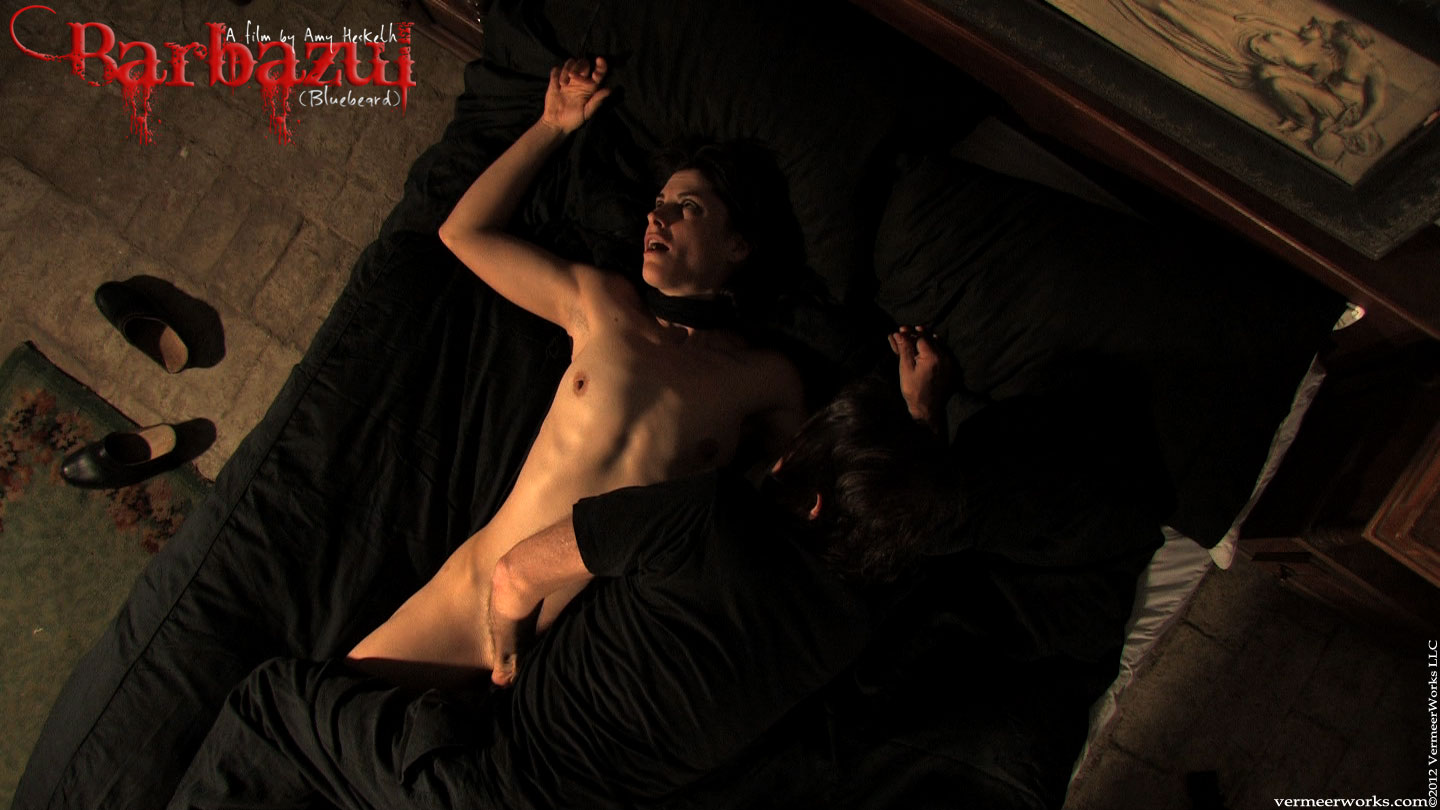
When they first have sex, Agata extends her arms in a crucifixion position as Bluebeard pumps away. Her expression exudes pain with ecstasy.
In an overhead shot, burning candles are on both side tables. The scene has a religious overtone with the sex ritualistic in nature, a blend of ancient paganism and the emergence of the Church.
By the way, Agata is never totally nude, red sheets cover her from mid-torso down (is the blood of redemption everywhere?). Nakedness is a measure of a woman’s sexual arousal to Bluebeard and we see Agata and Maga as minimized and easily dismissed.
At dinner, Agata makes it clear that life on the plantation suits her and she intends to stay, but she has no use for Walter. Her fawning bores Bluebeard. When he picks up bread from his plate, she puts her hand over his in a gesture of control. His body language tells all; he leans away.
On her death night, Agata’s head is at the foot of the bed. Bluebeard comes over and ties her arms in a spread-eagled position. Forever the fool, she thinks it’s exciting, but her expression soon turns to desperation.
He strangles her in a metaphorical upside down crucifixion position that reminds the viewer of the death of St. Peter who regarded himself vastly inferior to Christ.
Certainly Agata is unworthy of Annabelle the film suggests, tongue firmly planted in cheek.
Is this Bluebeard’s attempt to reconcile his spiritual side with his Jekyll and Hyde contradiction?
After Agata’s last breath, Bluebeard puts on his slippers and walks out of the room, leaving the mess behind for Walter, we assume.
Excuse Me?
Maga and Agata are stopovers that prepare Bluebeard to confront the abyss of his most highly sexualized shadow: his sadism. After that, he will search for solitude (Soledad) as his companion . . .
But first we move to a randy scenario that is a salute to wit and dark humor: Jane.
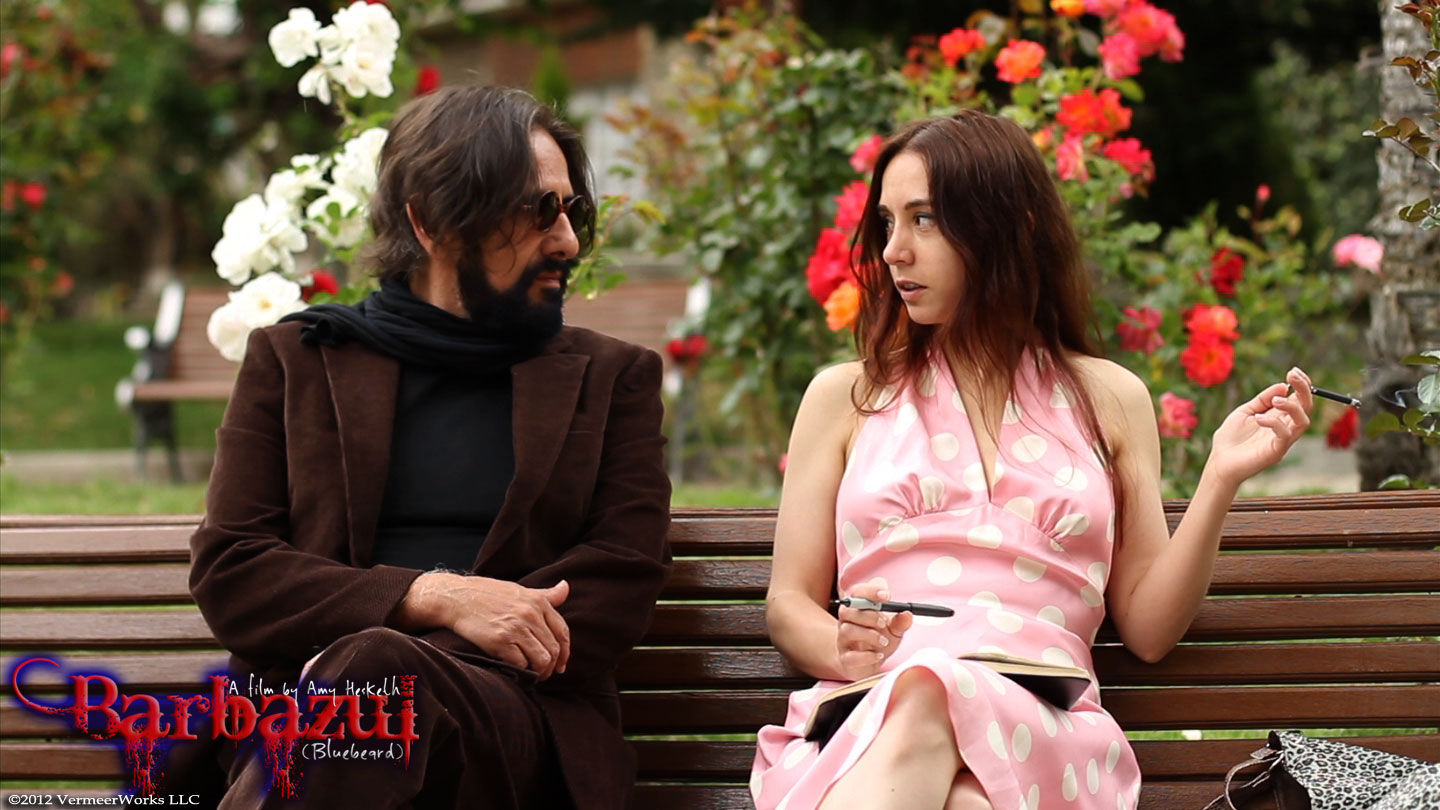
In a playful nod to her early modeling career and eventual transition into filmmaking, Amy Hesketh casts herself as Bluebeard’s next victim. Wearing the pink polka-dotted dress that hangs last in line in the plantation office, she’s sitting on a park bench, notebook in hand, smoking a cigarillo.
Bluebeard slips next to her and inquires as to what she is writing.
She introduces herself.
He knows her from her photos, he says, and repeats his question.
“My next book,” she answers.
“Another one of your famous erotic S & M tales?”
Offering his hand, he says, “Bluebeard.”
“Excuse me?”
“Barbazul,” he repeats, “like the fairytale.”
Is she interested in drink?
“I only date fictional characters,” she whimsically replies.
“Do fairytale characters count,” he asks.
Jane smiles, “I guess.”
It’s the moment that breaks the fourth wall and lets the viewer in on the game.
Harder
There are no preliminaries with Jane. She is in control of her fantasies and has minimal interest in yielding to the whims of others if they don’t match hers.
The tone of their relationship is immediate. She will use Bluebeard as easily as he believes he is using her.
Jane, like Amy Hesketh I suspect, is a feminist.
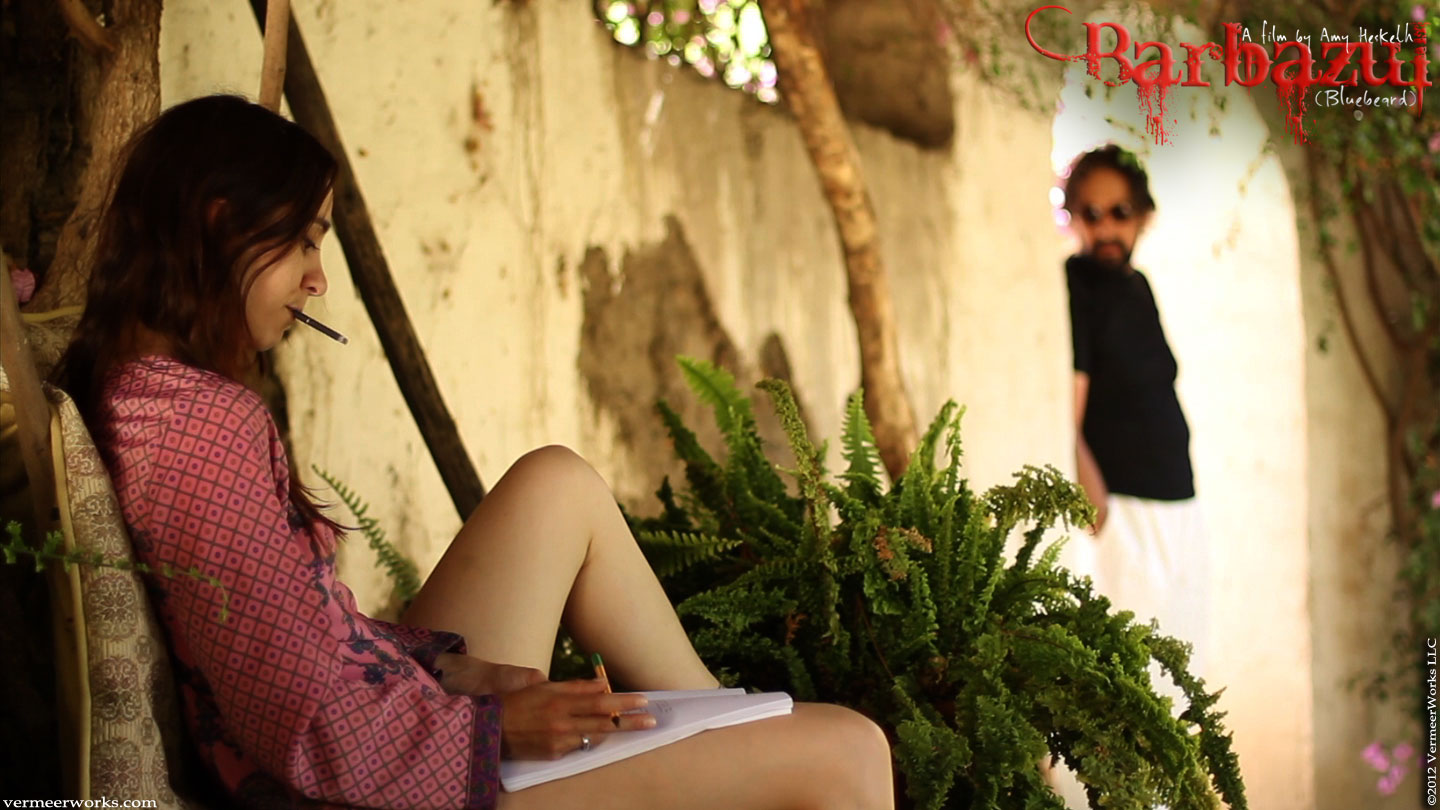
In a garden setting Jane is at work, pen in hand; a cigarillo dangles from her lips. Bluebeard looks around the corner and asks if she is “coming” (well, not yet, she needs a well-delivered preliminary activity!).
The writer smiles, puts down her notebook and grabs the upper support of the arbor with both hands, stretching out her arms.
“Wanna to do it here?”
With Jane there’s more to dangling than a smoke.
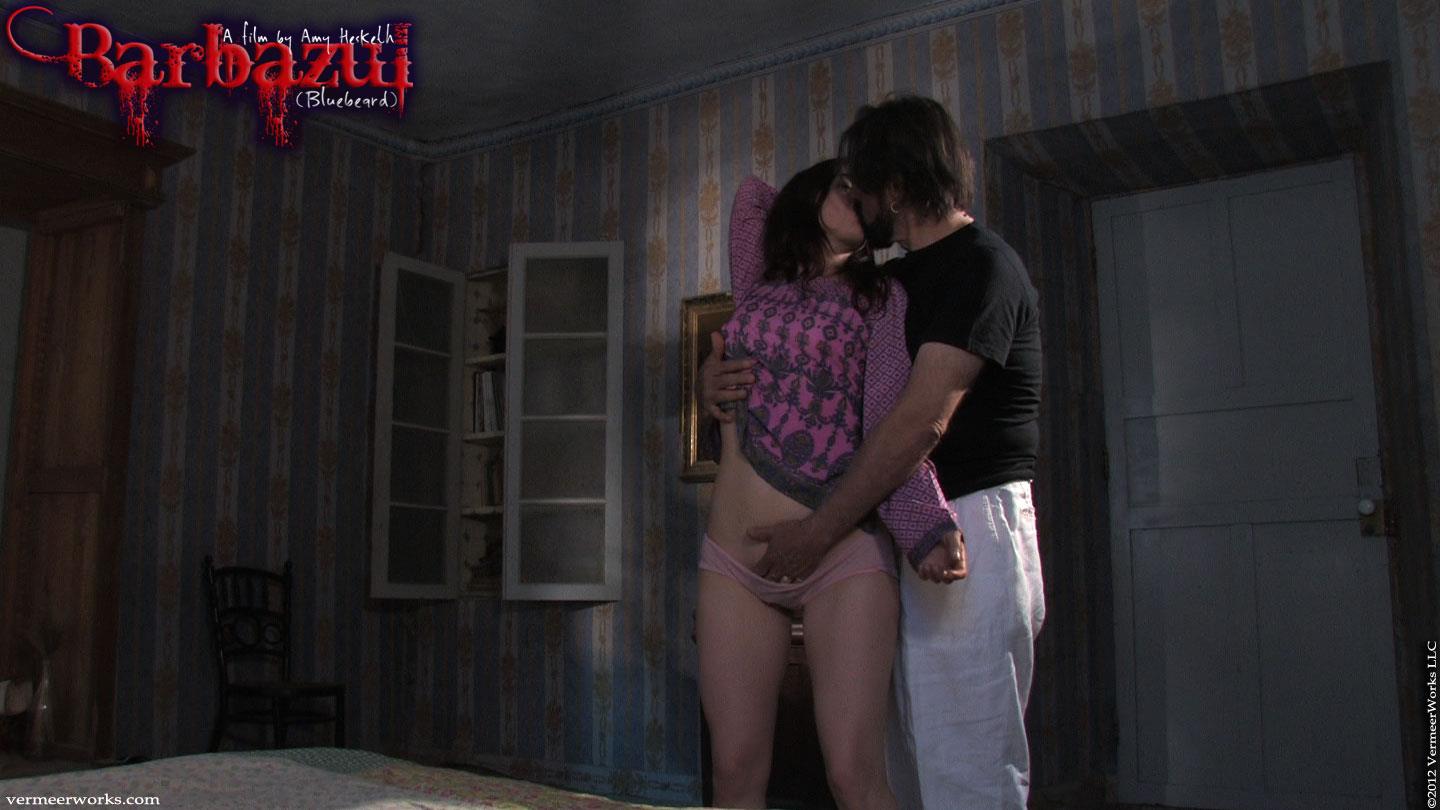
“I’m more traditional,” he says, removing her cigarillo. They walk off arm-in-arm. Bare-legged she’s wearing thin panties and heeled espadrilles that promise all that is raw and raunchy.
In the bedroom, the Jane digs out handcuffs and a whip from under the pillows and gives them to Bluebeard. She knows what she likes in a scene that is classic Amy Hesketh.
When her working over begins, Jane grimaces and says, “harder.” The sex that follows is as nasty as her salacious novels, but that suits the S&M author just fine.
Later Bluebeard approaches her at night in the garden where she is again writing. He’s brought her toys, he says. She puts him off momentarily.
Breaking the tried and true rule that everything is consensual in BDSM play, an annoyed Bluebeard ignores her. Amy Hesketh is now in her favorite role, the victim punished for her tormentor’s pleasure.
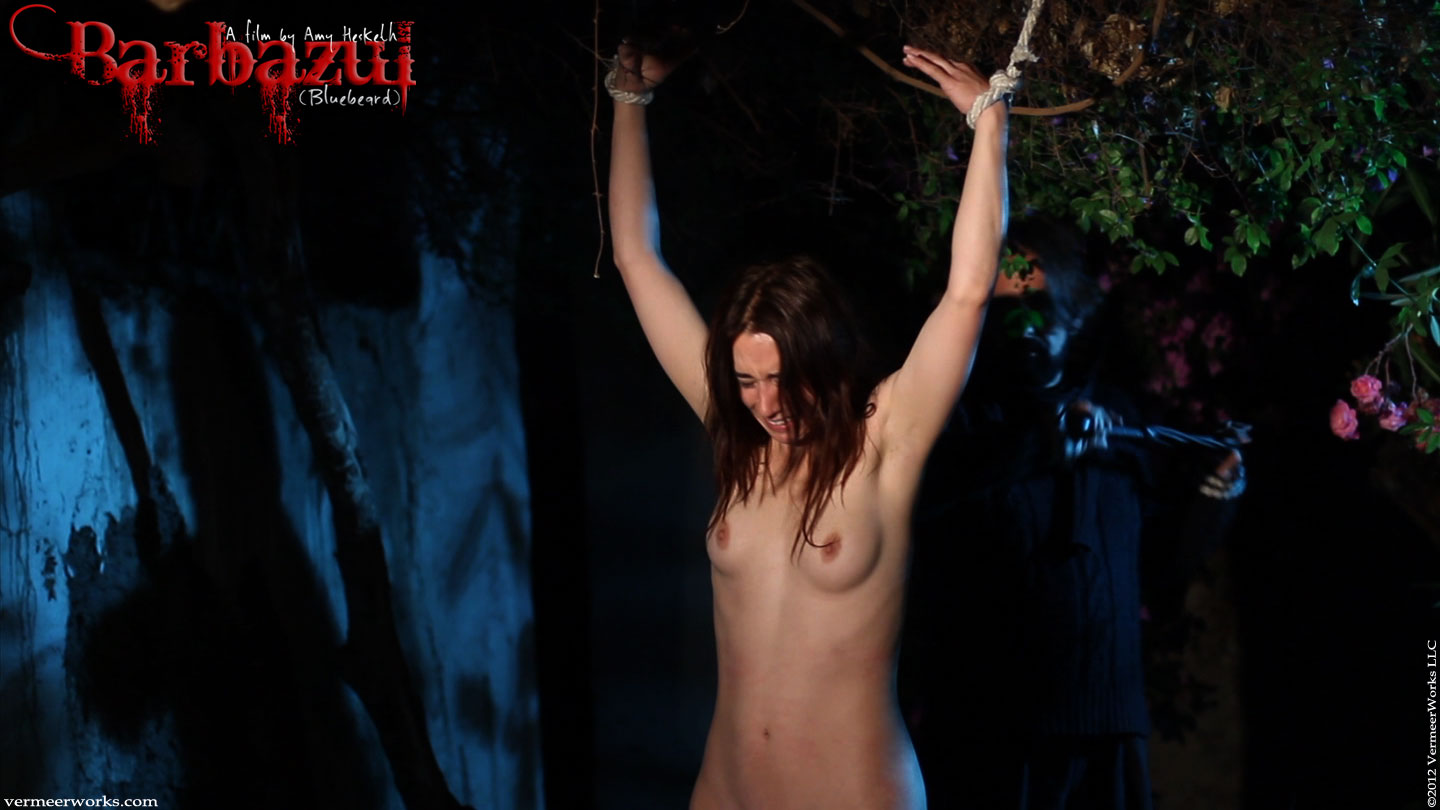
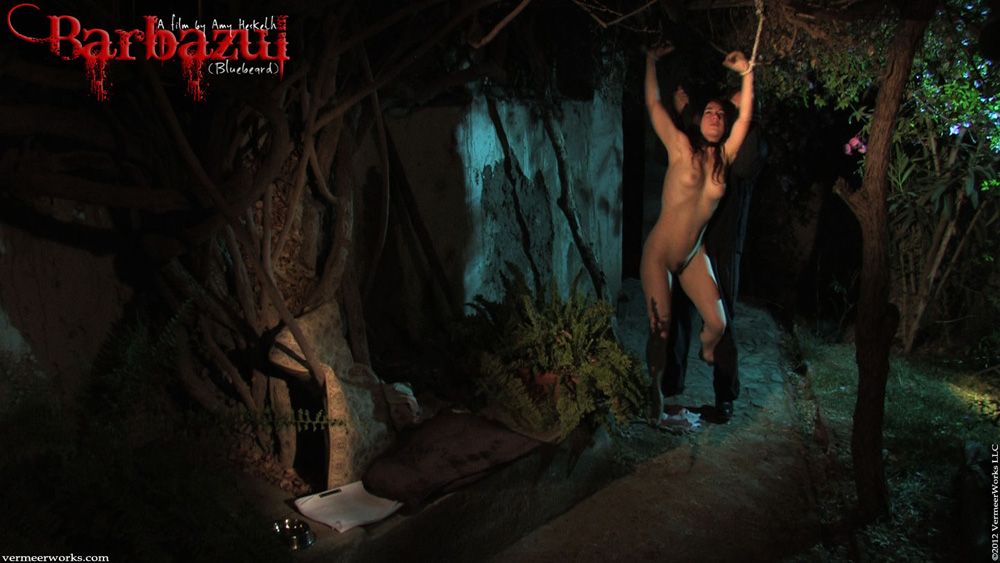
He binds her, arms extended, and tears away her clothing. Crying, she begs him to stop. The extended whipping scene is topped off with a garrotting.
One more shadow is put to rest, this time more formally with an execution-like conclusion. In a bodacious performance, Amy Hesketh salutes the Grand Guignol’s legendary Paula Maxa.
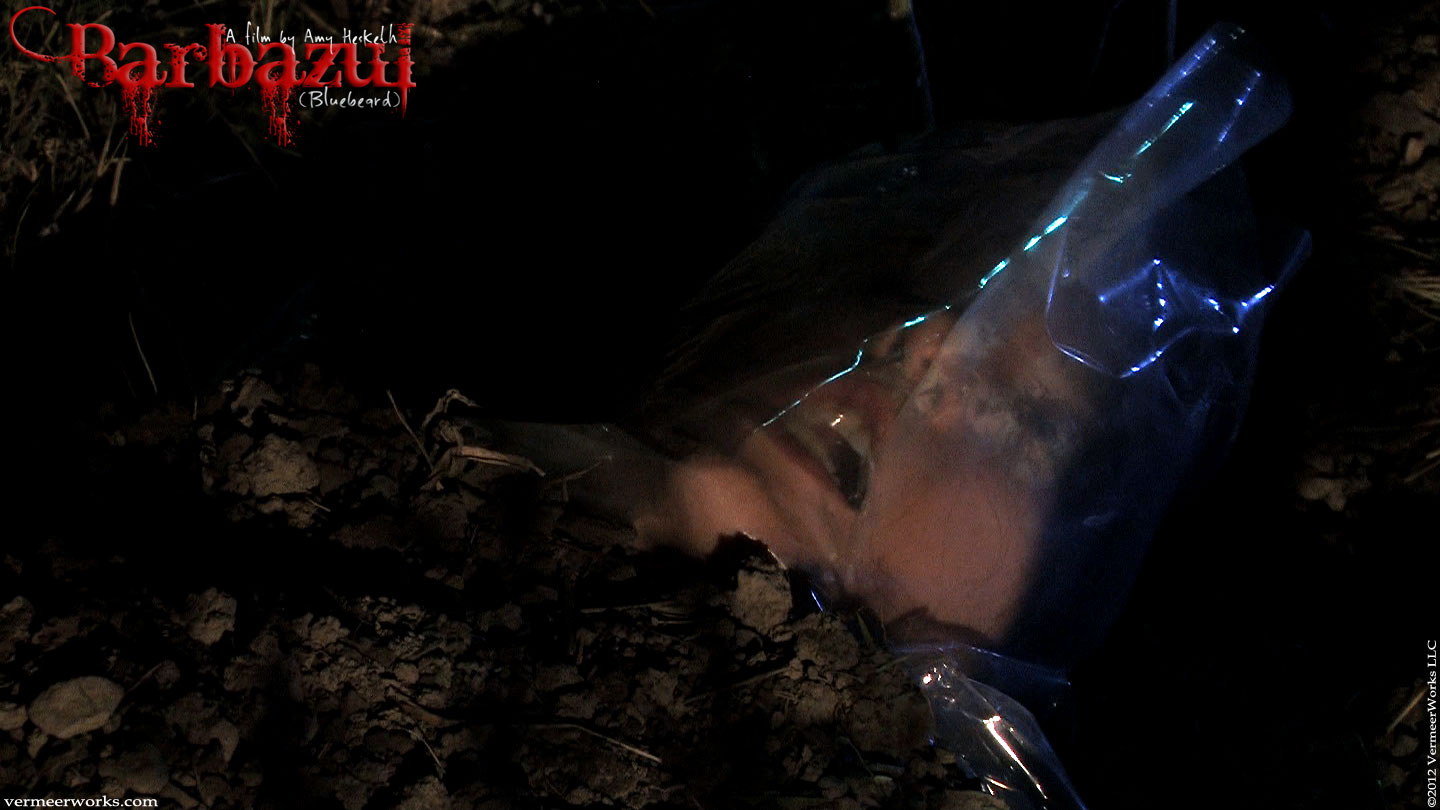
Walter appears with shovels and clear plastic wrap. In a particular gruesome scene that features a mummification fetish, Jane awakens, verifying a traditional fear that has haunted civilization from its beginning.
But that is only part of the scene’s importance. Bluebeard can never put to rest his sexual aggression and the blood that flows from it. Even solitude will not satisfy him.
Somewhere deep within his past and his inner self, it became a part of who he is that cannot be suffocated. Simply put, our sexuality is never extricated or disentangled from who we are, no matter our fetishes or proclivities.
Of all the scenes Amy Hesketh and Jac Avila have played together, this is among the best. It speaks to the heart of their cinematic collaboration.
There’s more to come as the story reverts to Soledad and Bluebeard’s return to the plantation with her sister Ana. But, that’s not for here. Buy this film and see the bizarre conclusion for yourself.
What to Make of this Film
Amy Hesketh’s version of Bluebeard is hard to pin down. Is he a misogynist or a serial killer or both? Perhaps he is just a man whose warped view of all women was triggered by the one woman who toyed with his emotions?
Or does Bluebeard suffer from a personality disorder in which attachments and emotional bonds are weak but ephemeral relationships easy to form? Does he get off on manipulating and exploiting women until ennui sets in? Is he afraid of his own sexuality in such a way as to self-emasculate, leaving violence in the place of real affection?
On the other hand, perhaps Bluebeard hides his inability to “feel” under a thin veneer of infatuation. He fears rejection and offs his women to keep them around, the ultimate expression of aggression and control.
In the Jungian sense, however, each of Bluebeard’s victims represents an insatiable part of his sexual self that Bluebeard must cast away to reach his core: his prepubescent innocence.
Take a look: Annabelle is the beautiful, unattainable, and the ultimate put down; Soledad is the submissive and pliant; Maga is the cheap trick and Agata the disdain for the morally righteous.
But Jane is Bluebeard’s emotional Dracula, the raw sexual aggression that lives eternally in every male, overwhelmingly desirable and uncontrollably demanding.
In the end, misogyny is not the villain of this story as it is with Charles Perrault’s fairy tale, nor are Bluebeard’s paraphilias to blame for his actions.
Rather, the malefactor is anger and rejection driven by an immature sexuality that objectives women, an all too common malady among men.
Incidentally, during the film I thought the best place to conceal the bodies would be in the casks of wine. Perhaps now we know what the dead mouse was trying to tell Annabelle when she walked by it . . .
* * *
Congratulations to Amy Hesketh for a provocative and dark interpretation of a long-recorded tale.
Barbazul is a film that begs to be seen again and again.
The cinematography in Barabazul is expansive and invigorating. Often indie film companies are handicapped by lack of funds which can show up in the technical aspects of their work, but Pachamama/Decadent productions manages to overcome that shortcoming with finely crafted shots equal to those of big budget studios.
* * *
You Were Perfect
Barbazul now moves into its flashback stage. Soledad reads through the journal and meets each of Bluebeard’s previous women.
The first is Annabelle (Veronica Paintoux). She’s doing a fashion shoot for the slave-driving Paul. Soledad is also present, assisting the cameraman but hardly to his satisfaction. He criticizes her as a “nappy-haired cunt.”
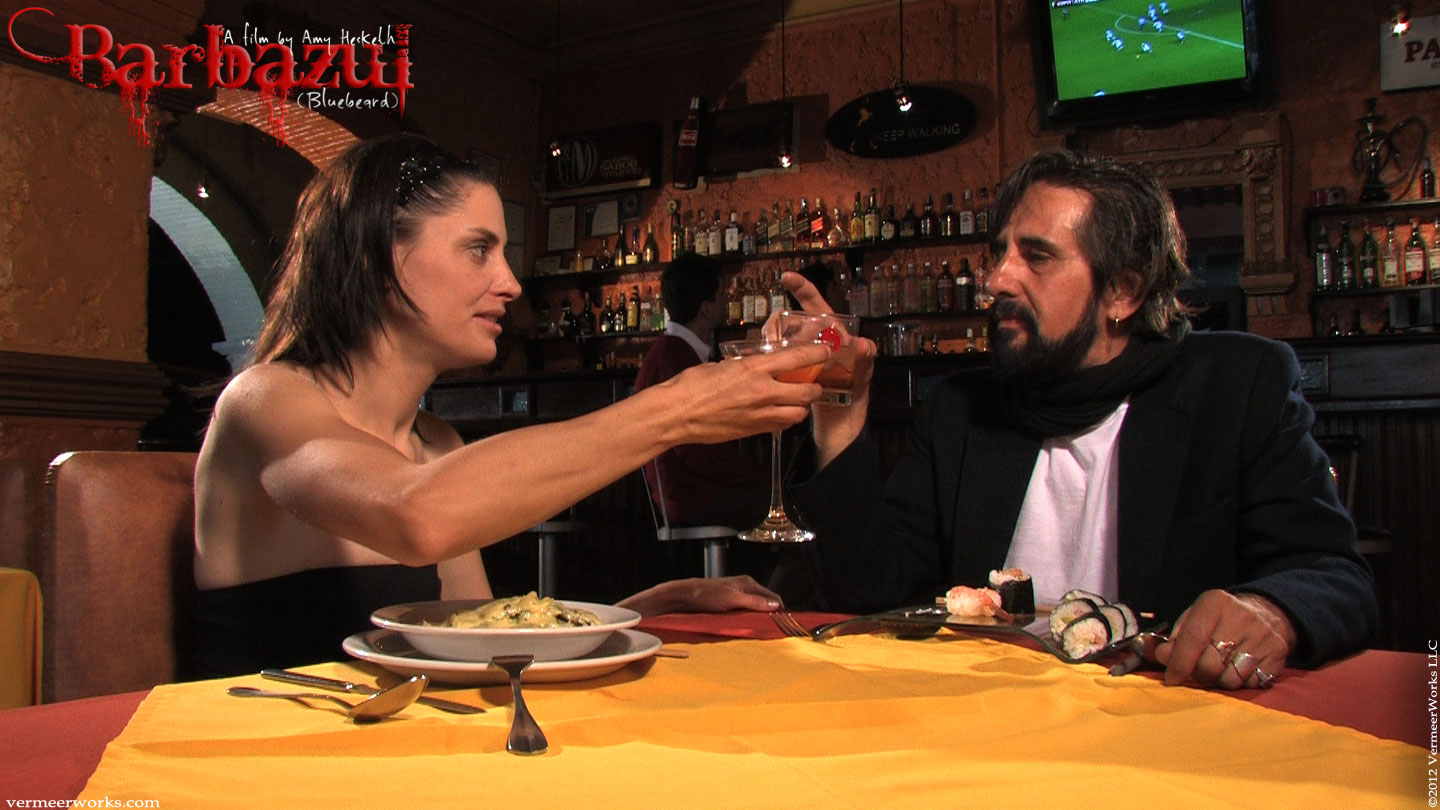
After a round of poses, Annabelle chats with Bluebeard.
She wants his opinion of her work.
“It was perfect. You were perfect,” he says.
Annabelle suggests he must have paid handsomely to be on set because Paul doesn’t want clients hanging around when he’s shooting.
“I like seeing the action,” Bluebeard replies.
So does she, apparently, and invites him to dinner. Eating, a Freudian interpretation of sexual interest, is a major motif in the film.
Conversation revolves around her talents. Her photos “will last forever,” Annabelle says, because modeling is an art that requires “using your body, knowing how to move, knowing yourself.”
“To understand your own beauty is not that easy,” she remarks with a knowing smile.
Annabelle is self-confidence personified, a statuesque charmer quite the opposite of Soledad who is socially reserved despite her exotic, understated look. Elegant and cosmopolitan, Annabelle seduces Bluebeard.
She even tells him his scarf is all wrong and in a moment integral to the film, gives him hers. It’s black and will become the pivotal image for the rest of the narrative.
Director Amy Hesketh has set the table, so to speak, in this restaurant scene. We know what is to come.
Suicide?
As expected, the boat ride and hotel sex follow. Annabelle is far less reticent than Soledad about stripping down before crawling across the bed to Bluebeard.
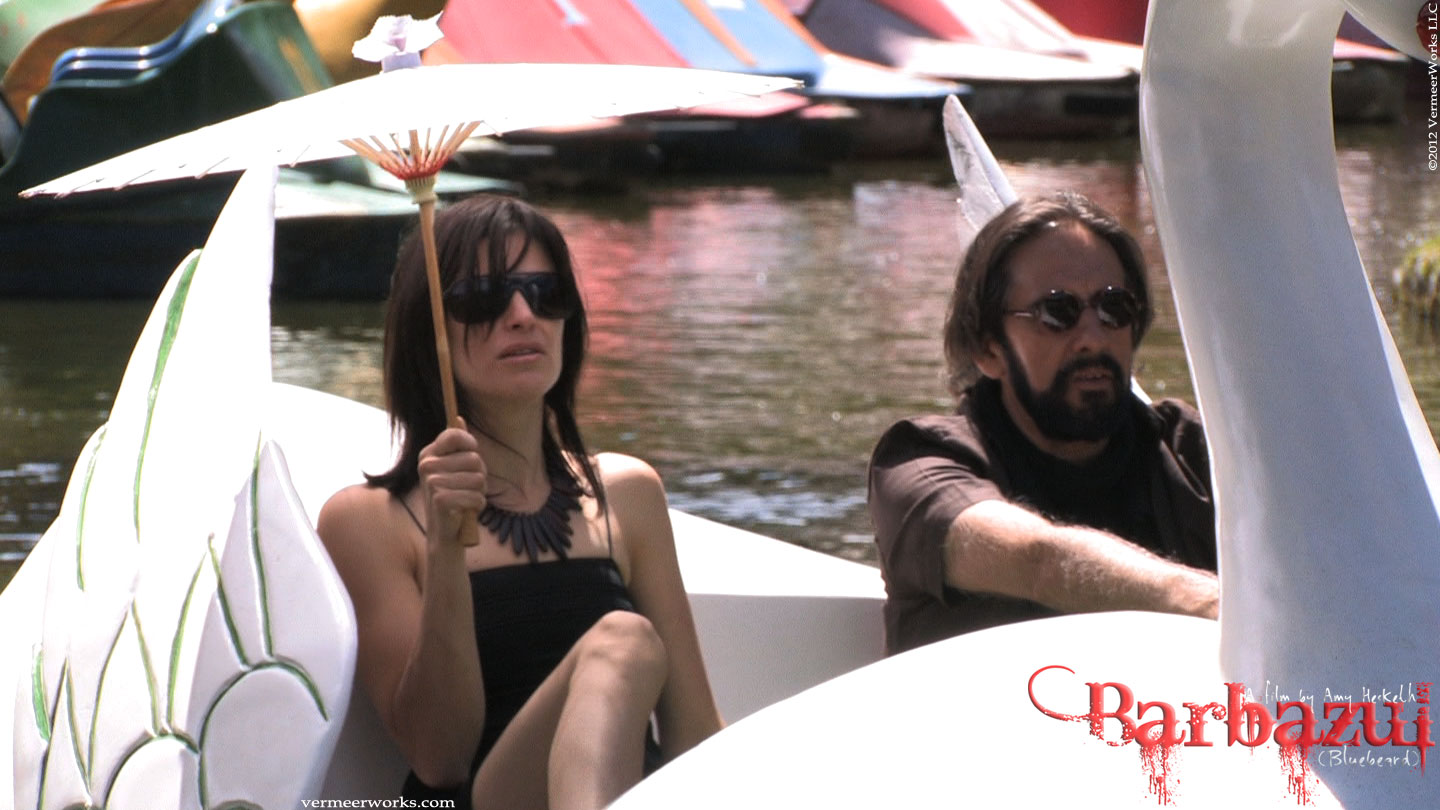
Annabelle’s demeanor on the boat also differs from Soledad’s girl-next-door image. The craft requires pedaling. For Annabelle, donned in a black mini-dress, modesty is of no importance. On the other hand, Soledad wears a lengthier garment, keeping her hand modestly placed between the folds of her outfit to ensure nothing is revealed.
Incidentally, Veronica Paintoux is a natural beauty, the perfect choice for Annabelle. She wears no make-up and holds a conversation with refinement and grace. What man would not be attracted to her?
Later, Annabelle tells Paul she’s getting married because “this won’t last forever,” a reference to her modeling. He concedes she’ll lose her looks but is that any reason to commit suicide?
“It’s not suicide,” she says. Well, it’s close.
A Dusty Mouse
After their marriage (in the city, not on the plantation) Bluebeard takes Annabelle to the hacienda over the familiar dusty roads. She holds an open parasol to preserve her complexion.
During the tour of the wine casks, she is indifferent, unlike Soledad who is impressed with facility.
When the camera shows a close-up of her steps at ground level, Annabelle walks by a cobweb-covered carcass of a mouse that reveals much about the film. She doesn’t notice it.
Moments later she recoils at the sight of the bats on the ceiling. Her reaction is disgust, unlike Soledad who finds the night creatures fascinating.
Later Bluebeard offers Annabelle the same bike ride Soledad enjoyed, the lithe model waves him off and heads up the steps.
To her credit Annabelle is wonderful when the arrangement calls for her charm, glamour, and role-playing. On an outdoor picnic, she amuses Bluebeard by creeping seductively like a tigress stalking her prey. But it is a performance that raises the question of who is the real quarry?
Inevitably, Annabelle, the gorgeous model who is as urbane as they come, has “the great realization.” The plantation is not her kind of place. Her decision to marry was self-centered and hasty, perhaps driven by her desperate fight against a force she cannot control: the passing of time.
No problem really, her worries will soon be put to rest.
Do You Need Help
Annabelle’s self-absorption hints at her demise. Wearing her signature little black dress, she enters the bedroom with a portfolio of photos, the same one Soledad later discovers. The aging model lays out the glossies on the bed with care. Three nudes lead the way.
Bluebeard comes in. He picks out one he likes and unzips her dress. They fall together on the photos.
When he asks if she loves him, the snapshot immediately to her left is telling. It’s a close-up of Annabelle’s face; it has a wide-eyed look devoid of animation.
Over dinner Bluebeard and Annabelle fall out. She takes off her clothes and goes to bed, but that doesn’t silence the argument.
“I want to go away. I’m leaving you, I want to live my life,” Annabelle declares. The plantation is an emotional desert; she has no friends, no real satisfying existence.
Bluebeard, in a moment of disbelief, responds, “You have me.”
She looks away. It’s the ultimate insult and rejection.
In a manner that borders on pleading, he offers her a baby. Not for her, she wants to work and teach modeling. This is the most sincere and honest conversation in the entire film.
Annabelle suddenly gets up to leave. Bluebeard uses the scarf she gave him to corral her around the neck and force her back onto the bed where he strangles her. An anguished Bluebeard utters a painful cry as Annabelle’s life slips away and the image in the photo comes alive. In an act of necrophilia, he penetrates her in a confusion of desire, rejection, and revenge.
Metaphorically, Bluebeard has killed off part of himself. Disconsolate, he sits outside the bedroom on the porch. A blank stare covers his face.
Walter peeps in the bedroom and asks, “Do you need help with this?” Bluebeard nods.
This episode is Jac Avila’s acting at its finest.
A Menagerie
Barbazul first kills because he is rebuffed by someone he truly loves or thinks he does. Cleansed of the shame of rejection, he will degenerate into a sadist who, in his own contradictory way, is looking for redemption. He is sorting through the layers of his shadow, reducing himself to his once naïve, child-like state that lives within him, thus his attraction to the barefooted Soledad. By the way, Bluebeard’s final intended victim, her sister Ana, is barely out of childhood at eighteen.
From Annabelle to Ana, the women get progressively younger. Notice Ana is a take down of Annabelle, as if the extra letters in her name are parts of Bluebeard’s personality he will snuff out.
It’s not quite that simple, of course. Bluebeard’s women are a menagerie of dresses on a rack, victims of his fantasies that yield their lives to a wealthy man’s search for his soul.
Amy Hesketh brings Bluebeard’s sadism to fruition step-by-step through cleverly constructed glimpses into his emerging psychological brutality. As he passes from one woman to the next, Bluebeard’s sex acts become increasingly rape-like with hard, violent thrusting.
Only Jane seems to enjoy that scenario. She initiates Bluebeard to her kinkiness and takes everything a step further when the whip orchestrates the sex.
But first we have two brief stopovers: gore with Maga and a crucifixion of sorts with Agata.
* * *
Before we get the final part of this review, here is an interesting note about making Barbazul.
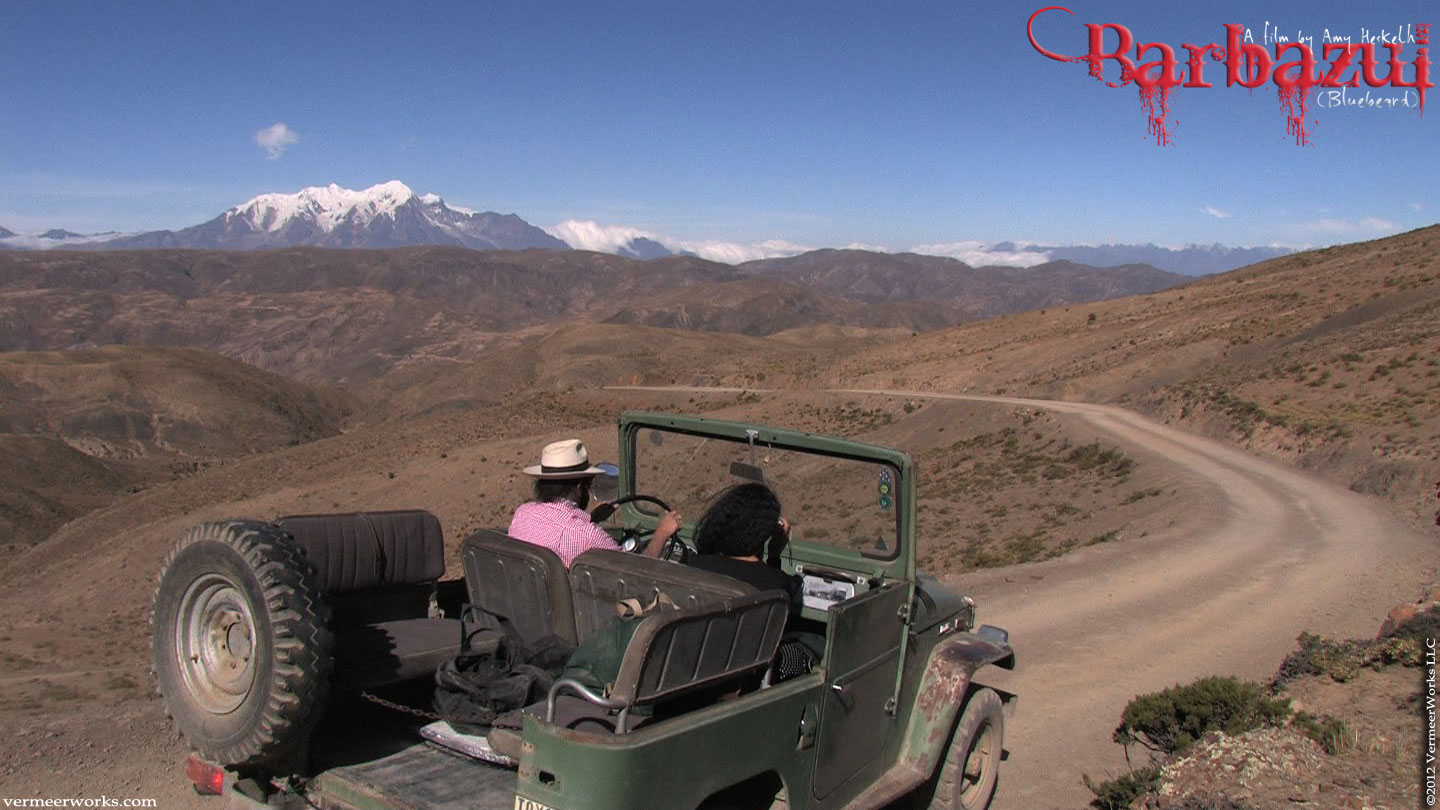
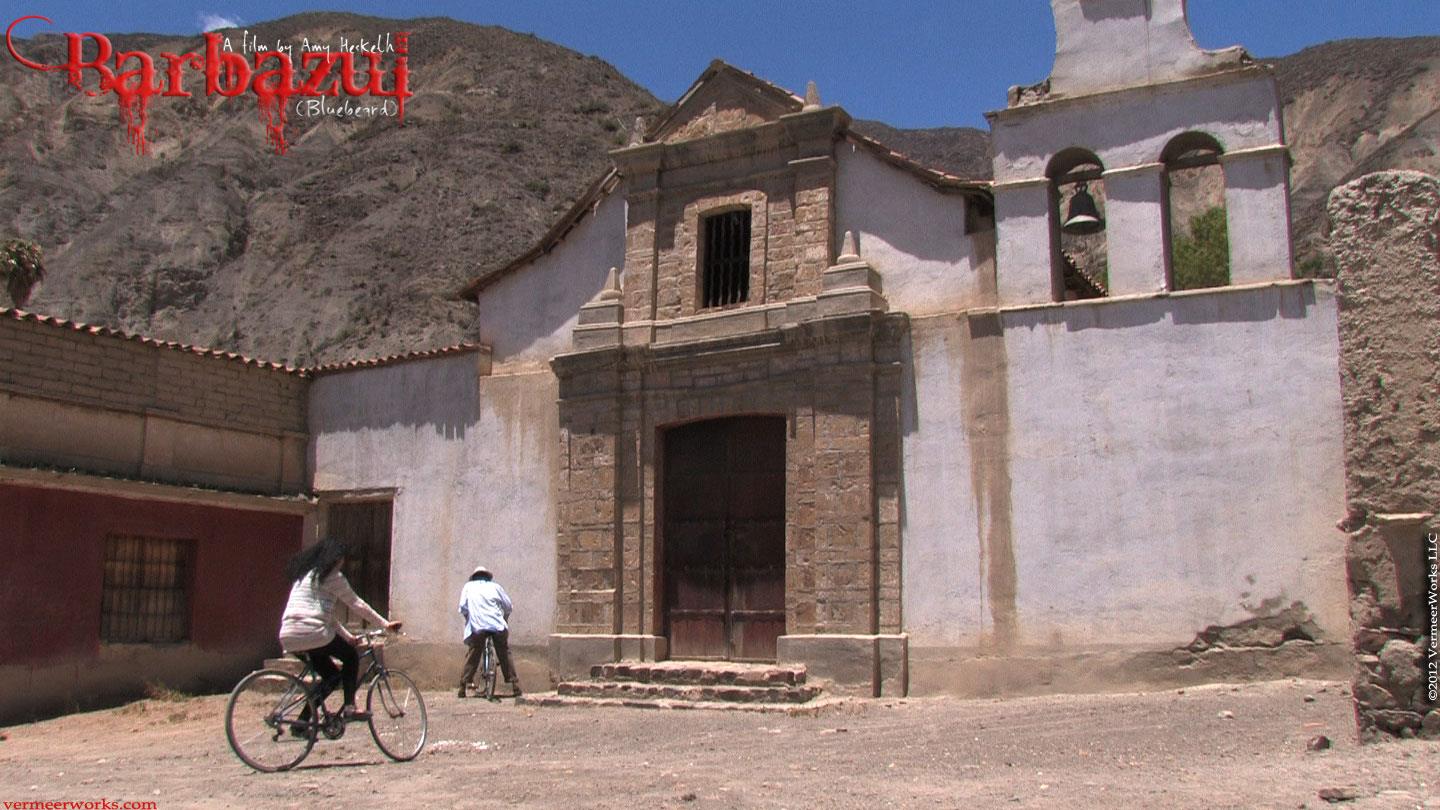
In a recent correspondence, Jac Avila told me, “The hacienda in Barbazul is in a valley, near La Paz, known as Chivisivi. It is still to this day used to make wine and vinegar. It’s an active vineyard. For Amy it was very important that the place gave some of the mood of the characters. In Barbazul each woman has a different color in the decor of the place and the way they dress and so on. Barbazul is very particular about that.”
To get an impression of the plantation’s magnificence, here it is.
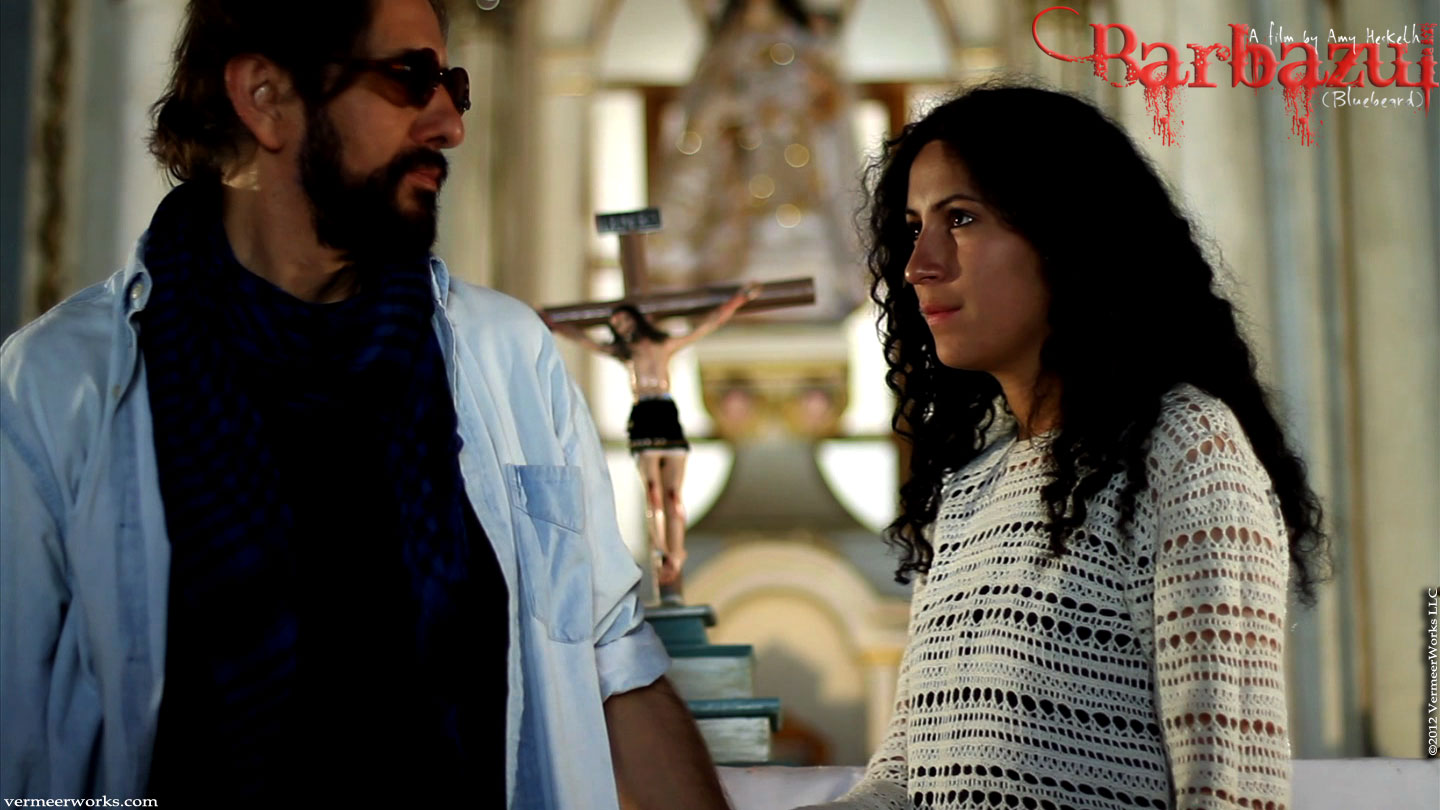
And like every good director, Amy Hesketh strives to capture the perfect scene.
In thinking about Barbazul, I ran various interpretations through my mind. This is the one I settled upon.
All photos are courtesy of Pachamama Films and Decadent Cinema.
* * *
The Taproot
For fans of Amy Hesketh films, the opening credits of Barbazul provide a glimpse into the erotic expectations she offers. Amy’s character is flogged and garroted in an outdoor nighttime scene. But hold on, this is not a BDSM film. Rather it is a bizarre and finely crafted journey of a man in search of his soul.
For the religious, salvation requires pain, suffering and death: the birth-death-rebirth archetype found in all ancient civilizations. As I’ve previously written, the theme of rebirth is ever-present in a Pachamama/Decadent production, though not always in the politest of ways.
In Barbazul, Amy’s Bluebeard desires to connect with himself, to confront and conquer the shadows within his personality that torment him. It’s a form of redemption.
There is one problem, however. Corpses of the fairer sex litter the path along the way.
Here’s why.
Psychologist Carl Jung asserts that to become a whole person we must reconcile the subdued side of our personality with its dominate side. In one respect, it’s gender oriented. The duality of anima (female) and animus (male) come into play in determining behavior.
To look at it in non-gendered way, we show our public front, our persona, while we cope with our less well-developed self, our shadow. The persona is often a mask, very much like an avatar, while the shadow is real, our darkest feelings and urges similar to Freud’s infantile id.
Throughout the process, we are subjected to a myriad of human emotions, among them the drive for success, love, and empowerment and their opposites, anxiety, hatred, and fear.
However, the most painful emotion is rejection . . . and that is the taproot of the Barbazul story for anger and hurt can fester on the underside of who we are.
Amy Hesketh’s scriptwriting and direction artfully explores this dichotomy and Bluebeard’s struggle to find its resolution within himself.
Buying His Bride
In the film’s opening scene a young woman dressed in black is seductively climbing a rocky terrace. It’s a photo shoot and she is as primordial as she can get. Bluebeard (Jac Avila), a man of means in Amy Hesketh’s story as he is in Charles Perrault’s, is on hand to watch.
He likes his women crawling and slithering, the temptress archetype exhibiting her basest instincts.
The cameraman, Paul (Erix Antoine) is overly critical of his model, Soledad (Mila Joya), referring to her as a “useless cunt.”
When the shoot takes a break, the belittled girl is approached by Bluebeard.
He invites her to dinner and the romancing begins.
Perrault’s Bluebeard is physically unattractive, not so in Amy Hesketh’s interpretation of the story. And, she’s given her Barbazul an easy way with women.
With the demure Soledad we are introduced to Bluebeard’s modus operandi that includes picnics and boat rides in the park. Offered a ring, she accepts and the scene shifts quickly to a hotel room for a premarital romp.
Bluebeard instructs her undress but modesty prevails and she doesn’t remove her undies . . . the reality of the temptress quickly fades.
“Do you remember what you were doing when we met? Do it now,” Bluebeard insists with quiet firmness.
Soledad gets on the bed and crawls toward him.
As a sign of commitment, Bluebeard’s women wear the ring on their right hand as is customary in some European and Latin American countries. In the story it’s a single ring removed from one woman and passed to the next.
Incidentally, Bluebeard marries only one of his fiancées, Annabelle, but curiously the ring is not shifted to her left hand in the usual practice.
Later Bluebeard dines with his intended and her sister. Soledad is shy and a little nervous, perhaps caused by naiveté or an innate fear that something isn’t right. (Interestingly, she remains barefoot through much of the film, existing in an infantile state like young girls in Perrault’s time.)
Hearing of his plans, the sister, Ana (Mariella Salaverry), remarks, “You’re buying her. Do whatever you want.”
Soledad bows her head in shame. They have no parents to protect them, a set-up for disaster.
Off to the Plantation
With his betrothed beside him, Bluebeard drives the dusty road into the countryside. Isolation and desolation frame the visual theme with aerial shots of the jeep snaking through the mountains. The road is descending at first, then climbs to reach the metaphoric height of loneliness.
At this point, the narrative shifts to the hacienda. In fact, it’s one of the movie’s central characters, its persona and shadow a reflection of Bluebeard himself.
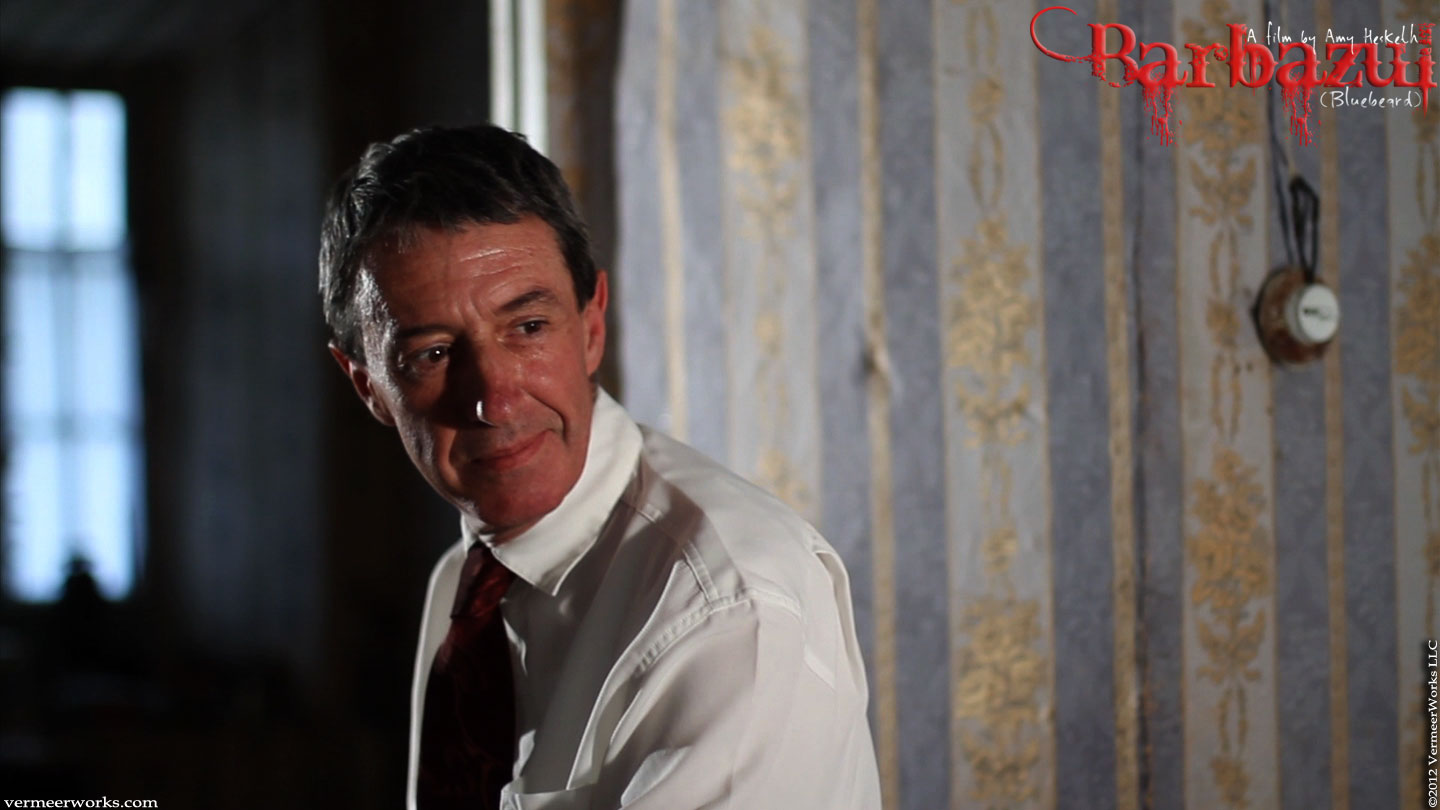
Walter (Beto Lopez), Bluebeard’s alter ego, acts as butler and “administrator” of the estate. Walter’s appearance is a counterpoint to Bluebeard’s. He is clean-shaven, prim, proper, and dresses immaculately.
He’s also sinister and secretive.
Incidentally, clothing is a major image in this film. For the women it’s dresses; for the men, neckware.
More formal than Bluebeard’s scarves, Walter’s ties are displayed in a colorful collection that corresponds to the rack of dresses in Bluebeard’s forbidden room. Neatness counts, of course. Walter is there to help Bluebeard keep up appearances.
One of Bluebeard’s women, Agata, insults him when she suggests they get rid of Walter (impossible, of course, because he is Bluebeard’s second self). On the other hand, Ana later suggests Walter should get a raise. Listening, the butler smiles wryly, smokes a cigarette and carries his own ashtray while he awaits the final bloodbath.
Empty Spaces
The plantation house feels empty and lonely. Upon arriving, Bluebeard opens a gate to go in. It carries a jail cell image in a shot that is heavily shadowed. At the end of a long veranda, Soledad walks from light into darkness.
Bluebeard’s bedroom is sparse with a weary, depleted feel that is mirrored in Bluebeard’s expression when the film concludes. Notice the dresser/chest of drawers outside the bedroom door. Some of the drawer pulls are intact, others absent, and a couple replaced with short pieces of rope.
They reveal Bluebeard’s ritual. Women begin as decorations then die by strangulation leaving empty spaces.
The Chapel
Bluebeard takes Soledad on a bike ride around the estate (Annabelle refuses his offer, as we’ll see). They stop at the chapel where the camera focuses on statuary of a weeping Madonna and a Madonna and child. A male figure with a dangling key on a red cord is emphasized in a subtle tribute to Charles Perrault.
The icons are delicate but lack animation.
He wants to know if Soledad likes the chapel.
“Will we get married here?” she asks.
Though a crucified Christ is within sight, Soledad is clueless as to what awaits her.
Amy Hesketh now directly references Perrault’s story. Bluebeard gives Soledad the keys to the house and mentions there is a room she is not to enter. He knows she will, of course, but says nothing.
Later when they have sex in his bedroom, there is a burning candle (male desire and empowerment) on each side of the shelf above the bed. There is another phallic symbol, a print of the Eiffel Tower. There is no companion print of female sexuality.
Soledad learns Bluebeard is leaving for the city and will return with her sister.
Alone the next morning, she goes to the dresser for her robe and finds a portfolio of photographs. Some are nudes. She lays them out on the bed before returning them to the drawer.
Picking up the keys, she’s ready to sate her curiosity.
Getting to Annabelle
Having finished shaving, Walter notices Soledad headed for the forbidden room. He goes into a small bedroom and picks out the first tie to the left.
All is going according to plan.
Compared with the austere interior of the house, the office, for that is what it appears to be, is cluttered most likely because Walter avoids it.
There’s an old dusty wall telephone, a cash register that dates back at least a hundred years, and a desk with an old-fashioned adding machine. Newspapers and journals are scattered about. On another table there appear to be chemical containers.
Is the winemaking business still alive because in this room not everything is?
At this stage of her story, Amy Hesketh deviates from Perrault. There are no suspended corpses or pools of blood, just a tired looking office. The plantation teaches us that appearances can deceive. The shadow forever lingers beneath the persona.
Oh yes, don’t forget that rack of dresses nicely displayed in a line just to the right of the office door. The first is a black mini, the last a pink polka-dot; a dark sequined one and a red outfit are in between. As we will come to realize, an extra dress hangs alongside the others. Is it reserved for Soledad?
And, of course, prominently placed on the desk where it can’t be missed is a black bound journal. Soledad, like the young wife in Charles Perrault’s story, is consumed with the fatal flaw of curiosity. She spots it and can’t resist it’s contents.
No problem, Bluebeard wants his imprisoned prey to read about those who came before her.
That brings us to Annabelle and the next post in this series . . .

 Take The Bad Seed (1956), for example. The movie focuses on eight-year-old Rhoda who appears to be a sweet, well-mannered, young lady when in reality she has affections for snuffing out life.
 In a film infused with a heavy fantasy element, Ginger is transformed into a mythical being, a werewolf, when she is bitten because the beast smells the menstrual blood from her first period.




































 3hattergrindhouse

 3hattergrindhouse