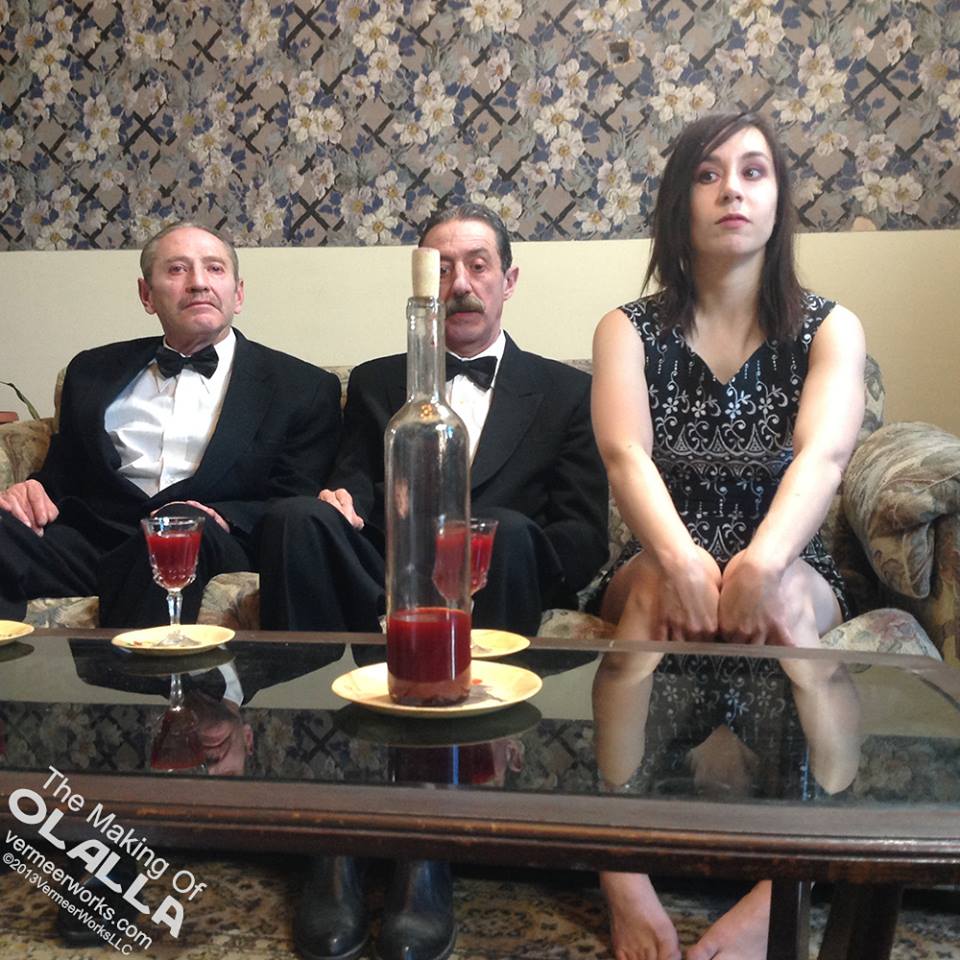
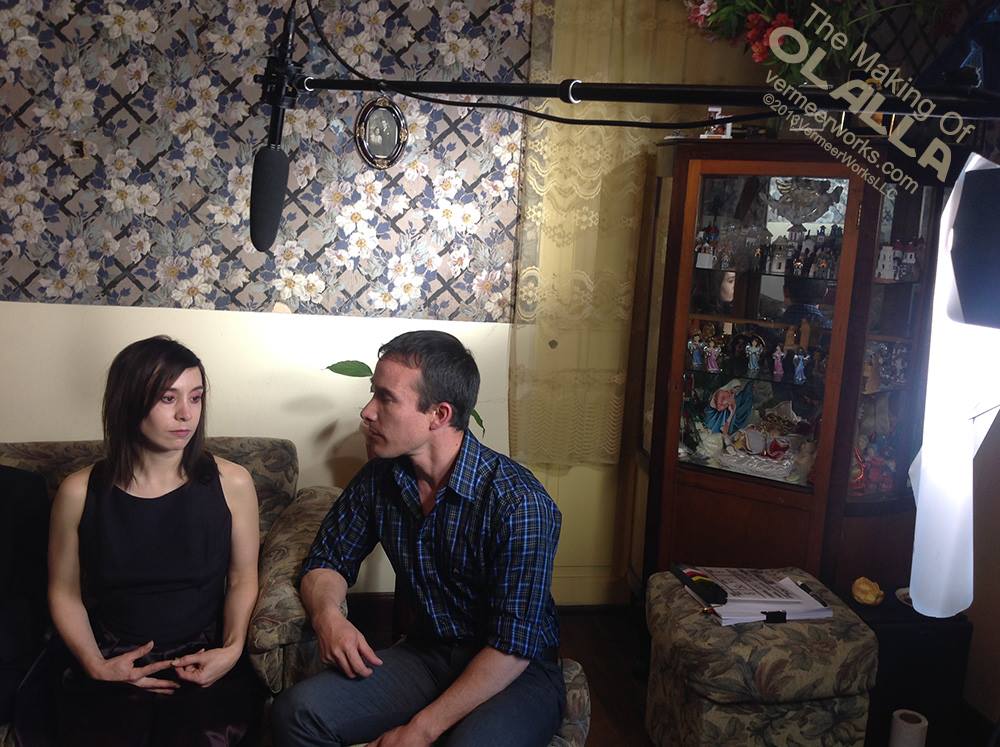
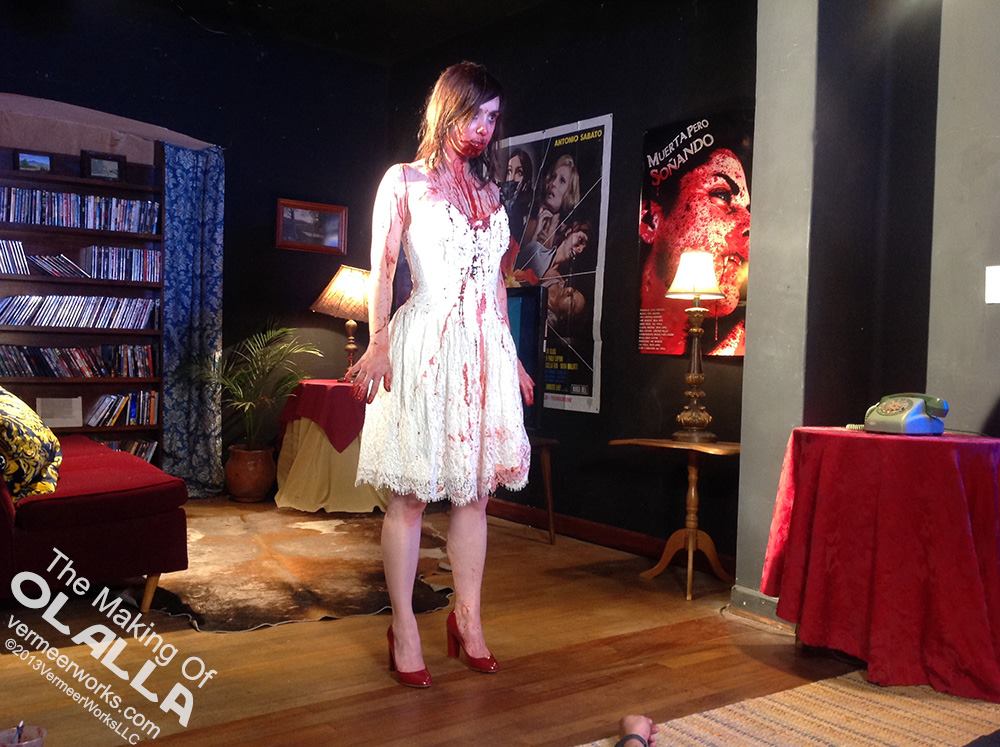
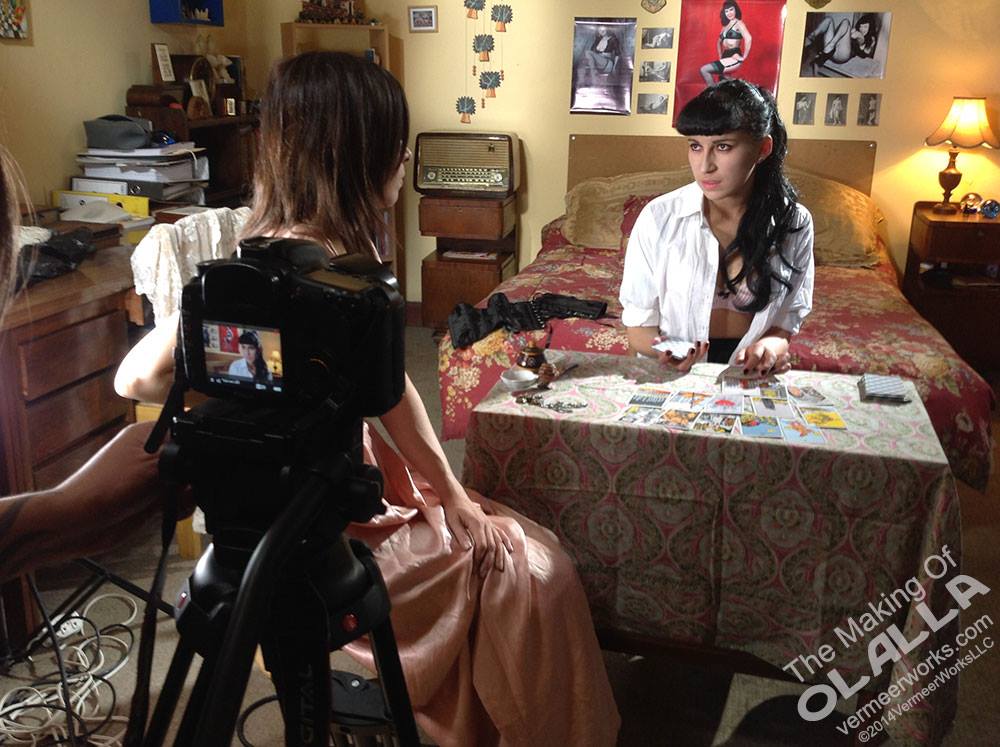
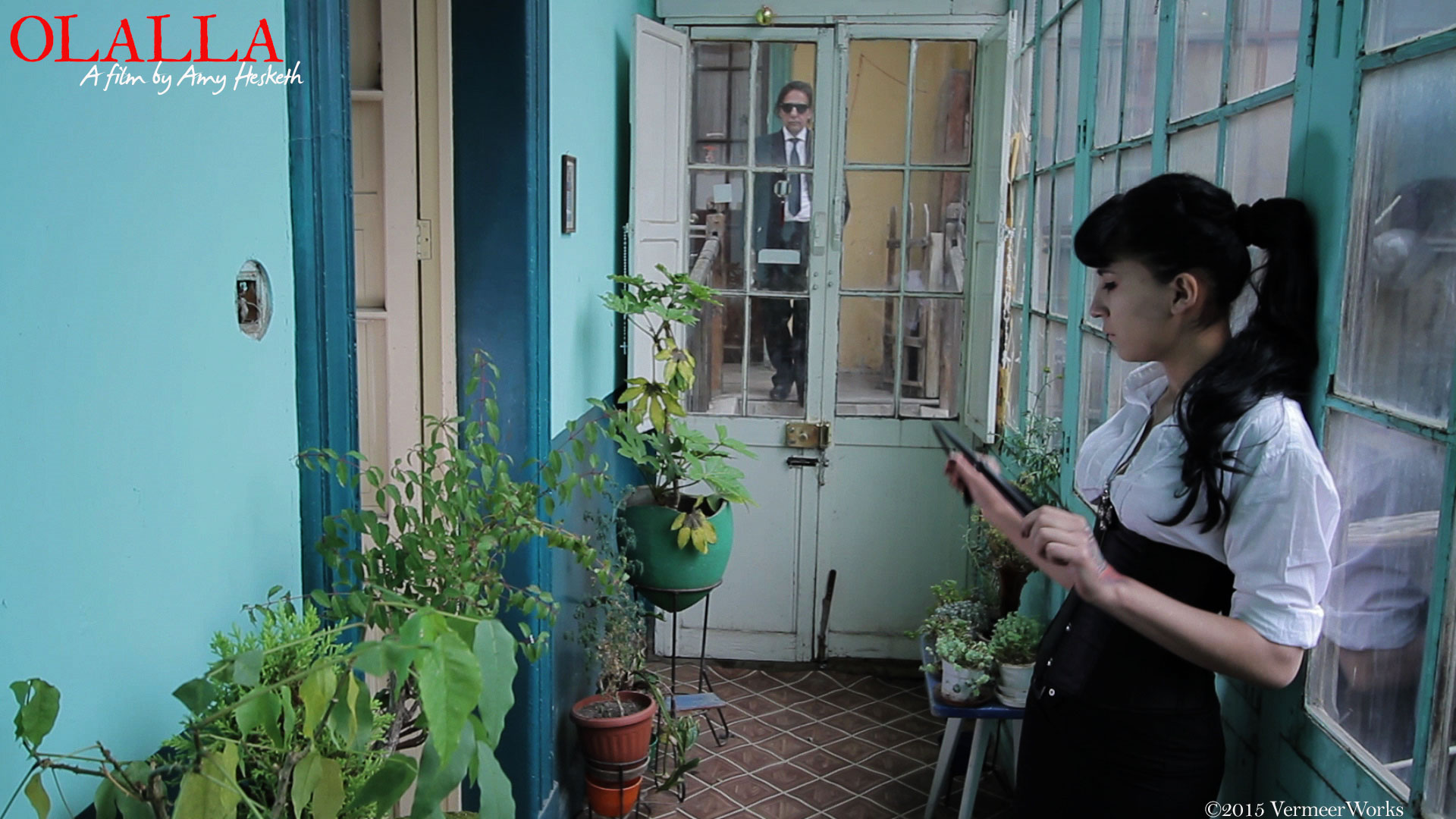
Tag Archives: Amy Hesketh

Jac Avila, Part Three: The Body in Pain

by Rich Moreland, August 2016

My thanks to Jac avila for sharing his views on film making and culture. I look forward to reviewing more of his work in the future.

All photos in this and the preceding posts are courtesy of Pachamama Films and Decadent Cinema. Vermeerworks is their distributor.

*          *          *
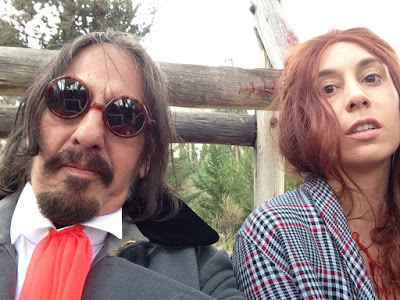
Jac and Amy on the set of Justine

Jac and Amy Hesketh on the set of the upcoming film, Justine

A Set of Values

In Jac Avila’s films there is a distinct theological undercurrent. In helping us understand how it complements his work, Jac begins with a snapshot of religion and society.

“Catholicism in South America and most of Europe, particularly Italy and Spain, is more a part of culture than religion,” he explains. For many of the faithful, it’s “a set of values,” a good mixture of  belief with “plenty of mythology” tossed in, “most of it not taken seriously.”

“However, when one grows up inside Catholicism, one is taught to love that culture,” he declares, though it “tries unsuccessfully, to repress a large part of one’s humanity, like sexuality.”

Of course, Christianity is closely linked to suffering . . . a natural human state. But, then again, so is sexuality. Is there a connection?

Blood Sacrifice

“In Catholic culture, the body in pain plays a crucial role with Christ at the center,” Jac continues. It’s really “blood sacrifice as redemption.”

This idea dates back to the Early Middle Ages as the church was making the transition from its birth in the Roman Empire to its place as Europe’s centralized institution.

But we need to remember that crucifixion, the ultimate “body in pain” statement, was around long before Christianity. That Christ and some of the Saints were crucified is more coincidental to their condemnation during Roman times when dying on the cross was the established demise for society’s outcasts and outlaws.

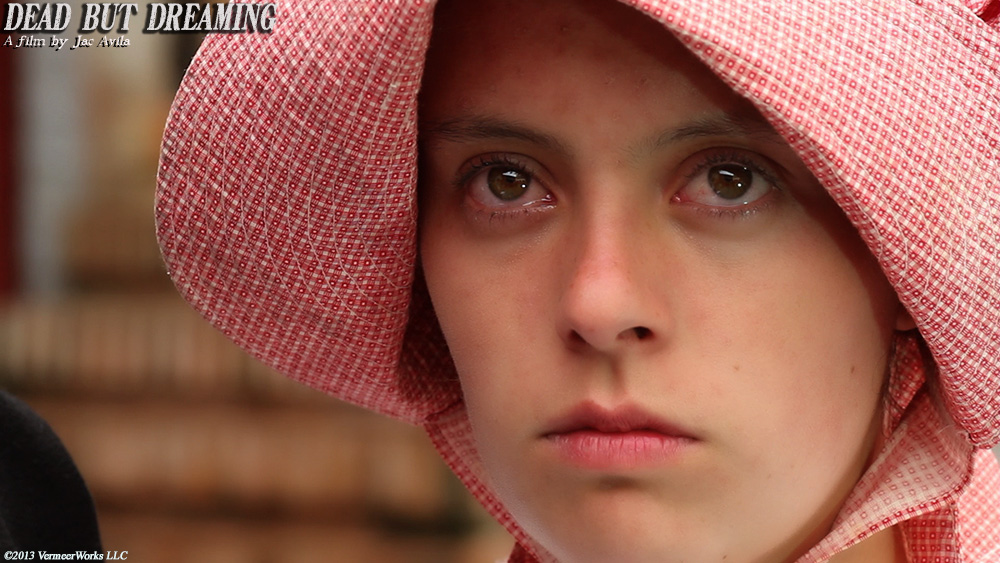
Roman times. Mila Joya in Dead But Dreaming.

Mila Joya’s character faces death in Dead But Dreaming’s flashback to Roman times.

From there, the diabolical combination of torture and death moved out of the Roman Empire into the next historical period.

“In medieval times this (The Body in Pain) symbol took over. Executions were cruel and public, so was penance,” Jac reminds us.

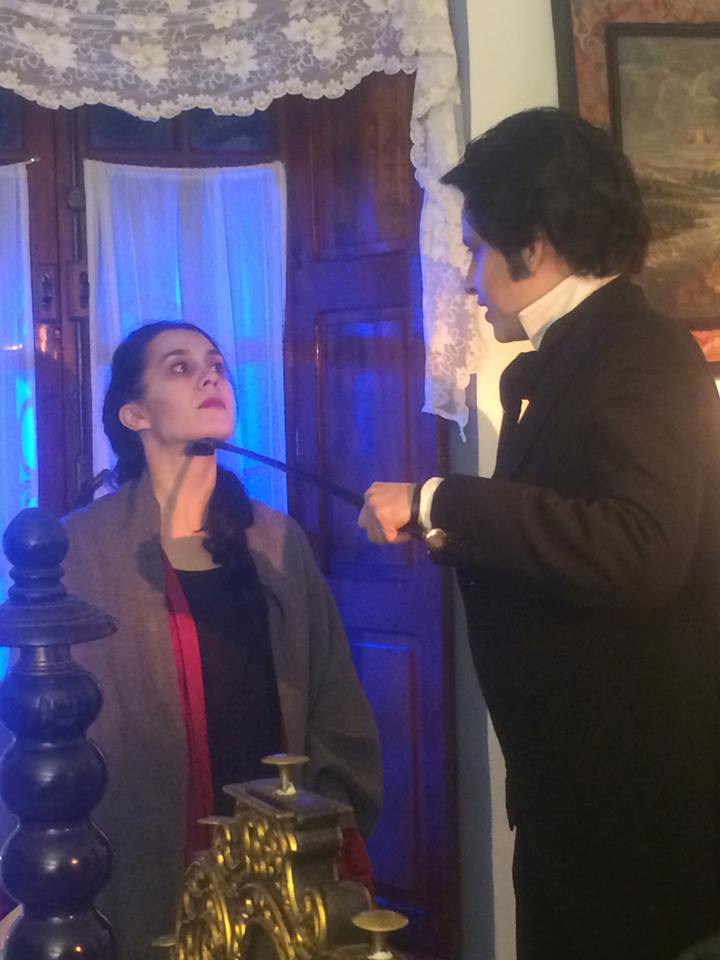
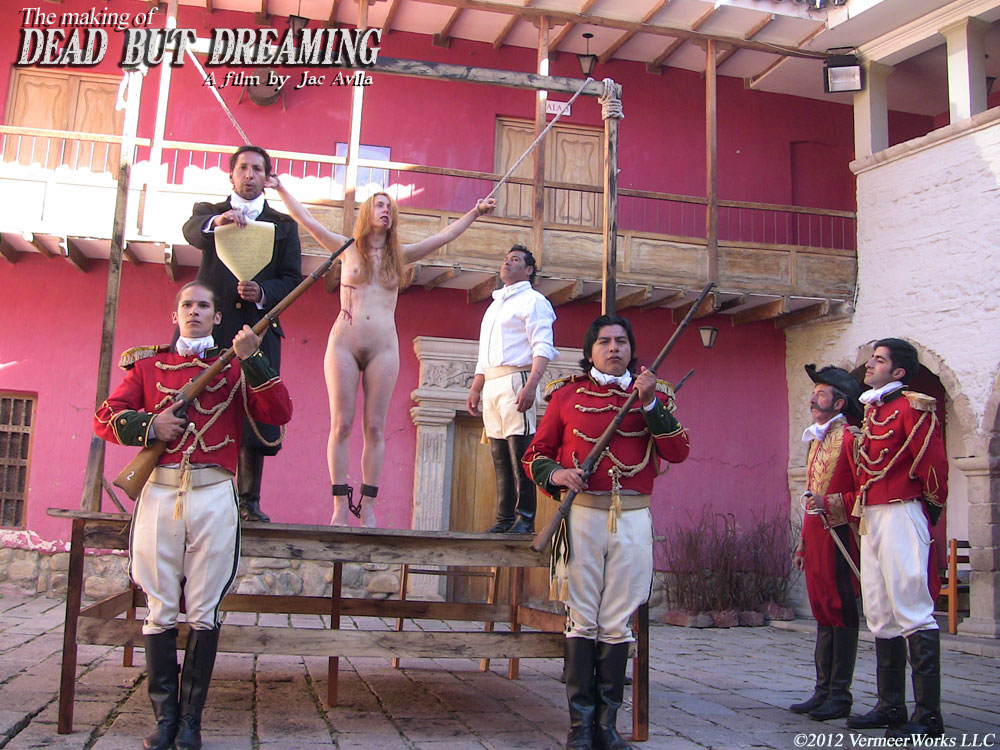
Incidentally, the public fascination with death lingered into the 19th century as Jac illustrates in Dead But Dreaming when the Irish traveler is garrotted before onlookers.
img-1409813635

Jac then cites the distinction between the Catholic and Protestant interpretation of sexuality.

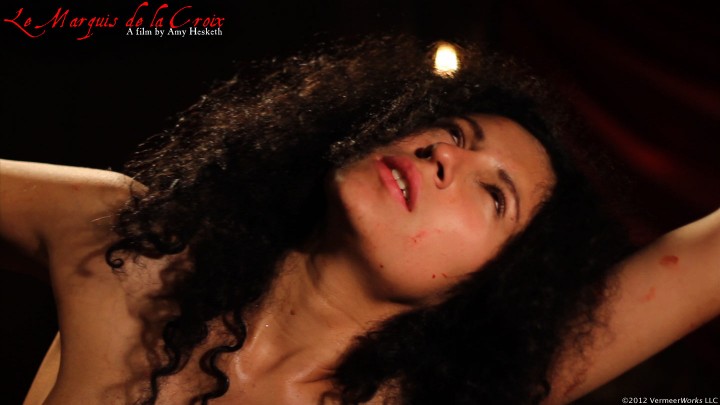
“Catholic imagery is full of The Body in Pain, a beautiful body, always, either male or female, almost nude or totally nude, with an expression of bliss in the very moment of martyrdom.”
LeMarquisTeaseCaps01223212-720x405

Elaborating on the visual impact of a crucifixion, Jac explains, “The school I attended was full of those images. Beautiful paintings expressing exactly that. Catholicism is far less repressed sexually than Evangelical, Calvinist, Lutheran Christianity.”

He follows that thought with a quick history lesson.

“The framing of the body in medieval Europe, was intrinsic to the historical moment.  Humanity was moving from an agrarian culture to the beginnings of city culture. Social interactions were changing dramatically. The image of the body as symbol became pervasive,” he says.

Jac regards the 12th century (1100s) as a pivotal time in the emergence of the body as art.

“The Church had the most power in influencing most everything,” he notes, which lasted until the Renaissance, a time “when art flourished and thought was liberated by Thomas de Aquinas (Catholic theologian and Scholastic) when he gave some long overdue importance to humans.”

For the most part, Medieval art is purely religious with Christ “an overpowering figure taking up the entire frame,” Jac suggests.

In other words, man is not celebrated. The heavenly bliss of eternity and the proper way to get there occupied Medieval artists, who, incidentally, never signed their work.

By the Renaissance, change was on the horizon. The ideals of humanism were infused into culture, at least in the Italian City-States where money patronized the arts. The result? Art and literature achieved a secular focus.

As for art’s theological representations, Jac gives us this example. We see the Virgin Mary as “a real woman breast-feeding a child,” a cultural broadening influenced by Aquinas.

And somewhere along the way, our sexual fascination with crucifixion and suffering took hold.

Feminism

So, what about the sacred feminism popular in pre-Christian cultures?  I suggest the Church patriarchy had some issues with this idea. Jac spins it less severely.

“Catholic doctrine did not do away with the Divine Fem all together. Mary was and is an object of worship almost equal to God, she’s more accessible; she is the mother. But yes, women were repressed of course, but so were men. The great fear is the true liberation of mankind. We’re all afraid of freedom. I don’t think we’d know what to do with it.”
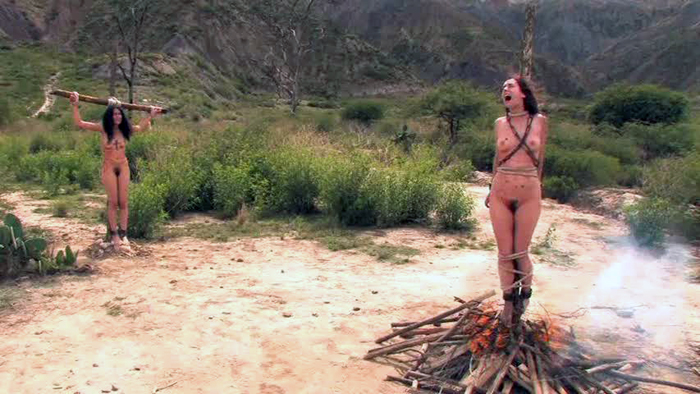
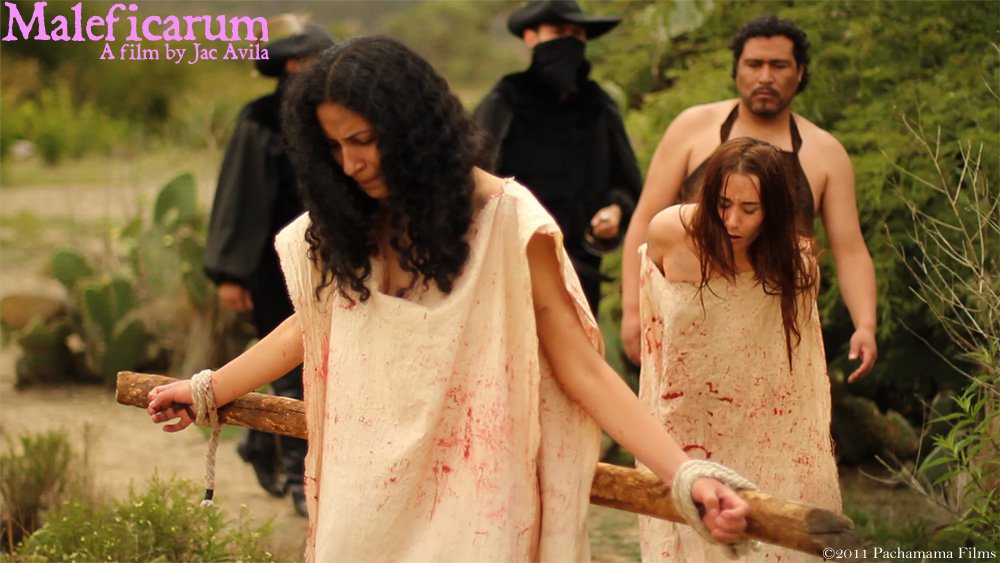
Mila Joya and Amy Hesketh in Maleficarum's execution scene, a reminder of the Church's fear of witches.

The Church’s fear of witches and it’s repression of women in Maleficarum’s execution scene.

I agree with the repression/freedom argument. Certainly the Church did not abide heresies and especially witches and warlocks. By the 15th century the Inquisition (the subject of Jac’s film, Maleficarum) was holding court. Credit Spain’s Ferdinand and Isabella for making sure everyone toed the religious line.

The Church court extracts a confession from Amy's character in Maleficarum.

Inquisition torture extracts a confession from Amy Hesketh’s character in Maleficarum.

Regardless, Jac steps up his defense of the Sacred Feminine.

“In Catholicism women have a high place because of the Virgin, The Mother of God herself. Catholicism is not as patriarchal as it may seem to be. What we may be expressing is that women, just like men, have the same or more capacity to suffer for humanity.

“In that sense, female martyrdom gets equal treatment… or better yet, takes the main role. The strongest character in Catholicism is Saint Eulalia. She’s crucified twice.”

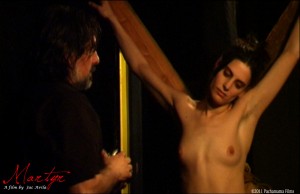
Of interest is that the original St. Elulia, the reference in Jac’s film Martyr discussed in a previous post, was, according to legend, a teenage virgin tortured and crucified on a St. Andrew’s Cross.

Carmen Paintoux

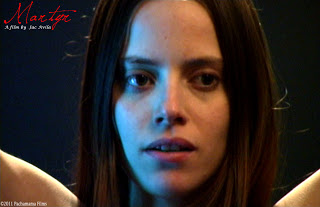
Carmen Paintoux in Martyr.

So there we have it. Do the images from Jac’s films energize the sexual question?

The Guignol Again

Despite the Church’s efforts, the uneducated retained their superstitions and out of this, particularly in Central Europe, phantasmagoric visions and stories emerged of evil forces beyond human control.

“As you know, most of the horror stories, like vampires, come from the old tales of old Europe, which come from far back in time,” Jac points out.

Veronica Paintoux

Veronica Paintoux as the Lamia.

And as we move from Medieval into modern times, with stops for the Enlightenment and Romantic Periods, superstition and the supernatural forces that go bump in the night linger in the human psyche.

It’s not a leap to understand that our world is still fascinated by cruelty, especially sexual torture, and can’t look away.

Our repressed blood lust comes to life with vampire stories and today’s slasher films which tap into horror as it emerged out of the Victorian Age into modern Europe.

10265587_486401324822610_8032003204742406405_o

But we don’t need the fantastic to energize our sexual interests. Human depravity played out realistically on a stage will do.
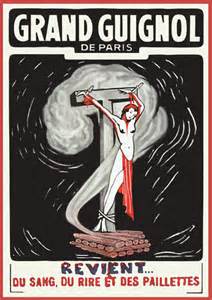
th“The Grand Guignol has its roots in that period of time where executions were performances for the masses. That’s why Guignol was also described as the Theatre of Cruelty,” Jac explains.

In fact, the Parisian stage and the fascination with crucifixion fuel the star power of Amy, Mila Joya, and the Paintoux sisters, Carmen and Veronica.

Brew the mixture of history, religion, and sex into a cauldron of savagery and sadism and what emerges is a new version of the erotic horror genre that is distinctly Jac’s and Amy’s, Olalla being the latest in a line of powerful films.

Framing the Body

“Not everything medieval was cruelty, of course,” Jac continues.

“There was a nurturing, serene, body sharing space with a conflicted body torn by desires, fantasies and that other body, the one in pain, dismembered, racked, whipped. The education of the masses by framing the body became all important.”

Mila Joya tortured in Maleficarum

Mila Joya’s character exemplifies “the body in pain” in Maleficarum . . .

Finally, the native Bolivian offers these comments on Amy’s Hesketh’s approach to her acting.

“As far as Amy’s performance in the films, like in Dead But Dreaming or Olalla I can say that those scenes are the way they are because of the stories. This goes to the Body in Pain discussion. The body as a central symbol in culture, but as it was seen in medieval culture, where much of the representations we have now originate.”
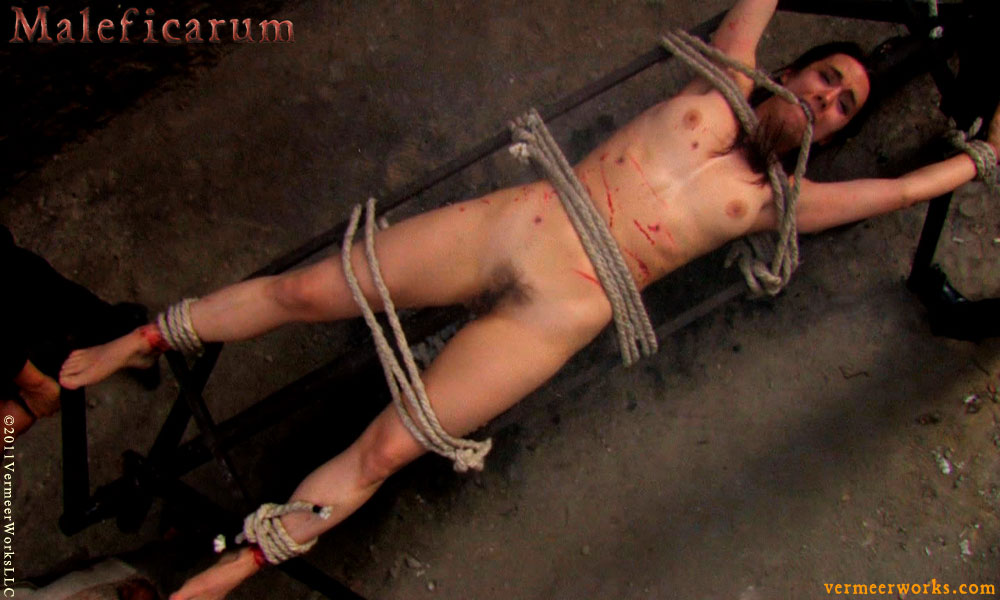
Maleficarum's roasting scene.

. . . As does Amy Hesketh in the film’s roasting scene, a particularly difficult and emotional shoot.

That is where Amy seduces the camera like no other actor.

To reassure the fainthearted, Jac leaves us this note about female performers in his films. Yes, they illustrate the Grand Guignol stage, as noted above, and all its perceived brutality, but there is more.

“Acting in these movies is, in a sense, empowering. The actress has complete control over her body, mind, and soul, to do anything she wants to do.”

That in itself is an empowering feminist statement.

Amy, Jac, and Mila.

Amy, Jac, and Mila . . . artists, innovators, and a new film intelligensia.


Leave a comment

Filed under Uncategorized

Jac Avila, Part Two: That Fantastic Thing

by Rich Moreland, August 2016

In this post, we’ll find out about Jac Avila’s background and his view on the female characters he creates.

*          *          *

Jac Avila as actor.

Jac Avila as actor.

Jac Avila is of international stock. His father was from Holland and his mother, Bolivia, giving him a heritage that is Dutch, Spanish, Basque, and French.

Born in Bolivia, Jac grew up in a Catholic society, a culture that takes on its own identity and values which many Americans don’t grasp. We tend to compartmentalize religion, often limiting it to merely attending church, and don’t see it as a larger social/cultural ingredient in our lives.

On the other hand, a Catholic society is overarching, emphasizing spiritual issues without negating worldly values. For example, it insists that learning take center stage in a child’s life.

“I was educated in the most exclusive Jesuit school in La Paz,” Jac points out with pride. “The education was secular with a big emphasis on science. No conflict there. As a matter of fact, Jesuit priests were very much ahead in everything. The religious aspects of our education was a mixture of ethics, morals, mysticism and the understanding that a great part of the Bible is rather symbolic and mythological.”

Sadly, his mother passed away before Jac entered his teenage years. His father moved Jac and his brothers to New York City where the future actor/director/producer studied movie making, art, and photography.

The Blue Buick

“After graduation I started working at CBS and later at a photo studio specializing in advertising. I quit my job in 1979 to become an independent filmmaker. By 1982 I was making my first film in Haiti and Cuba by way of New York and Miami,” Jac explains.

The film premiered at Cannes in 1988.

“It took me that long to make it,” he confesses, not surprising under the circumstances.

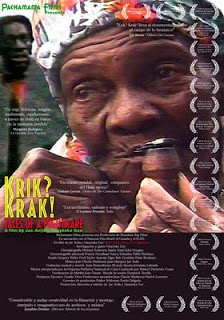
krikKrakPosterFacing expenses that can easily derail projects, Jac spent most of his time doing what indie filmmakers learn is part of the game: meeting the right people and raising money.

The film was Krik? Krak! Tales of a Nightmare which Jac co-produced and directed with Vanyoske Gee. Jac characterizes the production as “a surreal/expressionist docu-nightmare” about the brutal regime of Haiti’s Papa Doc Duvalier that includes the spiritual aspects of Haitian culture.

The work, though difficult, answered “a more political, radical call” for him, Jac declares, and was definitely a “challenge.”

And rewarding . . . the critics received it favorably.

“Le Cahiers Du Cinema, foremost film magazine in France described it as a great horror film in the tradition of Witchcraft Through the Ages,” Jac remembers.

From there he made a television mini-series and a handful of documentaries before shooting a “‘performance'” video, an inexpensive “project that started something unexpected that built everything” he is currently doing.

Jac explains how it happened.

When he was visiting Cuba, he developed a script about a young woman during the island’s colonial days who “has fantasies about being a martyr,” a practice common in “the traditional holy week procession.”

Carmen Paintoux had the lead role in Jac’s mini-series at the time and they discussed staging the girl’s fantasy for video. “During that process, she created Camille who is the central character in Martyr,” Jac says.

Martyr011244-300x194

The short film was born and the budding filmmaker’s career took on a new direction.

A remarkable journey for a little boy who saw his first movie at age four. Its violence left an impression. The Film? Walt Disney’s Bambi.

“I don’t remember anything before the movie. I remember everything after the movie, even the song that was playing on the radio when my uncle drove us back home in his blue Buick.

“From that moment on all I wanted in life was to know about that fantastic thing I experienced that day.

Magic to Art

Considering what he’s told me, I ask Jac if he designs his films to be political and religious commentaries.

“Not necessarily,” he begins. “Art is beyond those limiting systems. While religion tries and fails to interpret the unknown and the mysterious, politics often try, earnestly, to fit a square into a triangle, with fatal results.”

Having said that, Jac admits his explanation may sound  “a bit simplistic, since both religion and politics are mechanisms humanity uses to organize itself into something manageable.”

“In a way, mankind created gods to control itself,” he believes. But in time, more practical attitudes took shape and the overarching role of the gods receded in favor of elected leaders in civilizations like Classical Greece, for example.

Nevertheless, there is a magic to art, Jac insists.

“Art interprets what we see and turns everything on its head, art can also imagine a million futures and a million pasts. We don’t mock religion or politics [in our films], it’s just our artistic view of humanity.

“I honestly hope that our audience enjoys our movies for what they are and take from them what they feel like taking. I don’t really mind if they hate our movies. I love it if they love them. I hate it if they are indifferent.”

The Heroines

Fair enough. Now what can we say about women as they are presented in a Pachamama film? Are they captives of their own compulsions, unable to forge their own destinies, as might seem at first glance?

Jac gives us his view, beginning with Ollala.

“Olalla and Ofelia (Olalla’s sister) are not weak because women are not weak. This nonsense of the weaker sex is just that, nonsense. Patriarchy is a response to that strength. At one point men felt the compulsive need to control women first and other men second.”

10295096_486400914822651_2960701464743764157_o

With a moment’s pause, he adds, “Religion and politics are attempts to control, to make everything fit a pattern that can be controlled. That’s a very primitive view of life.”

It just so happens that when it comes to Church and society, the simpler, the better.

“There’s nothing more scary than women taking over, like in Olalla when she sucks the blood out of her boyfriend. It scares even women, so they have to burn Olalla’s mother,” Jac says.

OlallaVidCaps01291605

What about the other films we’ve mentioned?

Jac has his thoughts.

“The female vampires in Dead But Dreaming survive cruel torment, the accused witches overcome their death sentences in Maleficarum.

bts dead 5 on our way

“Is Varna [in Dead But Dreaming] taking the route Moira took? Will Justine go on after her ordeal is over?”

dbd00470222

Jac states that women in his films are his main focus, and I might add, his source of strength.

“The principal characters in all my movies, including Krik? Krak! are, for some reason, women. They are the heroines in all my stories. Men take second place either as aggressors or victims.

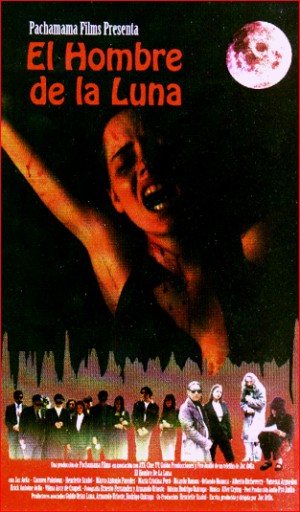
“Even in the miniseries El Hombre de la Luna, where I play the central character, an attorney/painter investigating the death of a young woman, the women in the story solve the problem and rescue the attorney from certain death.”

hdlposter04-300x512

But Jac’s women do suffer and it seems to have a sexual theme. So how does pain work into the art he and his filming partner Amy Hesketh create?

We’ll look at that next.


Leave a comment

Filed under Uncategorized

Jac Avila, Part One: A Working Relationship

by Rich Moreland, August 2016

Recently I’ve reviewed two erotic horror films, Dead But Dreaming and Olalla, products of the independent film companies, Pachamama Films and Decadent Cinema.

This post begins a three-part series on actor/producer/director Jac Avila whose business imprint is Pachamama Films.

Here he discusses his professional relationship with Amy Hesketh.

*          *          *

Martyr

Jac Avila and I have some common theatrical interests, among them the Parisian theater of fear and terror, the Grand Guignol. Pachamama’s take on the horror genre is influenced by the Guignol stage.BarbazulJac001tiny

“We’re very much inspired by Grand Guignol,” Jac tells me. Since the 1990s, the producer/director has shot “a series of performance videos” that reflect the theater’s unique stamp on shock and violence.

As his evolution in film progressed, Jac’s work drew the attention of Amy Hesketh, who was building her own erotic on-screen resume.

MartyrPosterSmall2One of his films, Martyr or The Death of St. Eulalia (2002), became the catalyst for the their artistic collaboration. Though it was made in New York, (Jac maintains dual residences in NYC and La Paz, Bolivia), Amy saw the movie in South America in 2005.

“It made a huge impression on her and that’s when she decided to join me in this adventure,” he recalls.

At the time, Amy was more into photography than modeling, Jac explains, and had aspirations to write and direct.

Martyr stars Carmen Paintoux, a French actress, whose history with Jac dates to the 1990s. The themes of Christian sacrifice, sadomasochistic relationships, and suffering drive the film and captured Amy’s interest.

Martyr001242

Subsequently, Jac began a working relationship with Amy, who picked up acting again. She joined French performers, Carmen and Veronica Paintoux, to create a new and innovative indie film narrative.

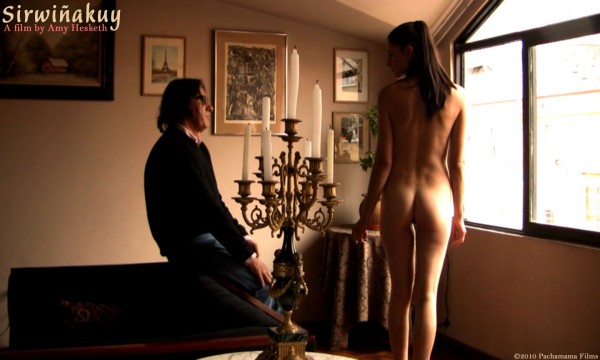
Amy’s first feature as writer and director was  Sirwiñakuy, a tale involving an older man and a younger woman in a BDSM relationship. “She wanted Veronica to play the lead character,” Jac mentions.

Sirwinakuy236-600x360

Later films like Barbazul, Dead But Dreaming and Olalla, saw Amy step in front of the camera. Not unusual, he adds, because Amy “puts herself in the more difficult roles” much to the delight of her fans.

In the movies I’ve seen, Amy dominates the lens. I asked Jac about her motivation to play parts which appear, at least on the surface, to be masochistic. Jac has some suggestions, but makes it clear he cannot speak for her entirely.

Catharsis

“The characters she plays appeal to her, yes, and at the same time scare her,” he begins.

Jac mentions Justine, a character in a film by the same name yet to be released. It’s based on the de Sade novel, so the sadomasochistic corruption of the innocent steps forward as one would expect.

JustineMakingOfDay01_2585

Due to Justine’s “religious stubbornness” Amy doesn’t have a glowing opinion of the girl as she appears in the novel, Jac remarks. In fact “Amy thought she was an idiot.” However, he adds, “as in any art, a part of us is in those characters and a part of our experience is expressed in them.”

“In some cases it becomes cathartic,he believes.

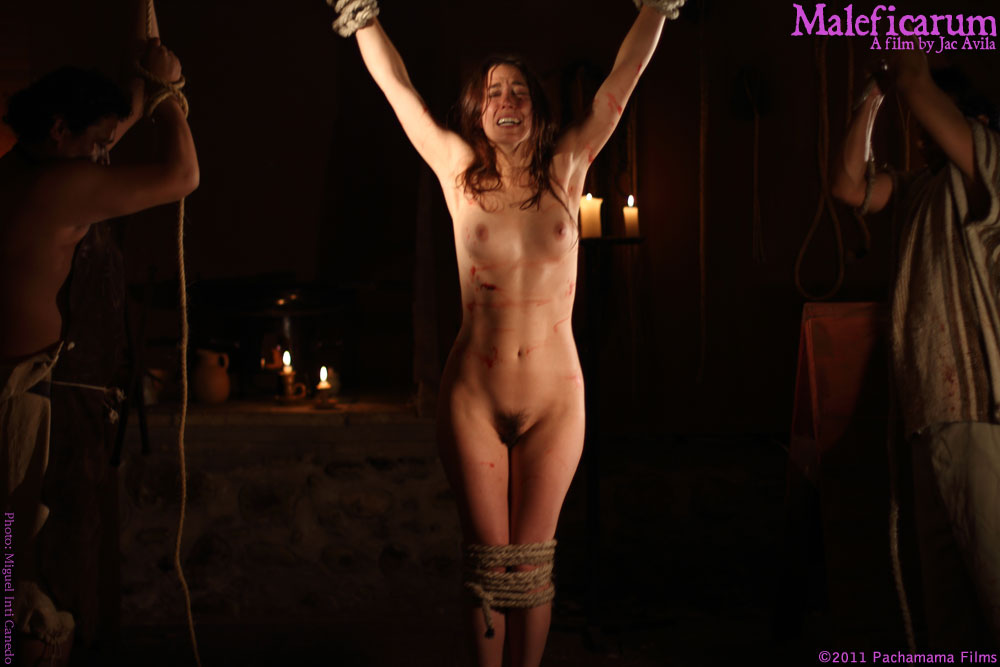
An interesting thought which I think is clear in Amy’s portrayal of Olalla and her role in Maleficarum, a film involving witch torture.

According to Jac, “Amy plays what appears to be submissive roles, although I see them more like women in peril type of characters, they do not submit, they are forced into their particular ordeal. I can even say that some do not go quietly into their ‘doom.’”

Maleficarum6344

As heroines, Justine and Olalla are united in that respect, but by different circumstances. Perfect, I might add, for Amy Hesketh’s talent.

How much more of that talent we will see on-screen may be waning because Amy is now concentrating on writing and directing. But she has an impressive resume as an actress.

“The way she prepared herself for her roles in the movies we made is impressive,” Jac remarks.

Bodies and Minds

That brings up another topic which needs clarification. Amy Hesketh and the other actors in the Pachamama troupe, Mila Joya and Veronica Paintoux, in particular, are whipped, tortured and crucified. So, are they the darlings of the BDSM crowd who might flock to see their films?

Sirwinakuy0012-300x389“I don’t think our films fit into what would be the traditional BDSM genre, except perhaps for Sirwiñakuy, which is about an S&M relationship, and Pygmalion, that has those elements too,” Jac observes.

As a director and actor himself, Jac notes that everyone in the troupe gets to “display different personalities in different filmswhich is diverse enough to move beyond the dominant/submissive formula.

“When they do get into their characters, they do go into them with intensity and completely, they become those characters for the time of the shooting. In other words, they do put their bodies and minds into them.”

Then he offers up a dose of reality.

tumblr_litvpumDNz1qhi6wuo1_500“I can also say that they do suffer, physically and mentally, during the difficult scenes. The whippings hurt, the crucifixions are very, very uncomfortable and even painful. There’s a lot of real suffering going on. I do not think that any of them enjoy that, they put up with it for the art.”

The Liberating Part

Of course, Pachamama/Decadent productions have their share of naked female flesh that some viewers may consider to be on the border of softcore porn.

Jac presents his take on that interpretation by referencing the Sexual Revolution of the 1960s and its counterculture.

The films of that era represented “an explosion on the face of Catholicism,” he notes. They were a part of the “cultural movements of the time,” in which new artistic and strident voices captured the day.

“In Europe and South America the rallying cries were the movements of liberation from whatever people felt they needed liberation from. Soon, in both worlds, the sexual revolution took over.”

With that, Jac Avila is blunt.

“Nudity in our films is the liberating part. People are still traumatized by nudity, it baffles me, so we put in on their face, warts and all.”

Sirwinakuy169-600x360

That is good news for all of his and Amy’s fans.

*          *          *

Jac Avila can be found online at jacavila.blogspot.com.

All Jac and Amy films are distributed by Vermeerworks.


Leave a comment

Filed under Uncategorized

Olalla, Part Six: In Her Eyes

by Rich Moreland, July 2016

Here is the final post on Olalla. 

I added this segment as a tribute to the talent and artistry of Amy Hesketh.

*          *         *

Amy Hesketh’s eroticism is unique in her roles. Consider Maleficarum’s Mariana and Dead But Dreaming’s Irish traveler to appreciate how Amy puts her body out there in a way that elevates sensuality beyond whatever passes for the commonplace and predictable in our culture.

Rarely can an actor pull off suffering in such a way that it becomes a visual spectacle that gives us pause. Amy’s performance in Olalla’s burning scene, for example, honors her as a true Grand Guignol artist.

OlallaVidCaps01291605

Olalla is my third Amy Hesketh film.10272592_474695762659833_4244678109927385087_o Her penchant for the abused victim and her courage to explore what anguish means in a psychological, spiritual, and physical context defines her work. Were she in Paris in the years before and after the Second World War, Amy would have been welcomed at the Theater of Horror.

Yet there is something else about Amy’s performance art that is irresistible, lures the viewer into her soul, and makes the story come alive.

It’s her eyes.

AMYUKHorrorNo matter the mood or the moment, they are mesmerizing, mystifying and exotic, haunting and intoxicating, penetrating, plaintive, often filled with pain, and sometimes inexplicably shy.

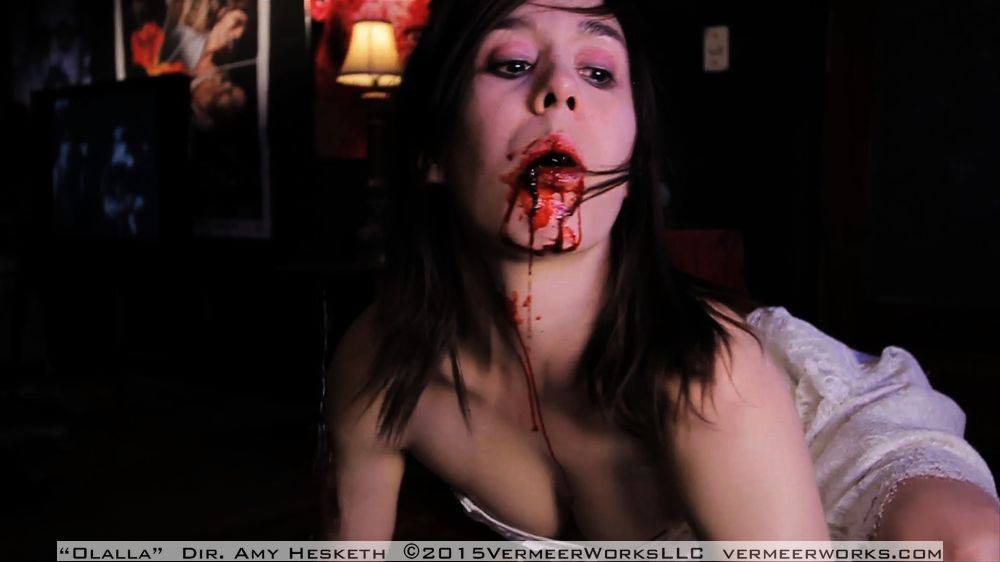
In Olalla Amy may have murderer’s blood splashed about, but her eyes remain the enigma, perplexed, almost befuddled by her deeds, yet driven with lust. In the end, they scream of “the body in pain” in all its agony.

Connecting with Amy

When we first meet Olalla in the original story, Robert Louis Stevenson reaches across time in a way he could never have imagined. It’s as if his vision of Olalla speaks to him directly through Amy Hesketh’s presence.

The unnamed English officer is quickly smitten when he finally encounters the mysterious senorita. Stevenson tells us why. God had “lighted the torches of the soul” in her eyes and “looked out” from them “and conquered mine,” the soldier says.

“In Olalla all that I desired and had not dared to imagine was united.”

10960402_794427550611370_4009839075170455572_o

In the film version of the story, Nathan tells Olalla her beauty is enticing beyond what we consider normal.

Indeed it is. But there is more. Amy Hesketh blends into Olalla so seamlessly that we sometimes forget there is a separation between actress and character. We willfully suspend our disbelief with ease, the mark of fine storytelling, because Amy is bold, sensitive, and seductive.

Stevenson is not finished, however. As if Amy is standing before him, the Victorian author declares through the officer, “In her eyes I could read depth beyond depth of passion and sadness, light of poetry and hope, blackness of despair.”

10942968_625583574237717_8607860649313695694_o


Amy Hesketh’s on-screen presence animates Stevenson’s words. Her eyes, in all their kaleidoscopic beauty and mystery, convince even the most casual viewer that her talent and her emotion are a provocative venture into film.

Stevenson sets the bar; Amy’s Olalla rises above it.

Emotional Catharsis

As we have seen, Amy Hesketh is the woman in pain, a victim who is misunderstood and condemned to the most awful of miseries from which, like the endearing Maxa of the Grand Guignol,  she rarely survives.

OlallaVidCaps01194404

Her torments, often inflicted by the bigotry of the righteous, defines Amy’s self-imposed artistic fate. In reality, it’s a personal psychosocial journey that explores woman as prey, scapegoat, and sacrifice, powerless to avoid the anguish that persecutors turn into sadomasochist pleasure.

But the victim scenario is not quite that simple because there a silenced anger shouting from within.

In Olalla, the deck is stacked against the younger sister. Her blood feast compulsions throttles whatever happiness she might realize. The notion that if freed from its familial shackles, Olalla’s determination would prevail. But we never see it, though Amy lets us know it’s there.

11081089_10152675656842882_816891267024977805_n

Highlighting all of her roles is a desire to explore the “body in pain” that infuses Amy’s art.

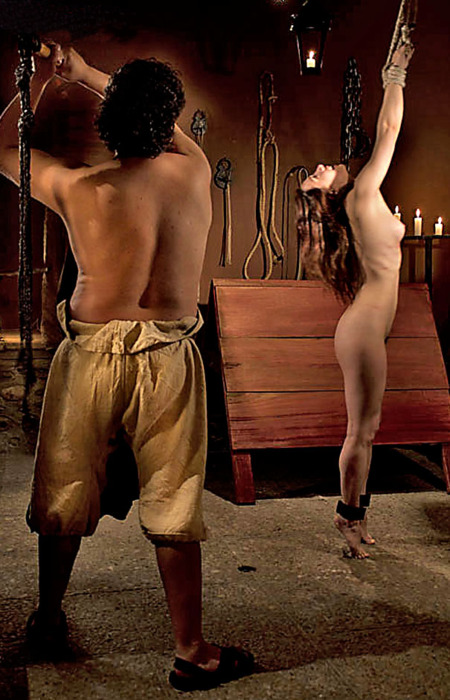
In Maleficarum, lesbian lovers Mariana and Francisca (Mila Joya) are sadistically tortured by the Church. In Dead But Dreaming it’s the whipping post for Moire’s political crimes then a vampire feast at the hands of the fiendish Nara (Veronica Paintoux).

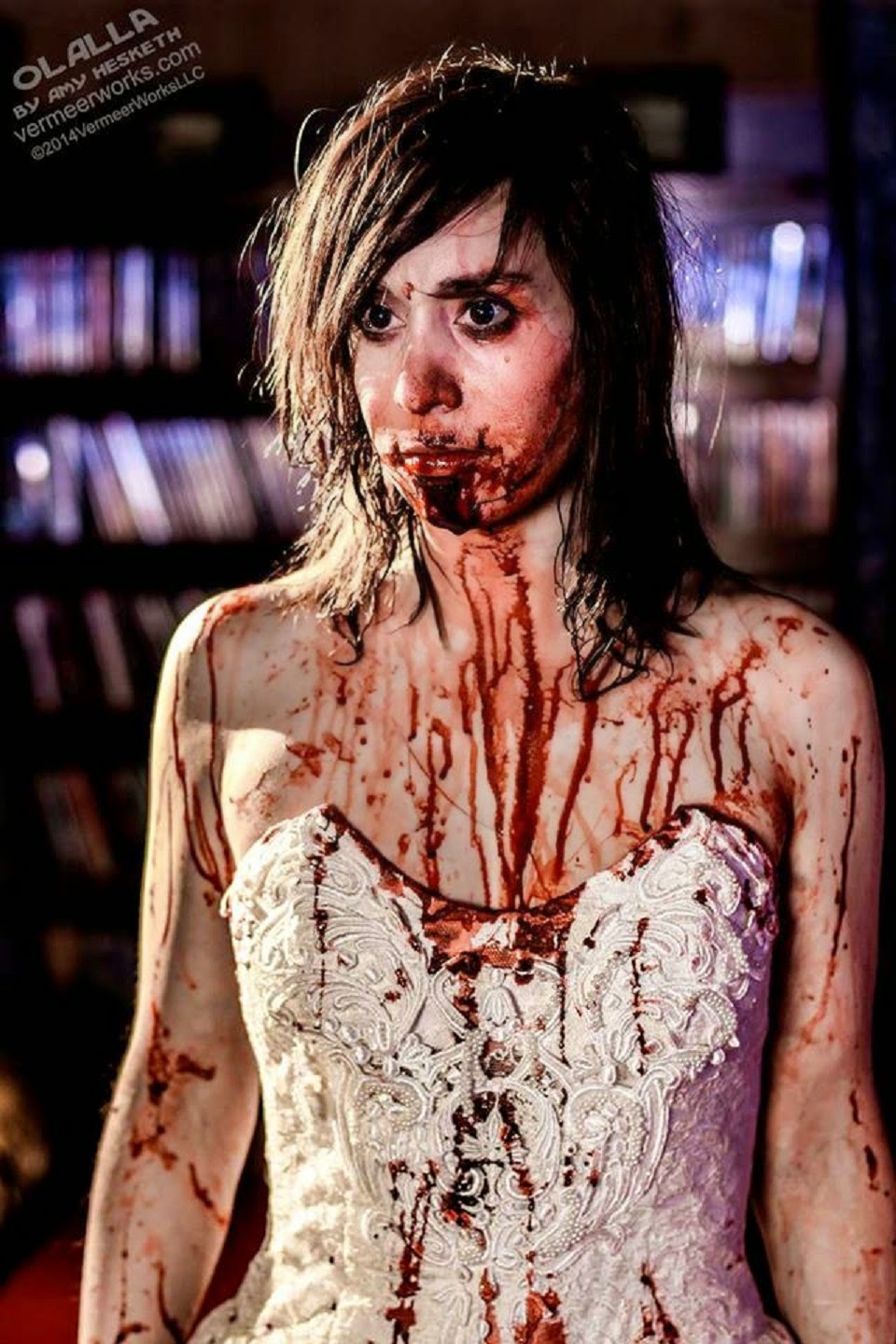
And, of course, there is Olalla who is beaten on the cross to satisfy superstitious villagers who believe monsters are Satan’s work.

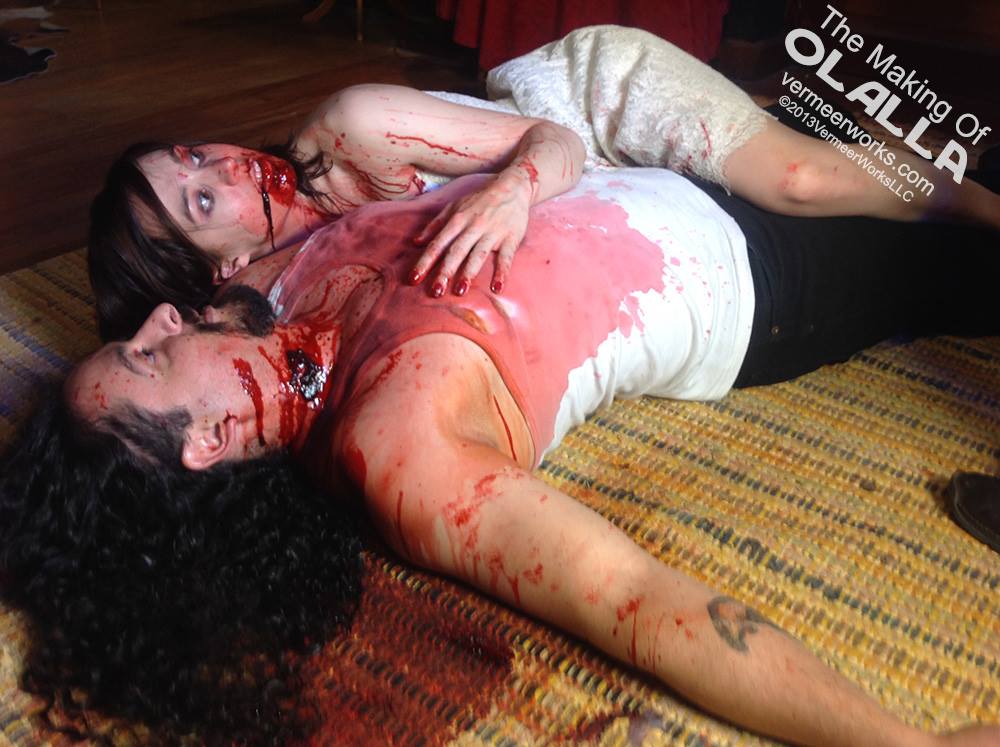
OlaMakingOfCayara_3255

These films present an emotional catharsis that releases Amy Hesketh to inhabit her characters in a way that few, if any, female performers can deliver in the erotic horror genre.

It’s intoxicating. We look away, but like the English soldier, can’t resist looking back.

*           *          *

By way of Mel Gordon’s Theatre of Fear and Horror, I’ll let the Grand Guignol playwright Andre de Lorde close out this analysis of Olalla.

“At all times . . . horror shows have drawn large audiences. If the Inquisition had made public its interrogations conducted on the rack, they would have had to turn people away.”

Here’s a toast to you, Amy Hesketh. You know this all too well.

We love to watch.

10985356_10152749187352882_807576401649007955_n


Leave a comment

Filed under Uncategorized

Olalla, Part Five: The Portrait

by Rich Moreland, July 2016

This post wraps up a few details about Olalla as I’ve interpreted the film.

Here we consider the portrait’s importance in the story and take a look at some of the cinematography.

*          *          *

Gothic

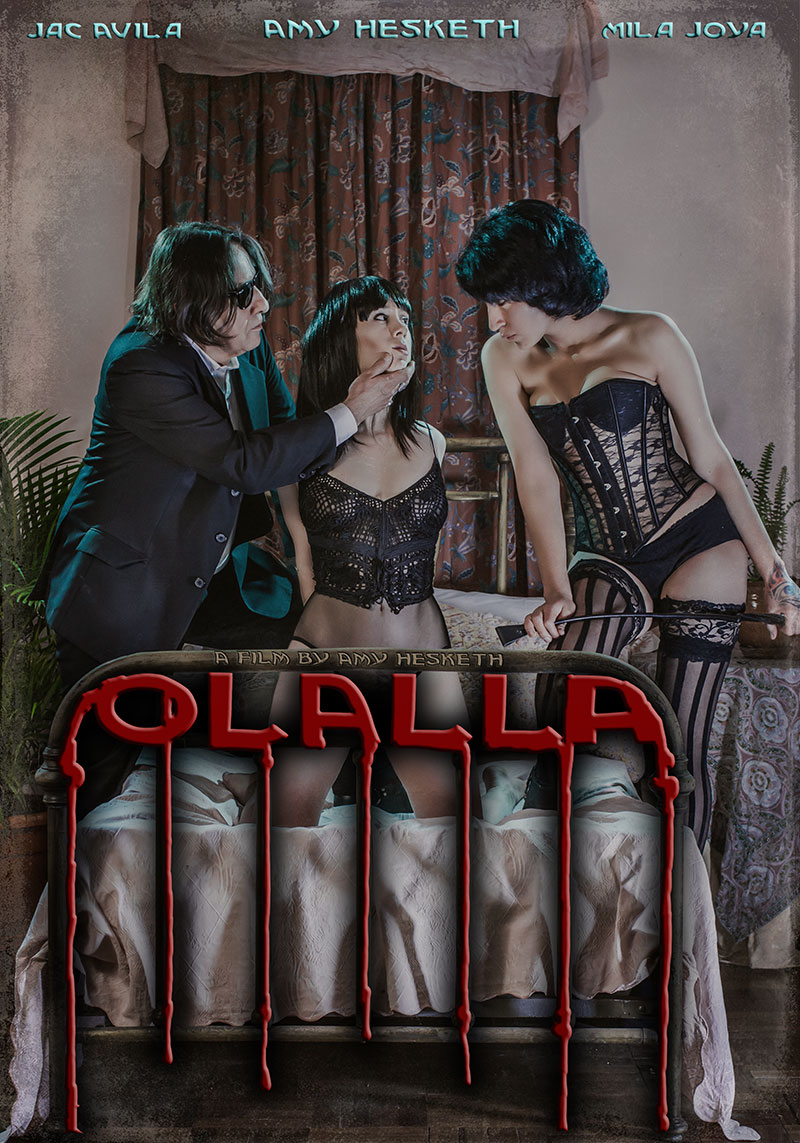
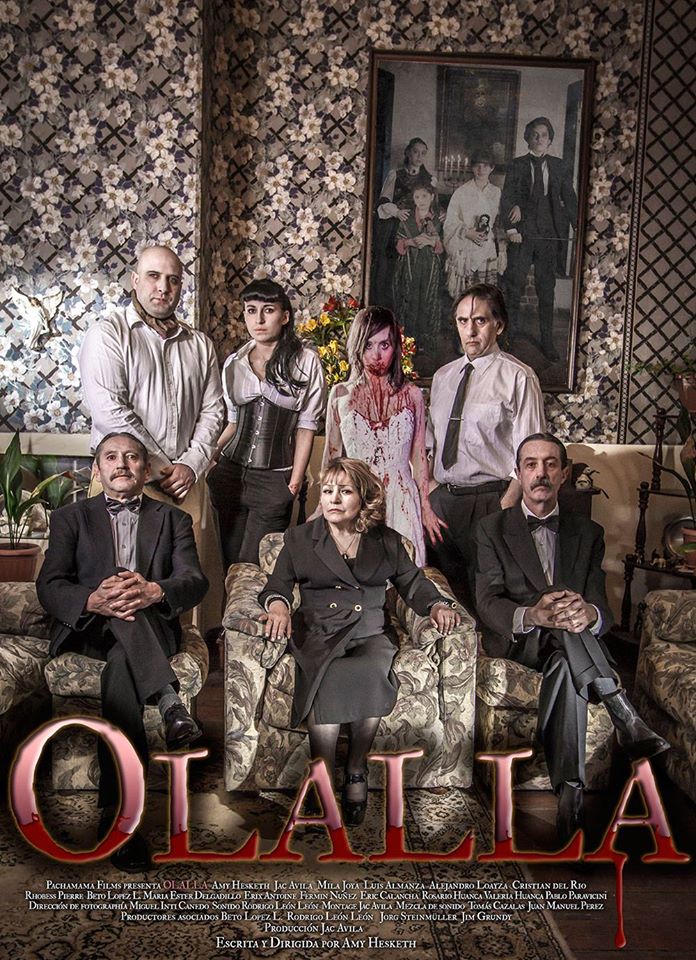
OlallaPoster800The central image in Robert Louis Stevenson’s “Olalla” is the portrait in the English soldier’s bedroom. It presents “a woman, still young” whose body is “very slim and strong.” Yet, she is “marred by a cruel, sullen and sensual expression,” the Englishman notes, and he fears the lady may still exist “in the body of some descendant.” Nevertheless, he is drawn to her.

In the film, the portrait travels across time. It is in Roberto’s bedroom in the 1885 setting and then in Nathan’s in the modern era.

At one point, Nathan, who is the final incarnation of the house guest, gives credence to the Englishman’s apprehension. He gazes at the woman’s face and it fades into Olalla’s, a bit of blood dripping from her mouth.

Like the English soldier who is “haunted by cries of pain” in the night, Nathan hears Olalla’s whimpering coming from her room. Could it be that Felipe is his sister’s abuser in Stevenson’s mind? Amy Hesketh lets us in on that secret in her updated version of the story.

Later, Nathan wants to photograph Olalla using his tablet. She resists at first, but gives in, and the photo reveals much.

First, her image is there, questioning the traditional (Bram Stoker) interpretation that vampires aren’t reflected in mirrors. Then, there is Olalla’s comment that she appears pale, perhaps denying any self-recognition that she is vampiric. Nathan counters her remark with the word “gothic,” an interesting concession to Stoker.

That strikes a chord with Olalla because she responds with one the film’s major themes. “I want to look normal.”

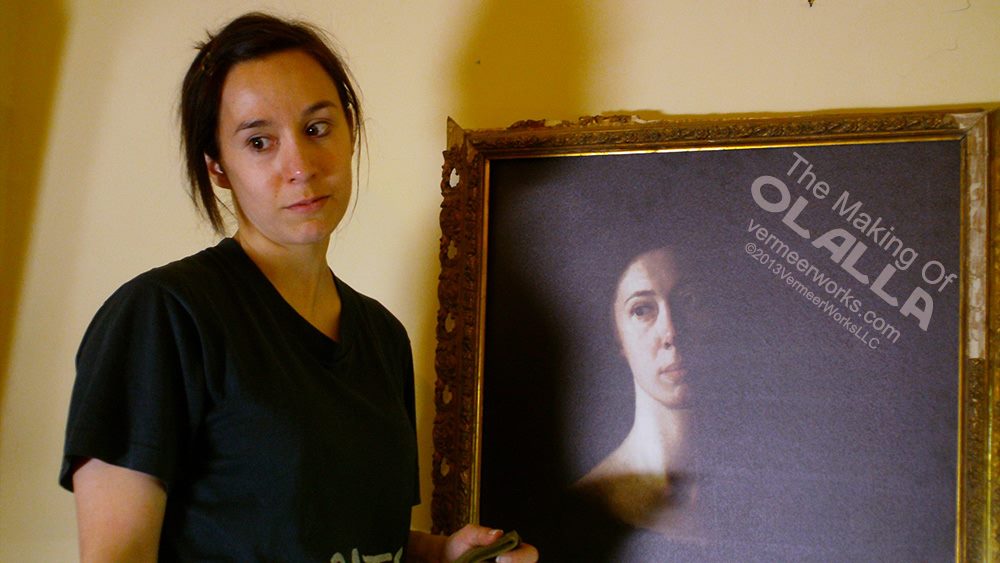
A test for angle and shadowing.

A test for angle and shadowing.

The portrait and the photo solidify the Olalla story. Both have the same shadowing that mutes the left side of the face. Olalla, like her ancestor, is crushed by a past she cannot escape. It’s the darkness that has engulfed the family for generations.

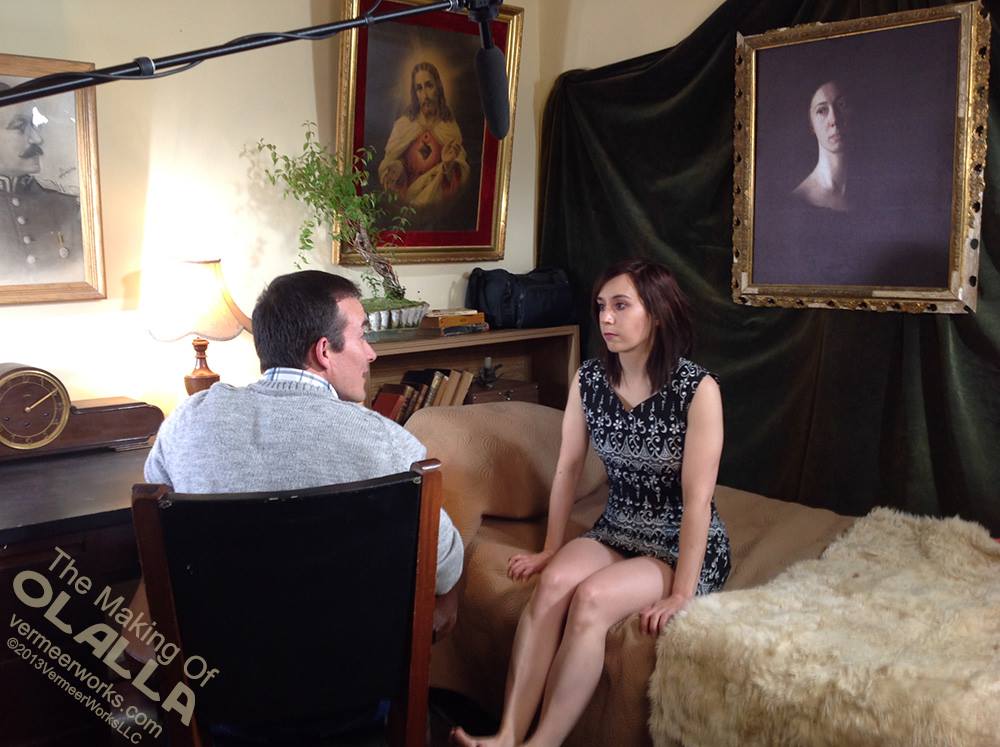
Coincidentally, there is a portrait of Christ immediately to the left (from the camera’s perspective) of Olalla’s ancestor. This foretells a cinematic ending that magnifies the conflict between suffering for sin and yielding to evil.

The images are together

The images: the soldier, Christ, and the ancestor

To bring all the images together, there is one more picture in the room, a soldier taken in profile. It’s a tribute to Stevenson’s original English officer, though the photo is of Victorian origin that fits with Amy’s interpretation of the Olalla back story.

As an aside, there is one more observation concerning Nathan’s tablet. Like the flat screen TV in the apartment Olalla shared with her boyfriend, the tablet is modern technology. However, the family hacienda lives in another era as we’ve seen. Only when someone from the outside, like the boyfriend or Nathan, appears in the narrative does Olalla experience what she desires, the freedom to break away and be “normal.”

Then, in a never ending cycle of entrapment, she kills off her chances of escape with deadly fits of blood lust.

Feeling Alive?

Throughout the film, the camera captures important details that help us interpret the story. Here are a few examples.

Olalla is frequently barefoot, understandable since uncle Felipe derides her as a “stupid little girl” confined her to adolescence. In the family’s presence, Olalla’s body language assumes the awkward posture of a child. Her hands and her feet are restive in an atmosphere that clearly makes her uneasy . . . as children often are among adults.

10492294_510837182379024_5957775856219147208_n

In the living room, a glass curio cabinet is filled with bric-a-brac, much of it religious, such as the porcelain Madonna and angels.

Can we assume the family’s blood-thirst clashes with a faith they’ve long put on the shelf? Or, are the religious relics merely socially acceptable trinkets for display, not to be taken seriously? On the other hand, perhaps their blood cocktails are more sinister . . . a perversion of the blood of Christ celebrated in church ritual.

Taking this into consideration, we are inclined to believe that the crucifixion of Olalla’s mother, who committed no crime, was an act of redemption that gives the family a pass to be their wonderfully deviant selves.

Olalla and Nathan talk among the images within the cabinet.

Olalla and Nathan talk among the images within the cabinet.

Nathan and Olalla are united in one respect. He tells her that he has seen so much death that he can’t “feel alive anymore.”

The reality of that statement is ready to be tested by the family who is itself a reflection of his thought. Soon the party will begin and a table neatly organized with napkins, glasses, and the like is prepared. The arrangement is a set-up for a violent end: a pistol is centrally positioned among the dinner ware.

Nathan’s arrival is eagerly anticipated as one would the daily farmers’ market where fresh fruits and vegetables tempt the taste buds.

A Few Words about the Production

Olalla is a finely crafted film. Numerous close-ups connect the viewer with the characters. Additionally, Amy favors overhead and high angle shots, putting the family in a metaphorical fishbowl that invites us to watch their goings on with a mixture of macabre humor and pathos. Cinematographer Miguel Inti Canedo’s work is impressive.

A superb example is Olalla’s first appearance in the long hallway. It’s shot in single point perspective from high above with her a small figure at the opposite end moving toward the camera.

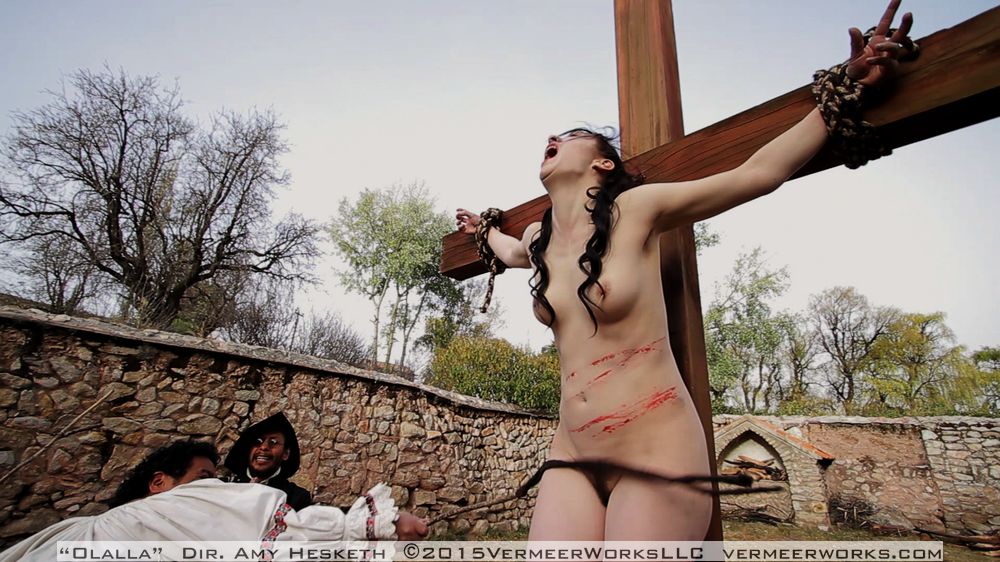
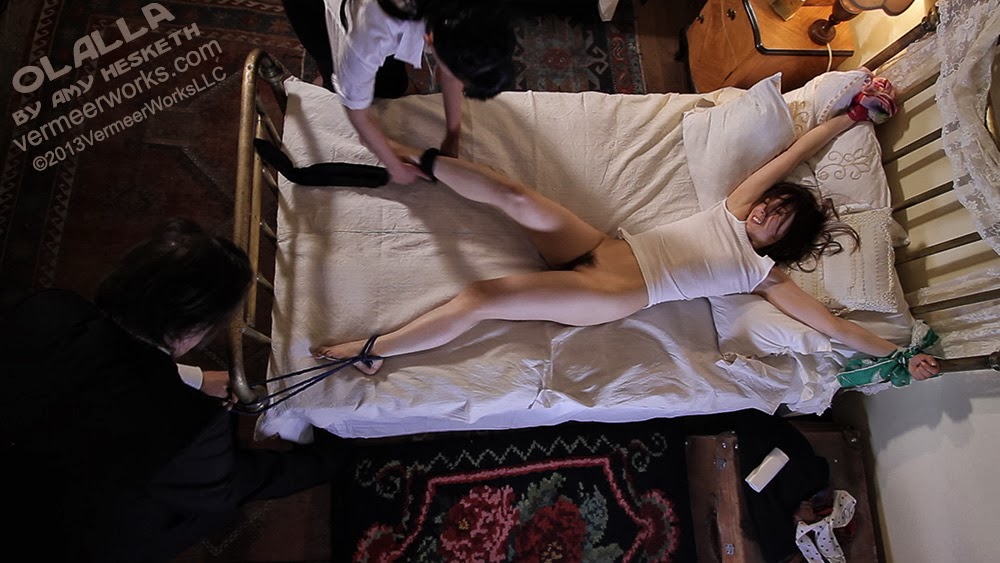
Later when Uncle Felipe overpowers Olalla, he binds her in a crucifix posture that references her mother’s death. The overhead shot tells us she may someday suffer a more grisly fate than a few beatings to reestablish her submission.

OlallaVidCaps00194209

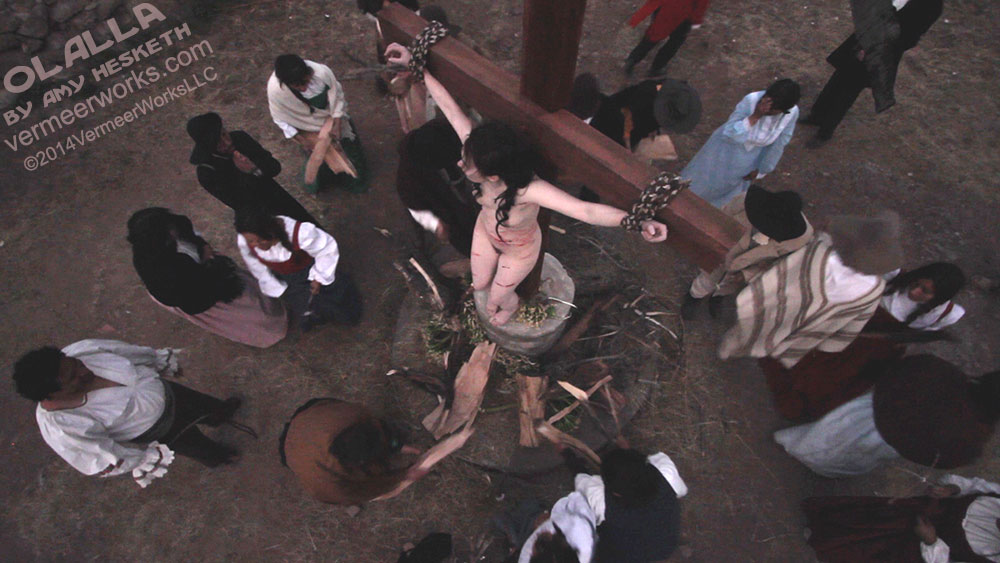
Nearing the end of the film, another overhead shot shifts the focus to the pitchfork crowd in the 1880s. Notice that the whip marks on Olalla’s mother replicate the strokes inflicted on a tied down Olalla. Mother and daughter are forever united.

Oh yes, don’t forget that the Englishman’s final memory of Olalla in Stevenson’s story. He sees Olalla “leaning on the crucifix;” Amy puts her put on it.

OlaSc62_2809_00003408-Promo

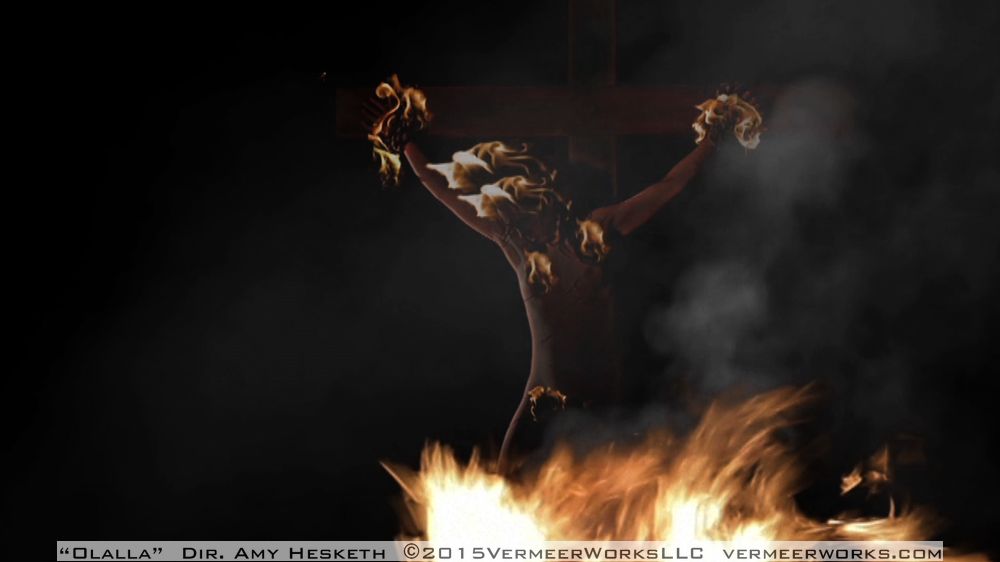
Olalla is a horror film, of course, but one that does not rely on special effects. Nonetheless, there is one spectacular moment when Jac Avila’s editing steps forward to show the fires that consume Olalla.

OlallaVidCaps01315708

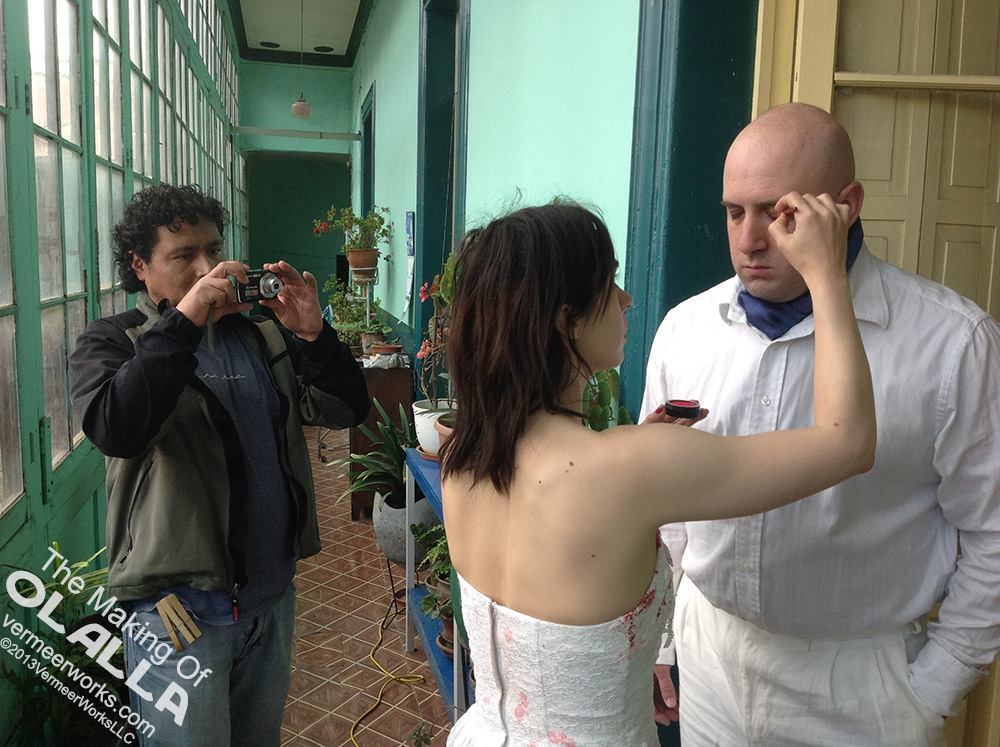
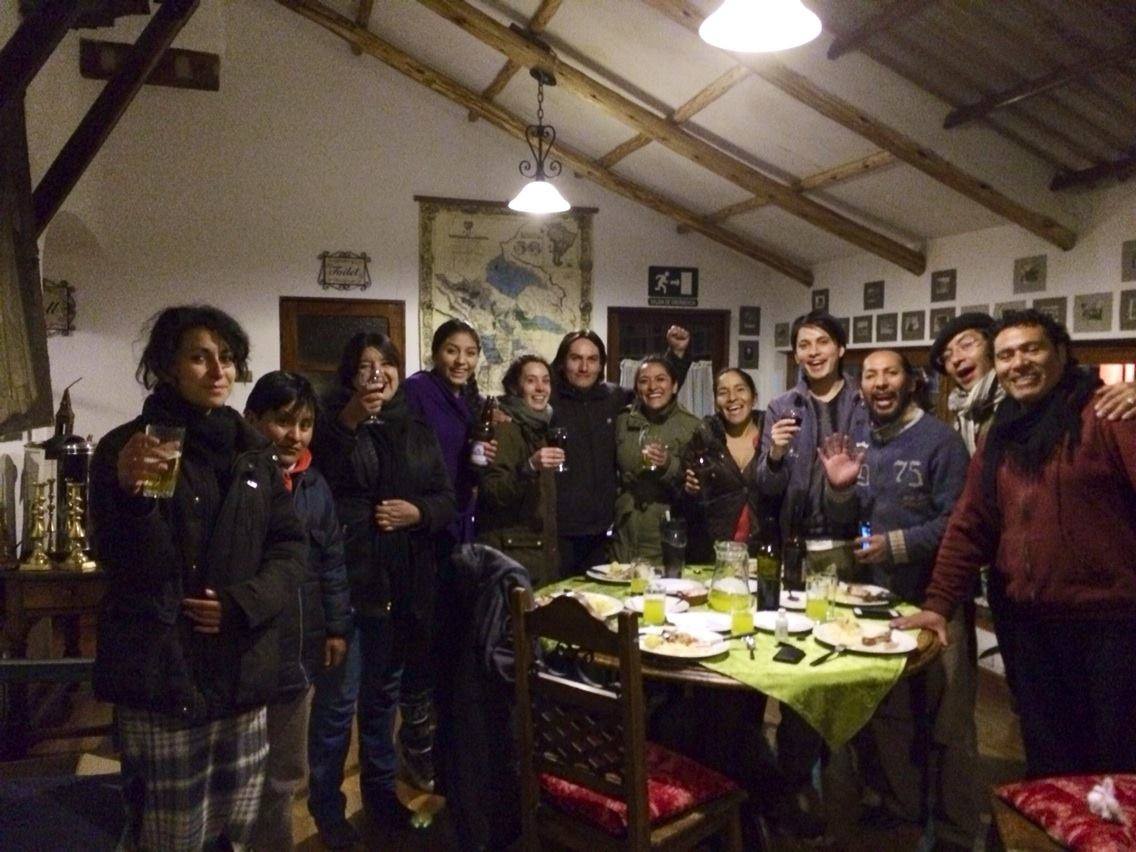
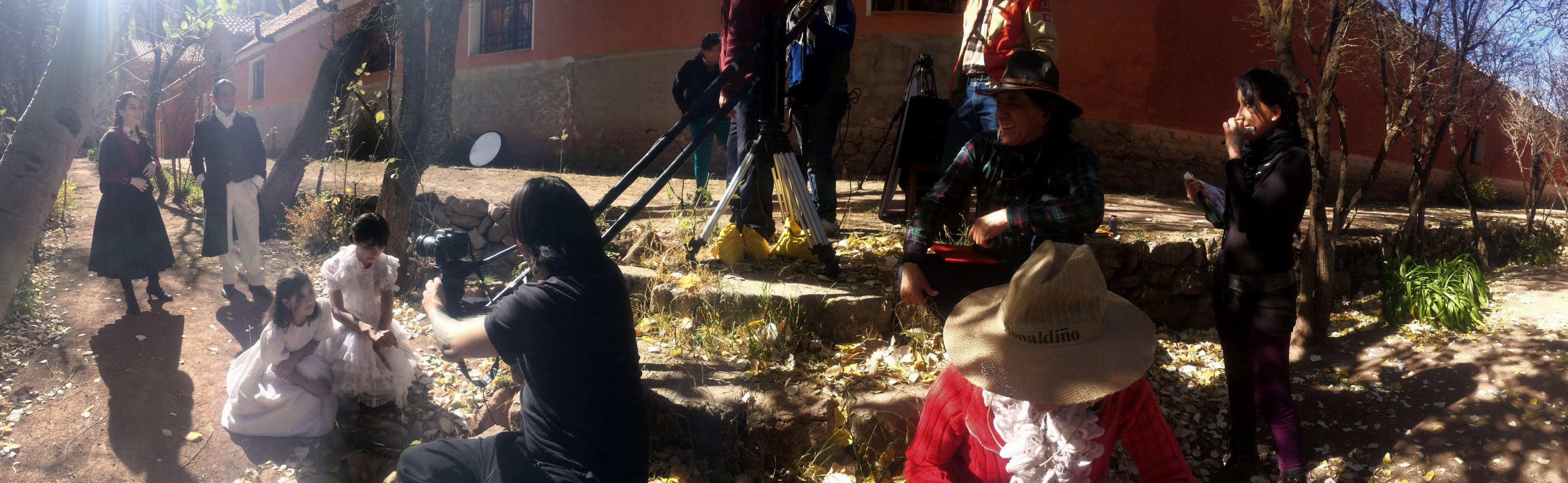
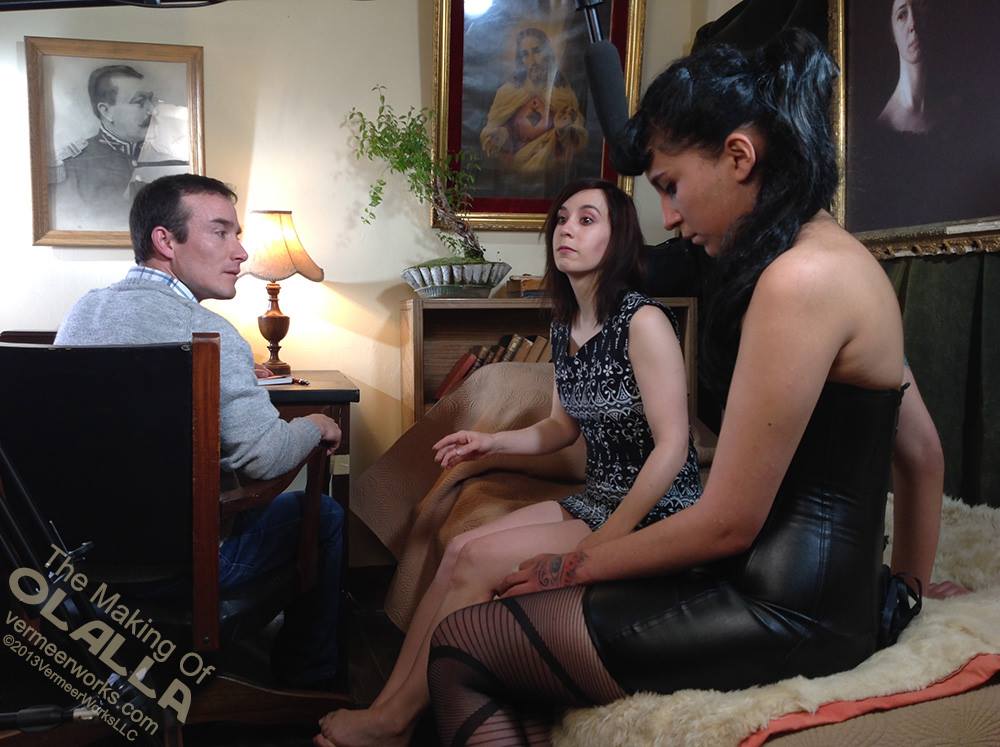
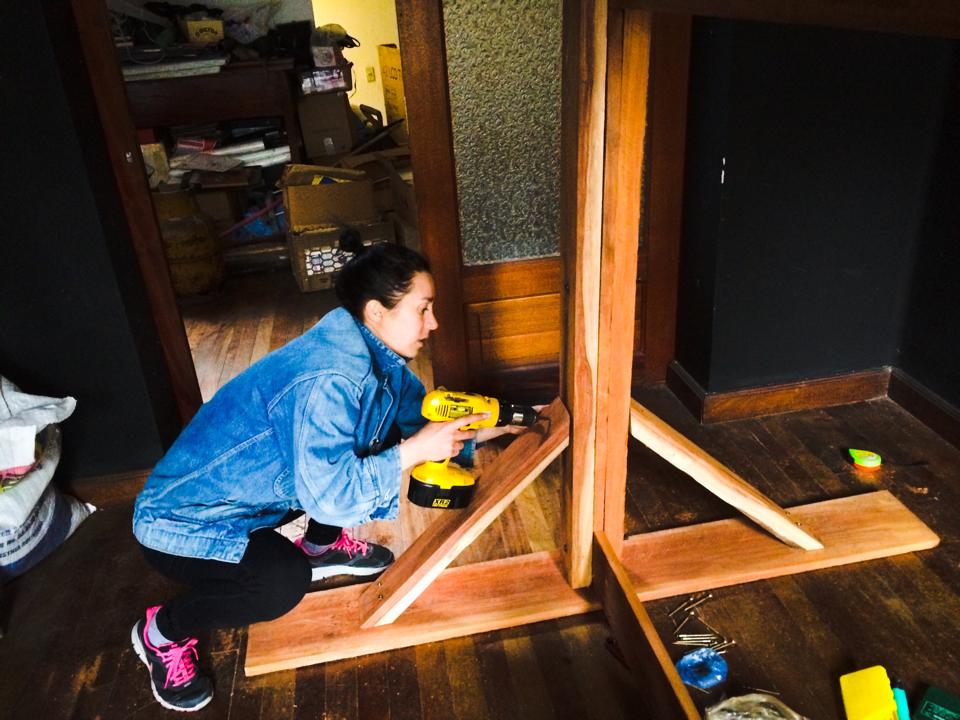
A note for anyone who doubts the versatility of indie film projects. Everyone does everything. Actors do make-up, take on the jobs of PA’s, build sets, capture the film grabs (production stills) and operate technical equipment when needed.

A director has many jobs!

A director has many jobs . . .

It’s the closest thing we have to neighborhood theater, a truly refreshing experience.

Which includes set construction . . .

Which includes set construction . . .

And speaking of performers, Jac Avila’s and Amy Hesketh’s Pachamama/Decadent Films is also an acting troupe. Revisit the second post in this series for the names of the talented people who do their very best to make every film a first-class production.

A celebratory moment!

A celebratory moment!

The Budget

Finally, indie productions must deal with the bane of budgetary restrictions. Considering that, Olalla is exceptional. Though the outdoor sequences are not elaborate, they more than adequate to supplement the story.

10417775_10153193597846840_8578639109230206091_nOn the other hand, the indoor shots of the family hacienda in modern times are the real driving force of the film.

By comparison, the 1800s flashback scenes emphasize the family’s once wealthy position that Stevenson establishes in the original story.

Their home is well-appointed.

Also, the church that becomes Olalla’s last refuge is visually impressive. Both are awash in color.

10960199_10153192480561840_838958167466423371_o

Because I mainly review films in an industry that operates outside mainstream Hollywood, I’m well aware that talented directors rarely have the money to bring their projects to the screen in the fashion they’d like.

Despite whatever financial hurdles they face, Amy Hesketh and Jac Avila create narratives that are intriguing interpretations of timeless stories produced with an innovative modern feel. As a team, they and their troupe deserve the highest accolades.

*          *          *

There is on more post to come. It centers on Amy Hesketh’s performance in Ollala.

To learn more about Amy and Jac, visit their twitter accounts at @Amy Hesketh and @Jac Avila.

Leave a comment

Filed under Uncategorized

Olalla, Part Four: The Flesh of Brutes

by Rich Moreland, July 2016

For some viewers, an Amy Hesketh film shivers with a sexual chill. For others, it’s pure heat. 

Either way, horror films in general are erotically perverse and Amy taps into that appeal.

 As we’ve seen, however, Amy Hesketh differs from other fear and terror filmmakers because her movies focus on realism while more traditional horror is pure fantasy. The result?  Amy’s torture scenes dominate the genre in ways others can only envy. The inquisition film, Maleficarum, is a classic example.

In Olalla, Amy adds another ingredient: the monster image as it resides in the human psyche. Let’s take a look.

*          *          *

449784430_1280x720

“Monster” is a recurring theme in the filmed version of Olalla. The family hurls the accusation Olalla’s way, though in the original short story, Stevenson never uses the word, preferring to rely on suggestion.

For example, the English officer hears wailing in the night he describes as “pitiable and hateful cries” that are “ravings worthy of hell.” But the source is never identified.

10924645_10153193700991840_5293608269395833368_oLater, when Olalla declares she will have no children, “My vow has been given; the race shall cease from off the earth,” Stevenson intimates dysfunctional idlers and strange creatures inhabit the family.

Do they?

To find out, let’s investigate how the monster image drives Amy Hesketh’s screenplay.

It’s My Turn

Uncle Felipe has his way with the sisters.

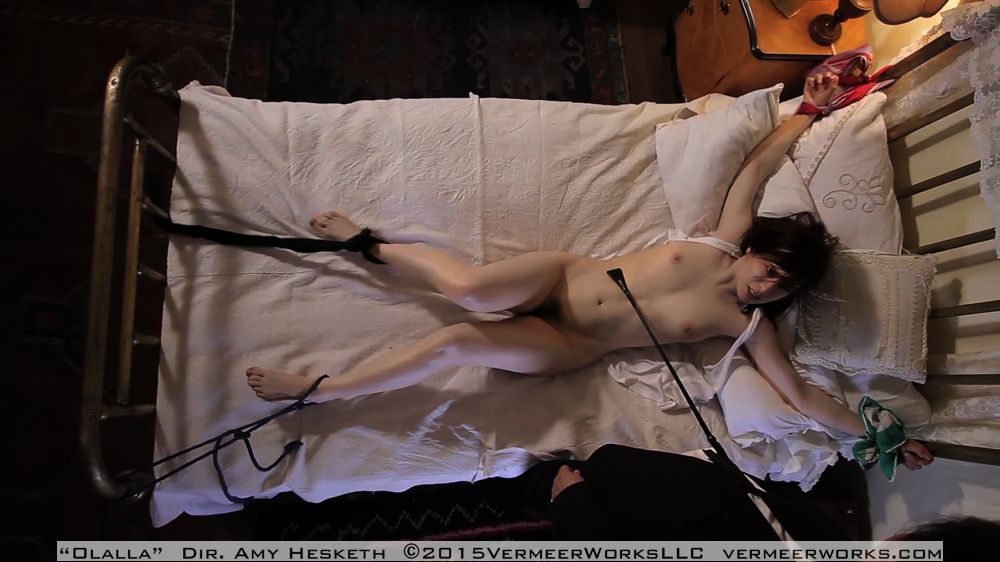
In the scene in which he emotionally abuses and punishes Olalla, Ofelia helps him tie her to the bed. Afterward, Felipe forces himself on his restrained niece in an act of incest and power (he is teaching her a lesson), though within the family that’s likely their version of “normal.”

To reinforce his discipline, Uncle Felipe reminds Olalla that she is “monster” and “they kill monsters” in a reference to her mother’s death.

Olalla9469

Later Felipe visits Ofelia who makes seductive moves in his direction. With her submissive side ready to romp, she coos, “It’s now my turn.” He closes the door behind him and we are left with an incestuous tryst that recalls the English officer’s inbreeding comment in Stevenson’s story.

maxresdefault

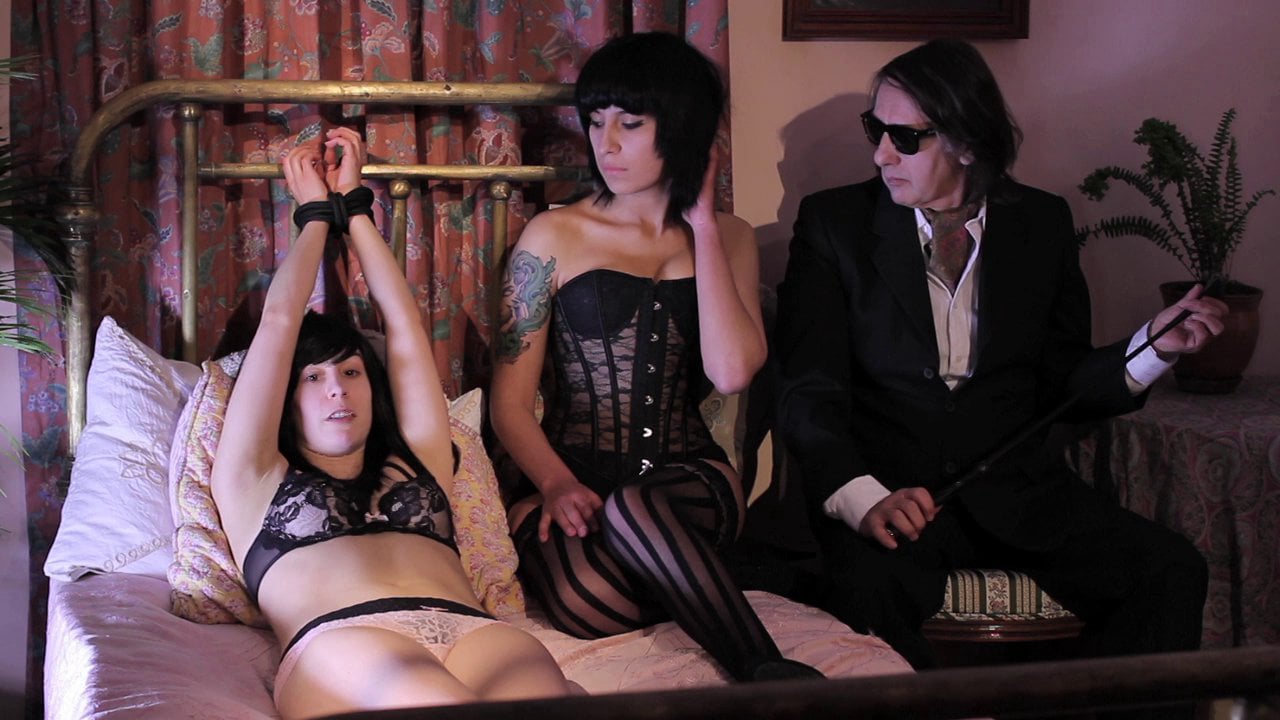
On another occasion, Olalla peeks through the door of Ofelia’s bedroom. Her sister is nude except for a corset and thigh-high stockings. Uncle Felipe is smacking her bottom in a brief scene that is reminiscent of a 1960s roughie or kinkie.*

jac and mila 2If there is any jealousy on Olalla’s part, we don’t see it and wouldn’t expect to. For her, Felipe’s riding crop is a source of discomfort, not the erotic fun Ofelia anticipates.

Unlike other Amy Hesketh productions, the scene is not explored further, though a brief glimpse of the sultry Mila Joya in her Bettie mode is a welcome moment.

Of course, there is irony at work here because Felipe proves that he’s just another fiend creeping around the family tree and raises the question of how long has this been going on.

Obsession Feeds the Monster

Olalla’s unnatural proclivity (compulsion? kink?) is revealed early in her life. In a telling scene, she and her sister are walking a narrow path that is a reminder of the hacienda hallway of present time. They’re followed at some distance by Roberto and their mother who have struck up a relationship Stevenson’s Englishman could only imagine.

1396876_10153192309316840_73150861489104434_o

The taller Ofelia suddenly cries to her sister, “What have you done, you animal?” Little Olalla raises her head, blood on her mouth. On the ground is a dead bird with a gash in its neck.

young olallaThe girl looks confused, guilty, and helpless.

This moment defines Olalla’s past. Uncle Felipe and Ofelia will struggle to keep her self-destruction from putting everyone in peril, though it is the family that ironically endangers her. Olalla, who desperately wants to be normal, will be disciplined and under lock and key within the house.

10959611_10153193663996840_5116423304263740522_nIn fact, Stevenson foretells Olalla’s fate. In the original story she explains to the soldier why their love will never come to be. The family “seed” was passed on, she says, but it’s “wrapped” in “the flesh of brutes” who are “inflicted with the mind of flies.” This infestation will stop with her.

In Amy’s film, the original Olalla propagates the family’s decadency and pays dearly. What does this portend for her daughters? Like the Victorians, Amy is leaving it to us to figure out.

Familiar Ground

So, we fast forward to modern times and, as mentioned above, Felipe binds a nude Olalla to her bed, hands over head and feet secured to the opposite end of the bedstead. She is wayward once again, this time with her boyfriend, and needs a forceful reminder.

Felipe uses the riding crop to raise some real welts on Olalla’s torso and thighs. It’s beautifully shot scene and once again marks (pun intended) Amy Hesketh as the darling of softcore sadomasochism.

OlallaVidCaps00361606-510x286

But, there is more going on here because the film gives Amy, as both director and actor, the opportunity to present erotic punishment from two distinct psychological perspectives.

As the modern Olalla, she is not the innocent victim. Rather, she is defiant and angry, caught in her own time warp in which she cannot escape her destructive and bloody urges.

We see this when Ofelia tempts Olalla with an apple, the traditional forbidden fruit. She dangles it and pulls it away letting Olalla know that breaking the bonds of the family’s perverse garden of joy may linger as a desire, but doing it is another matter.

OlallaVidCaps00302608-510x286

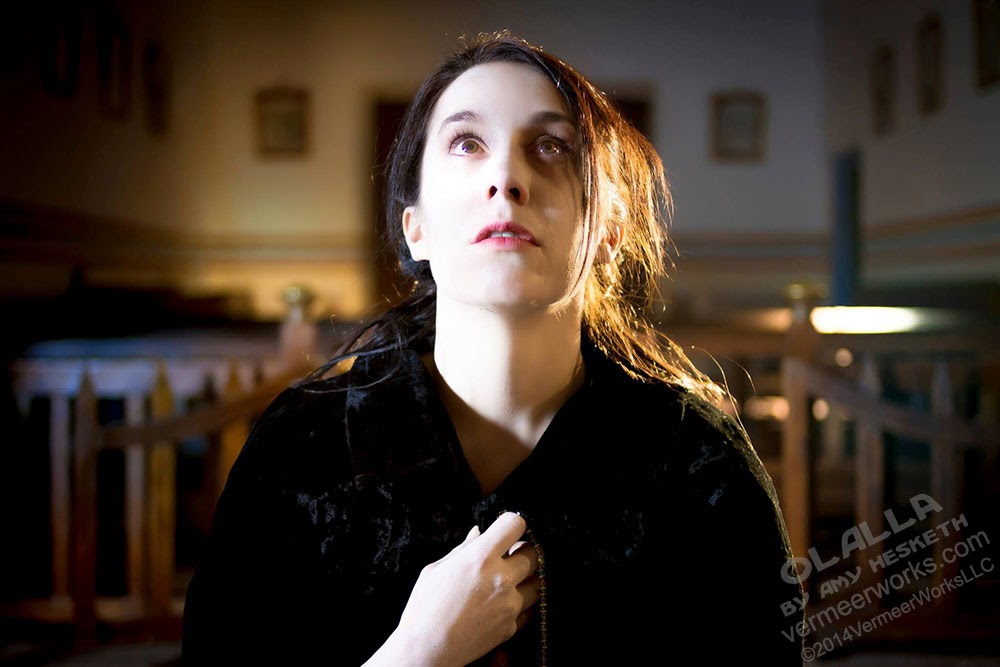
In her role as the 1800s’ Olalla, Amy is on familiar psychological ground: the innocent victim. Taking refuge in a church, the desperate and frightened Olalla persuades her daughters to flee with Felipe, then awaits the village mob. She prays just as her literary counterpart does at the end of Stevenson’s tale.

OlallaInChurchFB

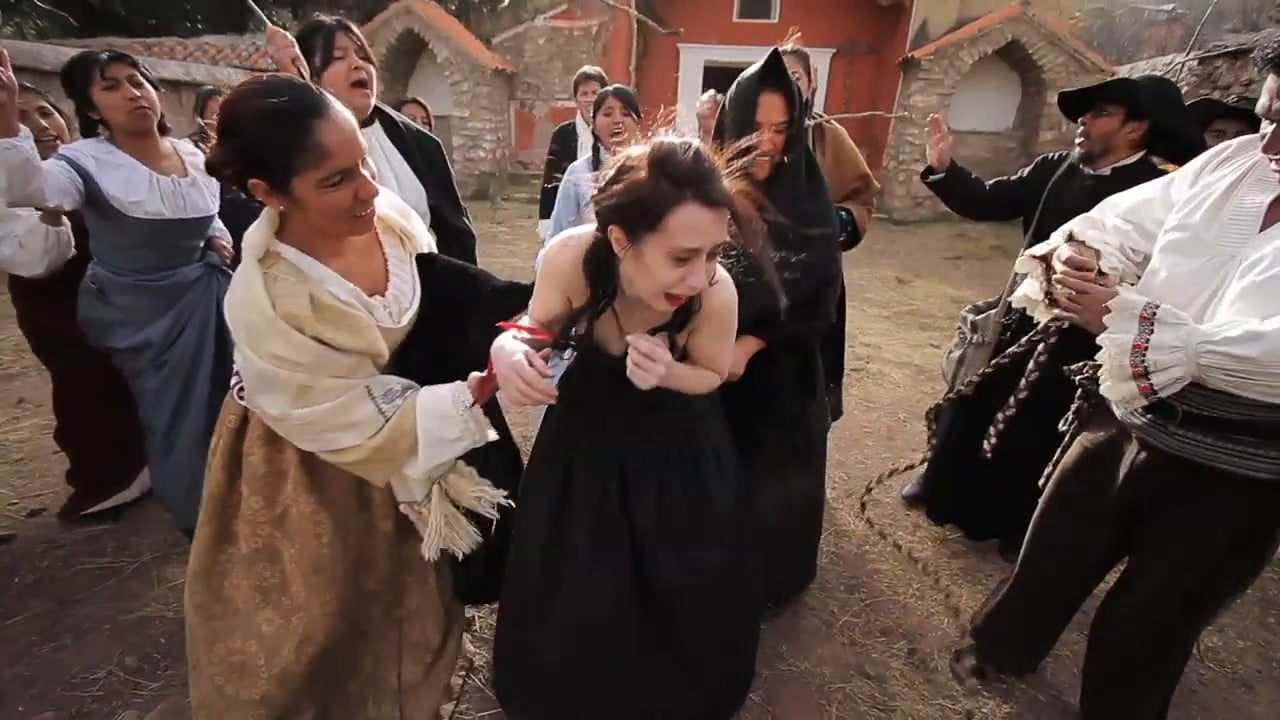
But her fate will not be to suffer silently. Rather, it plays out dragging and screaming to a heinous end.

493859106_1280x720

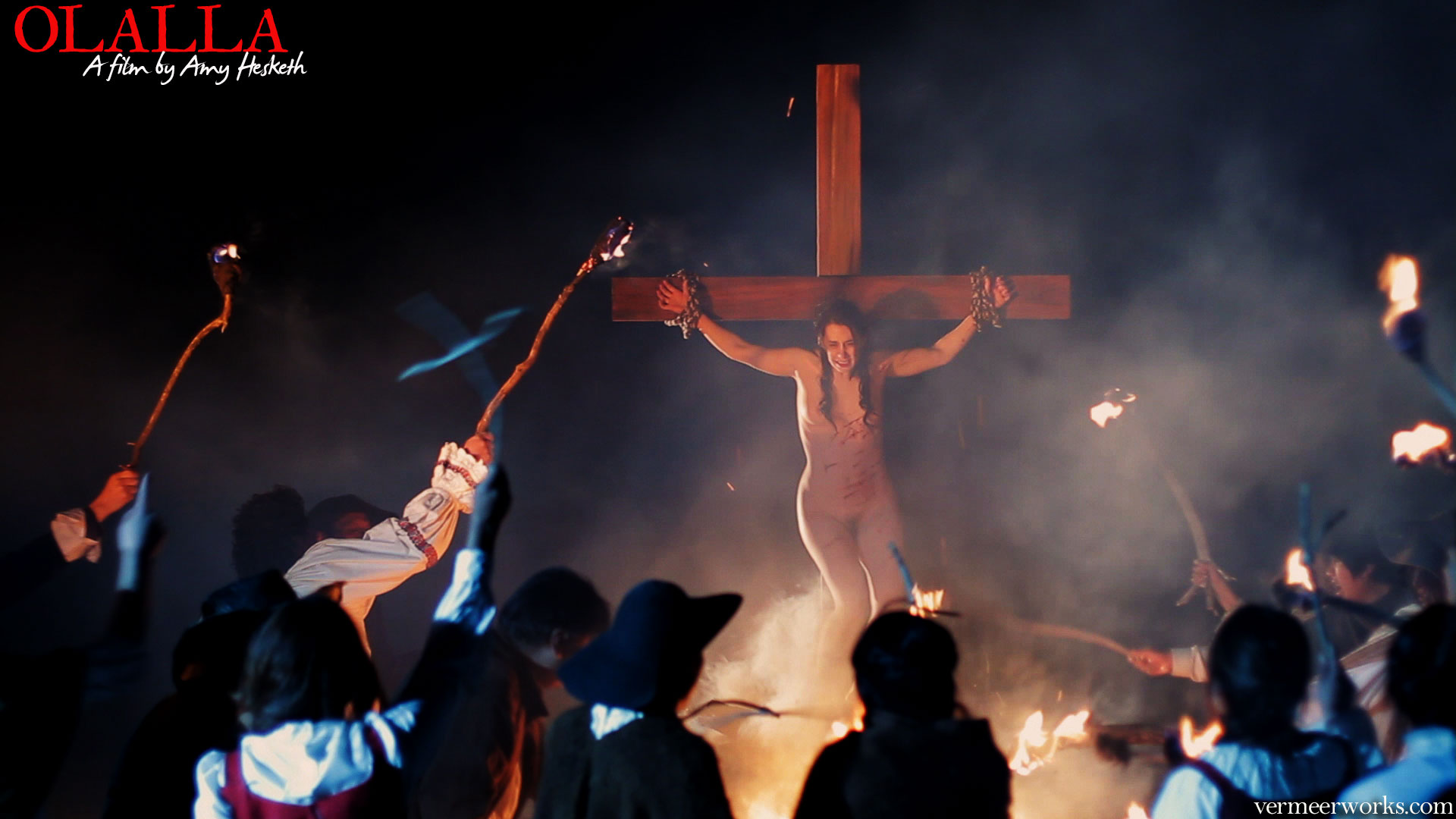
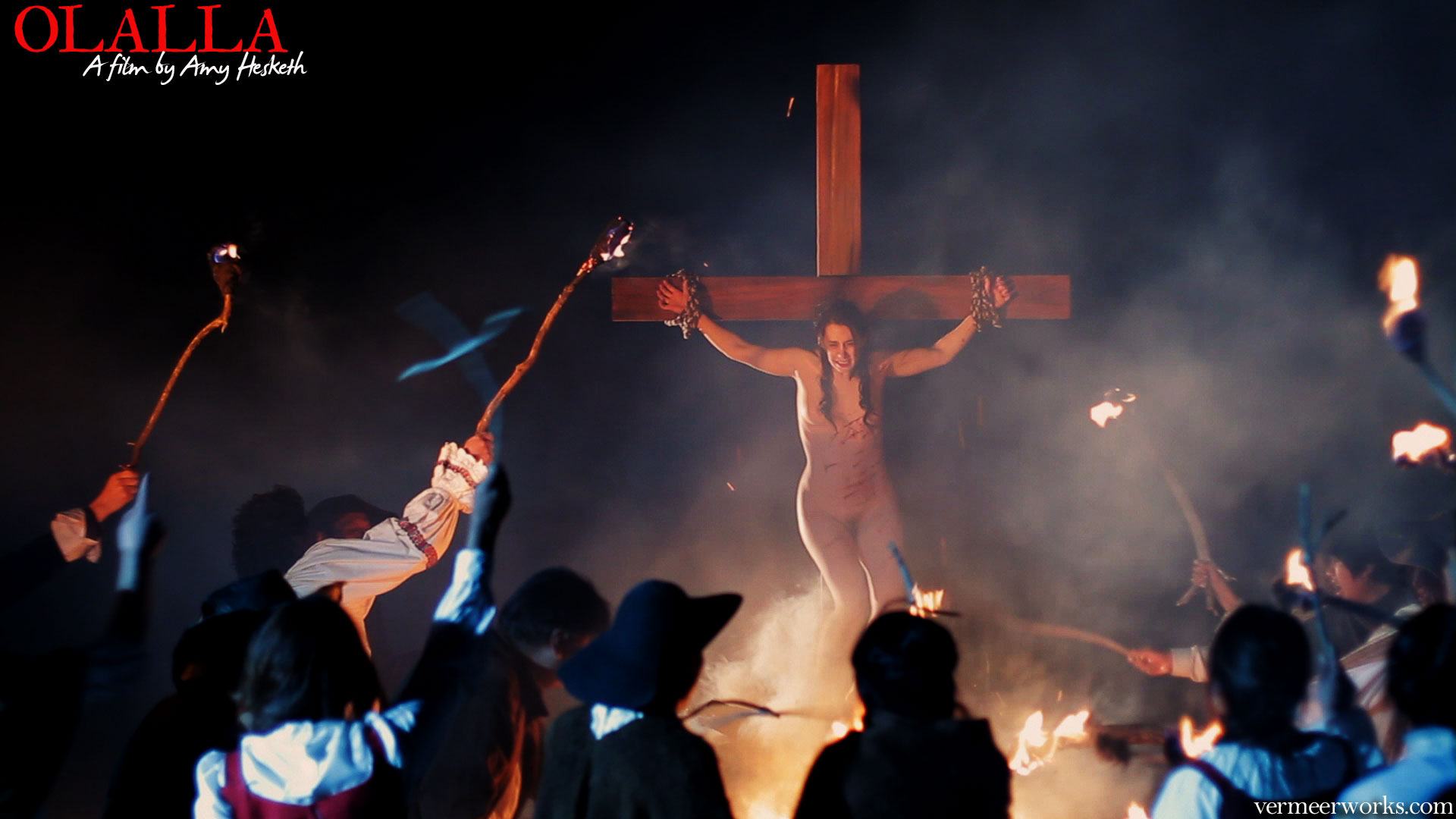
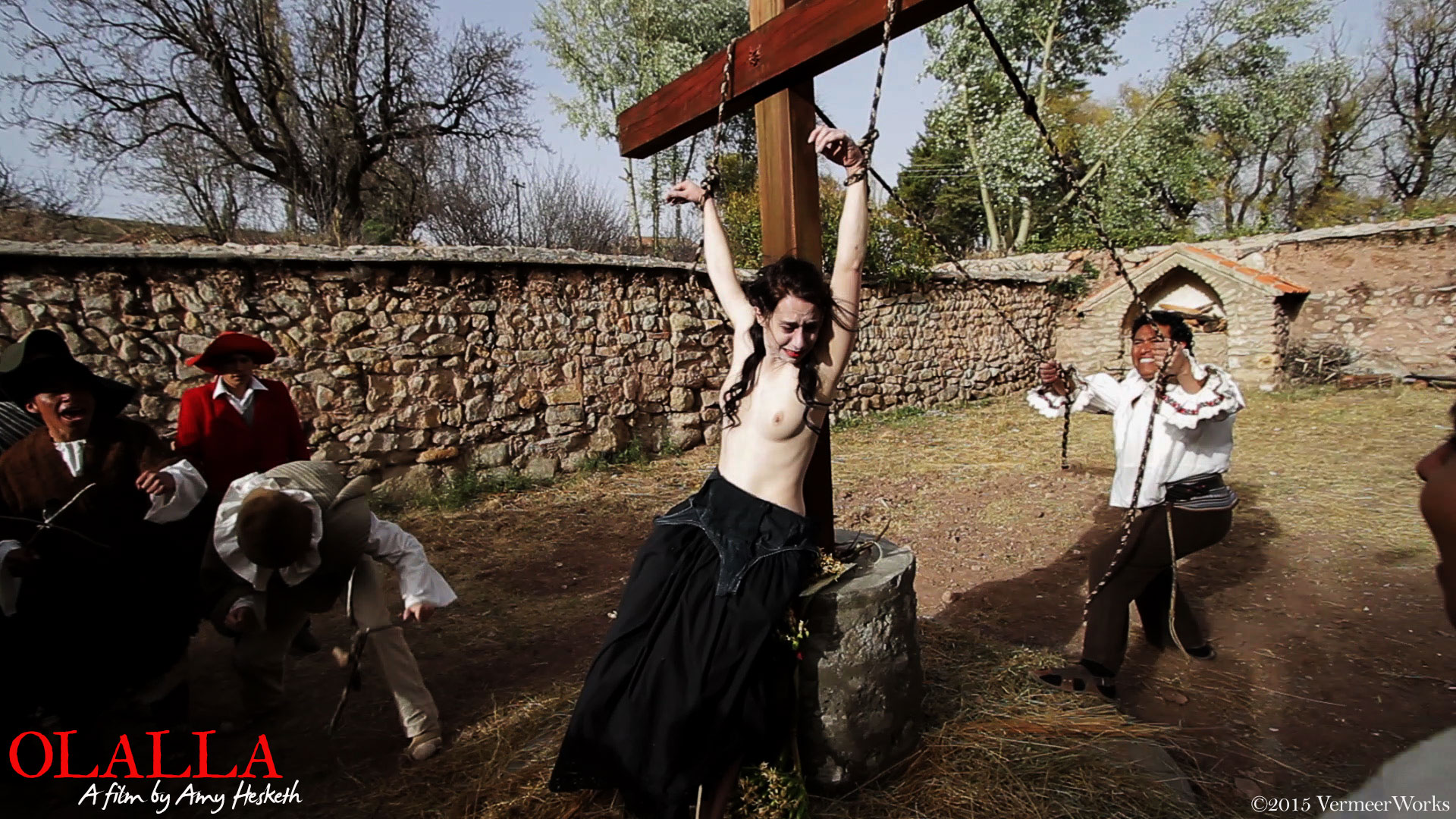
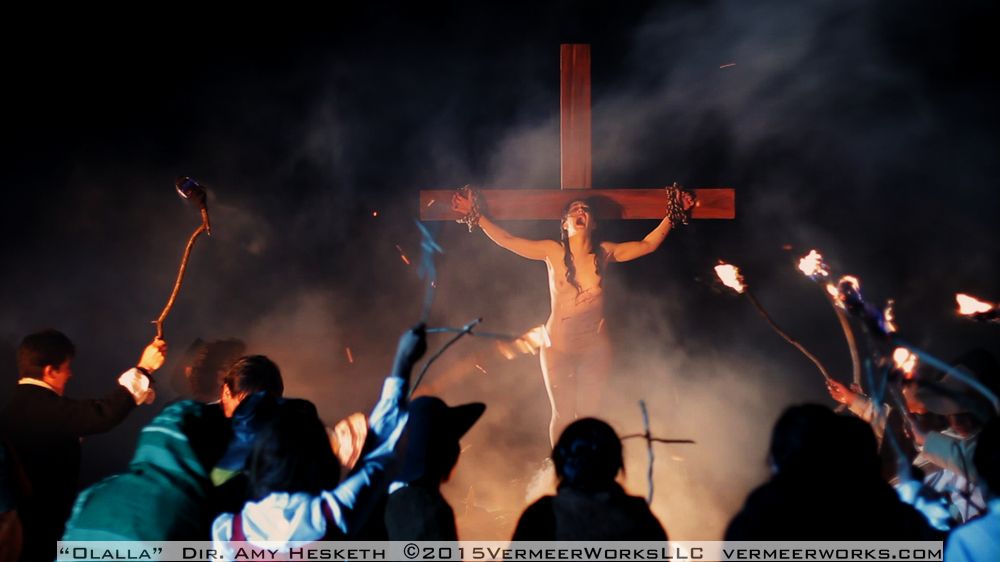
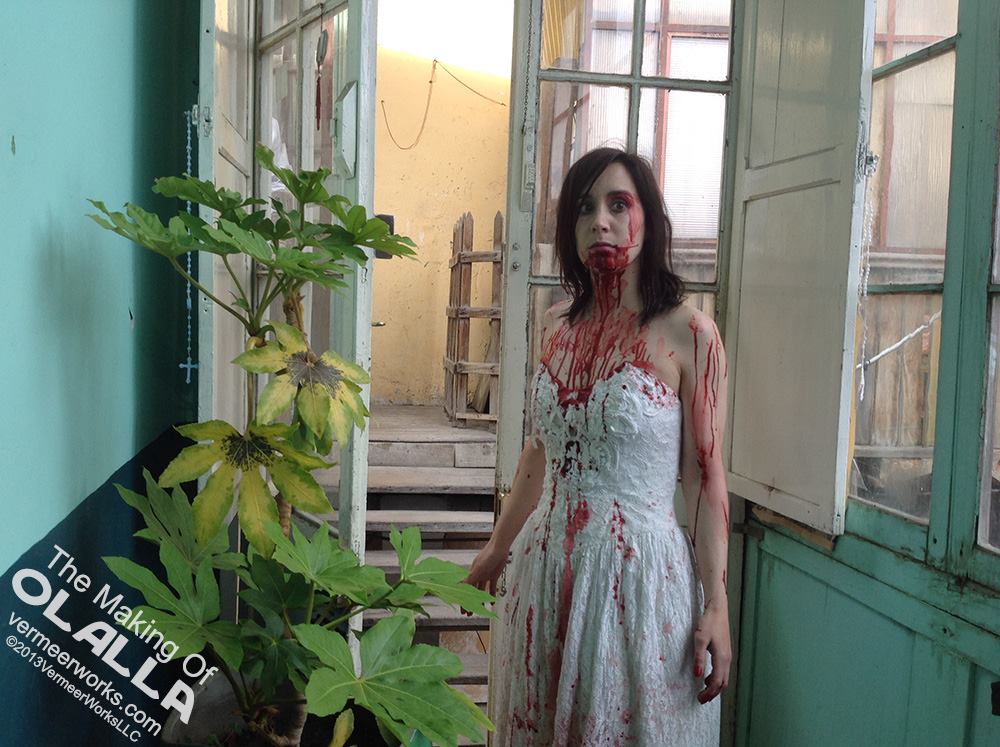
The villagers finally put her away with a crucifixion and burning, but not without a good flogging first. In the fashion of Biblical retribution, the mother suffers for the familial sins she has passed to her children—Ofelia’s incestuous desires and little Olalla’s blood thirst.

Is this final act a futile attempt at redemption?

OlallaVidCaps01185314

The extended scene is a reminder that as the Irish traveler in Dead But Dreaming and the tortured Mariana in Maleficarum, Amy Hesketh performs with a pathos and realism rarely found in cinema today. The Grand Guignol would be proud.

OlallaVidCaps01214921

The Final Real Monster

The cartoonist Walt Kelly’s Pogo once said, “We have met the enemy and he is us.” Amy Hesketh reminds her audience that the horrific vigilante murder of Olalla is the worst of human depravity: mob violence.

As the purifying fires of Christian mythology leap around Olalla, the vengeful expressions of the villagers become intermittent commentators on what they really are, a collective monster that far surpasses the degeneracy of Olalla’s family.

The flames of satisfaction intensify and the victim’s cries pierce the darkness. With the end moments away, the mob mentality suddenly recedes replaced by faces of regret and shame. Is the recognition of evil the final act of redemption?

OlallaVidCaps01291418

Oh yes, there is another monster in Olalla we cannot overlook: the demon of violent death neatly packaged by its flatterers: insanity, fear, amorality, hatred, and self-righteousness.

But it never comes without society’s approbation of the real monster that infects us, the ubiquitous “they,” the source of all evil that Uncle Felipe recognizes when he chastises Olalla.

It forever haunts our consciousness and feeds our imagination . . . along with The Grand Guignol and Pogo, of course.

*          *         *

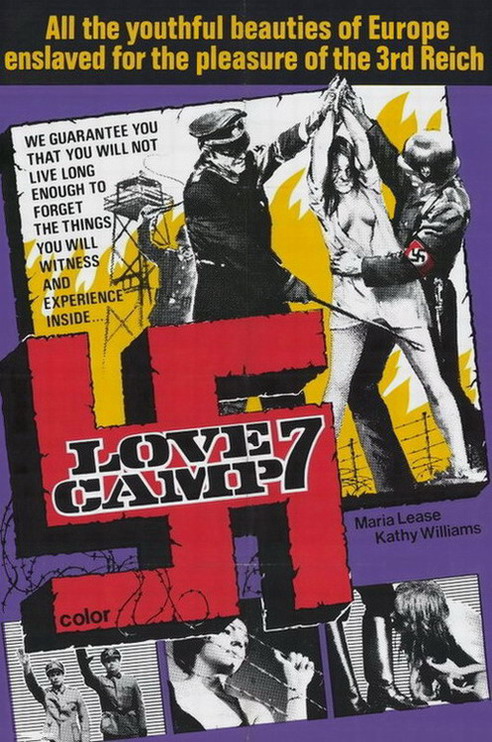
* In the decade before the birth of modern adult film, movies contained nude scenes in what we know today as softcore. Eventually, audiences wanted more but male/female penetration was off limits.

Love_Camp_7_1To spice up offerings, B-movie makers like David Freidman and Joseph Mawra resorted to rape, whippings, torture, and general mayhem to put the naked girl on the big screen.

These films became their own adult/horror sub-genre called roughies, kinkies, and ghoulies–largely realistic in settings that resided in society’s underbelly, such as the mad doctor’s house of pain, spy interrogation, female prisons, and human trafficking, commonly known as white slavery.

*          *          *

The next post explores some of Olalla’s cinematography.

Leave a comment

Filed under Uncategorized

Olalla, Part Three: Between Reality and Fantasy

by Rich Moreland, July 2016

In this post, we’ll consider the concept of time and how its dimension enriches Amy Hesketh’s take on Robert Louis Stevenson’s Olalla.

As scriptwriter and director, Amy floats her Olalla between centuries, stepping beyond the original Victorian version by incorporating time as a dominant motif.

*          *          *

1617763_10204333060700476_6941840773047380244_o

Olalla is marvelously complex. The casual observer who believes Amy Hesketh simply picks up the story where Robert Louis Stevenson left off is short-changing the film. She has integrated her modern tale with Stevenson’s in a cleverly scripted narrative.

More than a century separates Amy from the Victorian author, who also penned the macabre Dr Jekyll and Mr Hyde. That’s important because Olalla requires an understanding of time.

It can be a bit complicated, but here’s what I think is going on.

A Hundred Years

1392102_10152846713131840_9087870720375318202_nStevenson’s short story was published in 1885, but the narrative takes place in an earlier time period, the Iberian Peninsular War (1807-1814) in which the English fought the French.

Dropping hints that Olalla is a victim of her family’s past, Stevenson let’s it go without explanation. Amy picks up the thread by illustrating Olalla’s past with flashbacks set in the late Victorian Age.

As evidence of Amy’s approach, we have the period portrait over the living room hearth and the clothing of Olalla, Felipe, and the girls as a contrast to modern times. By the way, note its placement in the box cover shot above.

In other words, Amy uses Stevenson’s Victorian Era as her back story, moving the narrative forward by a century or more, depending on how we interpret her use of present time.

Here’s what I mean.

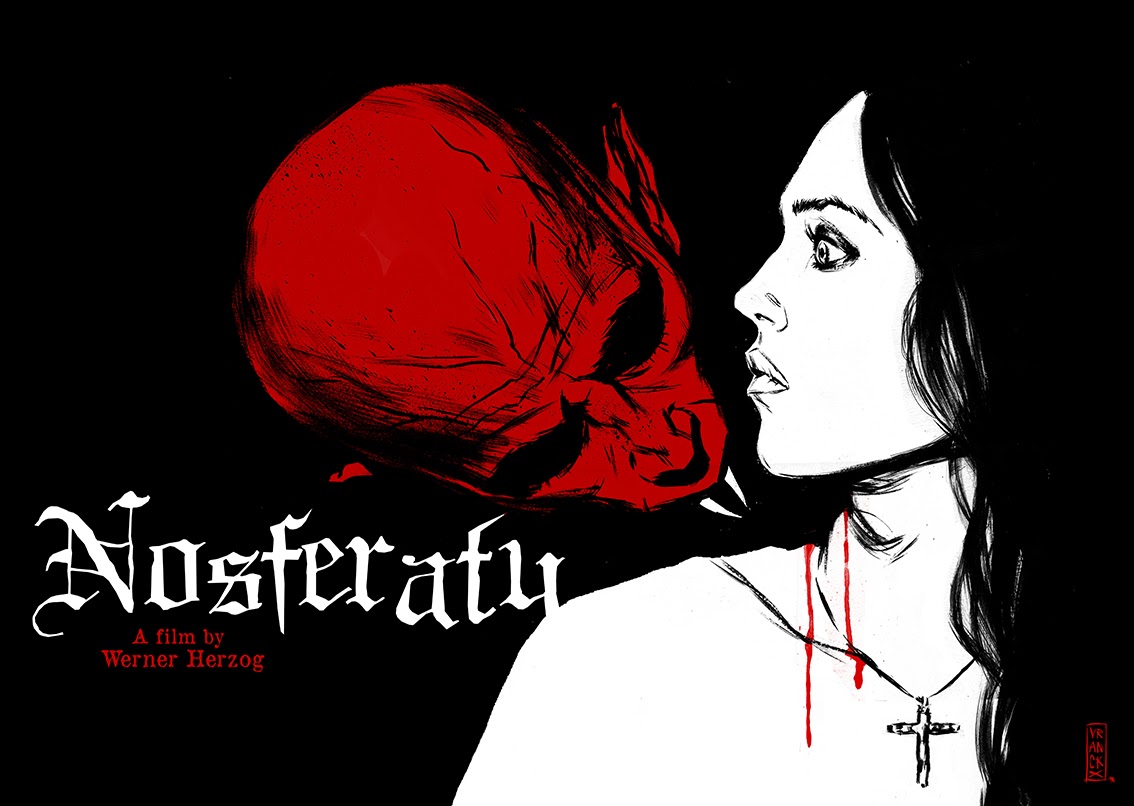
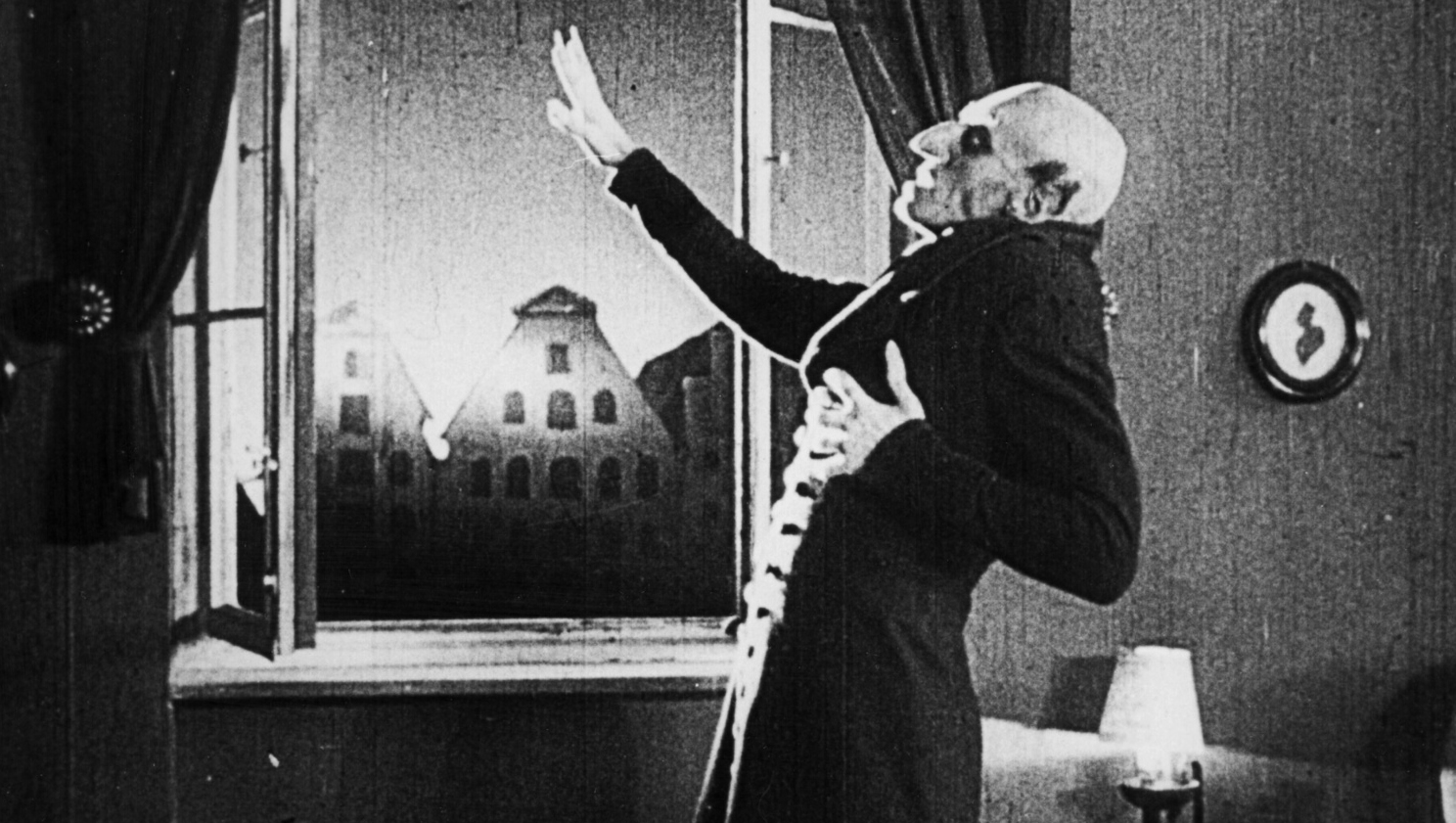
In the film’s opening scene we find the modern Olalla and her boyfriend in their apartment watching Nosferatu, the 1922 silent film widely recognized as the original vampire classic.

1540359_430180320444711_1610038729_o

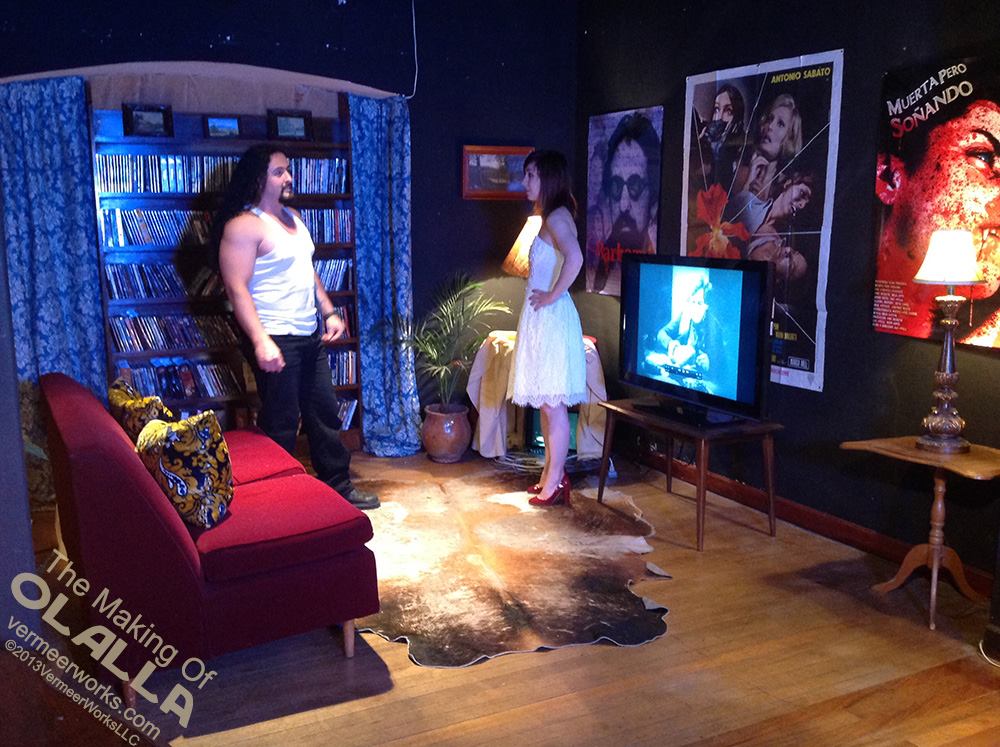
The TV is a flat screen with posters of other Pachamama films, Barbazul and Dead But Dreaming, on the wall above it. Okay, its product placement but everybody does it.

Here is where things get interesting. The boyfriend mentions that due to lost prints, a reconstruction of Nosferatu was shown at the Berlin Film Festival in 1985. In a nod to the original story, that is exactly a hundred years after Stevenson’s publication date.

NosferatuThere’s more. The boyfriend also remarks that Nosferatu is an example of German Expressionism, itself a lost form of film making. His comment lays the ground work for Amy to push beyond the Expressionist label. It’s a stroke of genius. Here’s why.

Dr. Mel Gordon in his book, Theater of Fear and Horror: The Grisly Spectacle of the Grand Guignol of Paris, asserts that the “unexpected brutalities and overall mad feeling of the German Expressionist film had less to do with Expressionism from the German stage than the influence of the Grand Guignol.”

This insight alone elevates Amy Hesketh’s production to levels akin to the horror films of Vincent Price and Christopher Lee because she uses the realism of the Grand Guignol without over indulging the fantasy aspect of the story.

10974405_631394760323265_266034218482356724_o

Simply put, when it comes to fantasy, Amy Hesketh is more interested in the lessons of the Parisian horror stage. Naturalism compliments fantasy rather than the supernatural directing it. For that reason, we have the crucifixion at the end. It’s the real deal, no vampire imaginations needed.

By the way, though the vampire’s name in Nosferatu was changed to Count Orlok, as the boyfriend notes, Bram Stoker’s estate sued over the unauthorized use of the Dracula novel. Nosferatu’s prints were ordered to be burned; fortunately, some survived.

The First Rule

Amy’s screenplay employs everyday items to illustrate the atrophy of Olalla’s modern family. For example, there is an old rotary phone in the apartment Olalla uses when she reports her dastardly deed to her sister, Ofelia.

Olalla must make that phone call.

Olalla must make that phone call.

A cursory review of Olalla’s family hacienda furnishings shows us an antique radio in Ofelia’s room, and kitchen appliances–a coffee pot, tea kettle, and meat grinders–that recall an earlier time. Later, the party music comes by way of vinyl and a turntable.

This is not to suggest that these things are not still in use today, it is merely to point out their importance in understanding the story.

In other words, is the family living in a past (exactly when is not clear) that connects them within a century of Stevenson?  If so, Amy Hesketh is putting the Olalla puzzle together within the bounds of its major motif and re-establishing the first rule of good vampire tales, they cut across time. . . everyone lives simultaneously in the past and present with no vision of the future.

Keep this in mind because Amy’s handling of that part of the story is brilliant, as we will see.

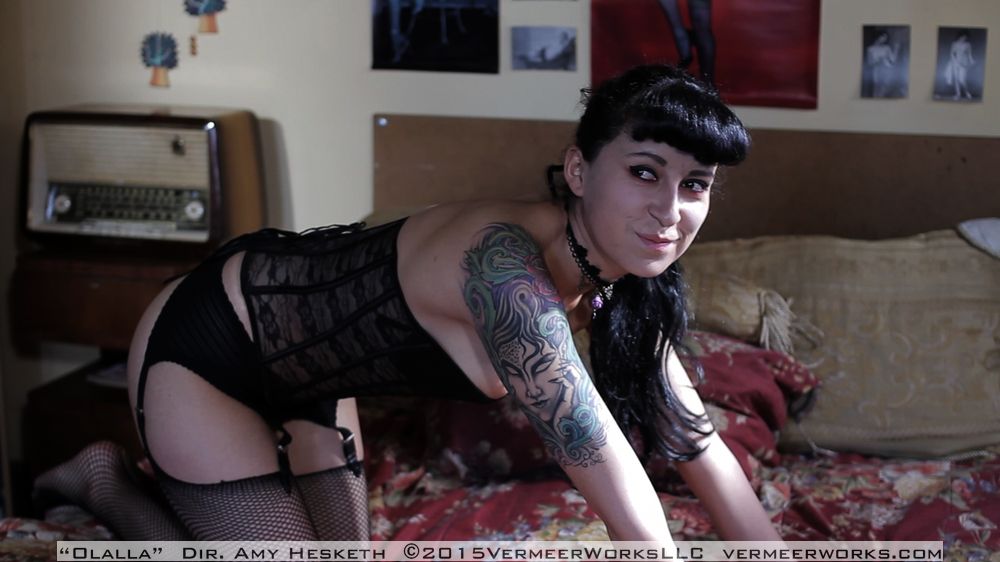
Ofelia’s fetish sexuality resides in Bettie Page, whose posters she has in her room. Also, her bangs are all Bettie and she sports the dominatrix-like corset and garters the pioneering bondage model popularized. Of course, these BDSM accoutrements are favored today, but in this case it lets us know that Ofelia’s self-image is 1950s/1960s oriented, another variance within of the time motif.

For further proof of that aspect of the film, check out Bruno’s outfit. He is a fugitive of the Disco Era where clothing alters identities and fetish, queer, and camp all met at the same crossroads under the glittering mirror balls. Think 1970s/1980s.

Ready to shoot, radio in place with Bettie posters on the wall.

Ready to shoot, radio in place with Bettie Page posters on the wall.

Also, notice that the tatted Ofelia is an occultist who plays with Tarot cards and has sex with her uncle. The occultism/mysticism theme played well in the Grand Guignol whose history (1897-1962) is within Ofelia’s personal time fetish.

Seven

The family is in trouble. It is dying of old age and needs re-energizing which accounts for the arrival of Uncle Felipe and Bruno. Incidentally, if aging is an issue, then they’re not vampires in the traditional sense. Maybe it’s really only Olalla?

Like the Victorian writers, Amy is leaving some of this up to us.

On the practical side, Felipe is the judge and enforcer (there is a gavel on the wall over his shoulder in one scene). His purpose is to discipline the two young women, because without them, the family line comes to an end.

Holding the riding crop, Ofelia awaits Uncle Felipe who will use it where needed.

Holding the riding crop, Ofelia awaits Uncle Felipe who will use it where needed.

In the meantime, the slothful aunt raises the ante when she tells Ofelia she must help her little sister or the childbearing “responsibility will fall on you.”

mila and auntEveryone feels the pressure. Bruno comments that he and Olalla came to visit from the north (does he mean like the helpful Witch of the North who guides Dorothy to see the Wizard of Oz for a ticket home?). He bakes goodies for everyone’s sweet tooth and stores the blood bags in the fridge, all to keep the family in functioning mode.

However, Bruno is gay and everyone else is ancient in childbearing terms.

That leaves Ofelia, whose bondage fetish reduces sex to playtime, and the wayward Olalla as the only reproduction options. It’s not a pretty picture.

OlallaVidCaps00344406

Notice there are seven family members, the archetypal number of completion found in myth and legend. Obviously, the recalcitrant Olalla must remain within the fold, so controlling her is number one on the family bucket list.

The Hallway

10533207_523083637821045_1176408918808312946_nThe film’s physical metaphor for time is the hallway in the family’s house. It is long and narrow with a bank of grimy windows on one side that over looks a deteriorating neighborhood.

Opposite is a dreary greenish wall lined with a myriad of plants positioned to strain for the sun which struggles to shine in.

The pottings are the family’s generations, once of “princely stock,” Stevenson says, but now “degenerate,” and, Amy shows us, totally immovable and dependent.

In the original story, Stevenson’s English soldier travels a road that “began to go down into the narrow and naked chasm of a torrent” (a stream) and later the reader learns that the family home was “hemmed” in by mountains. This visual imagery is repeated with the tightly packed buildings outside the hallway windows in modern times.

Amy maintains the same image in a flashback segment in the film. Roberto walks with Olalla and her daughters down a narrow pathway that is flanked by buildings on one side in an outdoor version of the hallway.

10947380_10153192265316840_1530069030042331362_o

Earlier when we first encounter the corridor, Olalla approaches the camera from afar. The shot is elevated to emphasize the distance across time she travels from her childhood that is inexplicably a century earlier.

Using the hallway we can orient ourselves to interpret the story. By facing the windows with our back to the wall, a look to the left gives us the past, to the right, the present.

Olalla comes from the past bearing her sins

The door to the past is open and waiting for its daughter of blood

The characters move back and forth along its distance, but never leave because there is no future. Confined by a physical narrowness that robs them of all options, they are in limbo, essentially a suspended time warp that imprisons their depravity and dissolution.

Think of it this way by borrowing from Bram Stoker: wherever they go the family members must return to their soil. The hallway is their version of Dracula’s coffin. It, too, has no future.

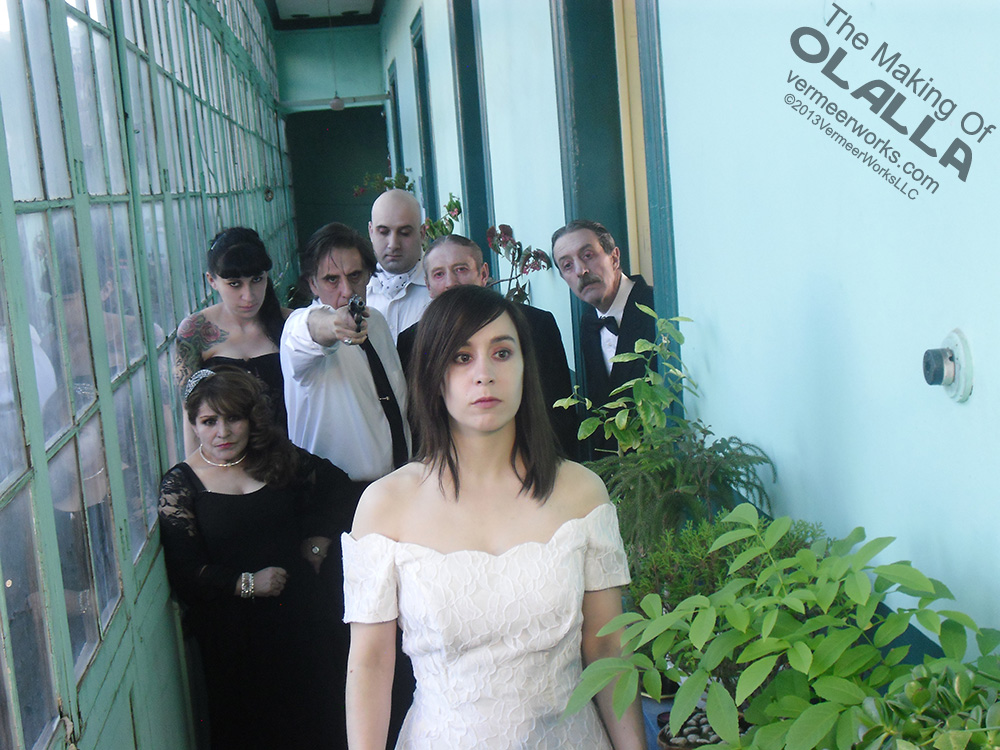
In the end after Olalla reveals she has tricked the family, she leaves the party and turns left into the hallway. She’s going back to her personal past, in this case her nasty biting habits. The family follows her and pauses, uncertain what to do. Felipe points the pistol (that did not serve its intended purpose during the party) at Olalla. A single shot to the back of the head will do the trick.

10368803_10203961950342949_5551590370514953116_o

But the family, like Olalla, is left suspended between reality and fantasy, the present and the past, unable to act in any meaningful way.

Told you Amy Hesketh is brilliant . . .

*          *          *

In the fourth installment of this analysis, we’ll investigate what it means to be a monster.


Leave a comment

Filed under Uncategorized

Olalla, Part Two: Depraved Miscreants

by Rich Moreland, July 2016

Olalla is billed as a vampire film, but how do we define vampire in the context it presents? Let’s take a look.

All photos are compliments of Amy Hesketh and Vermeerworks.

*          *          *

Credit to the Troupe

Robert Louis Stevenson’s original “Olalla” hints at vampirism without any real overt evidence. Keeping this in mind, Amy Hesketh borrows just the right amount from the Victorian short story to expand the narrative without misplacing its thread.

ah4

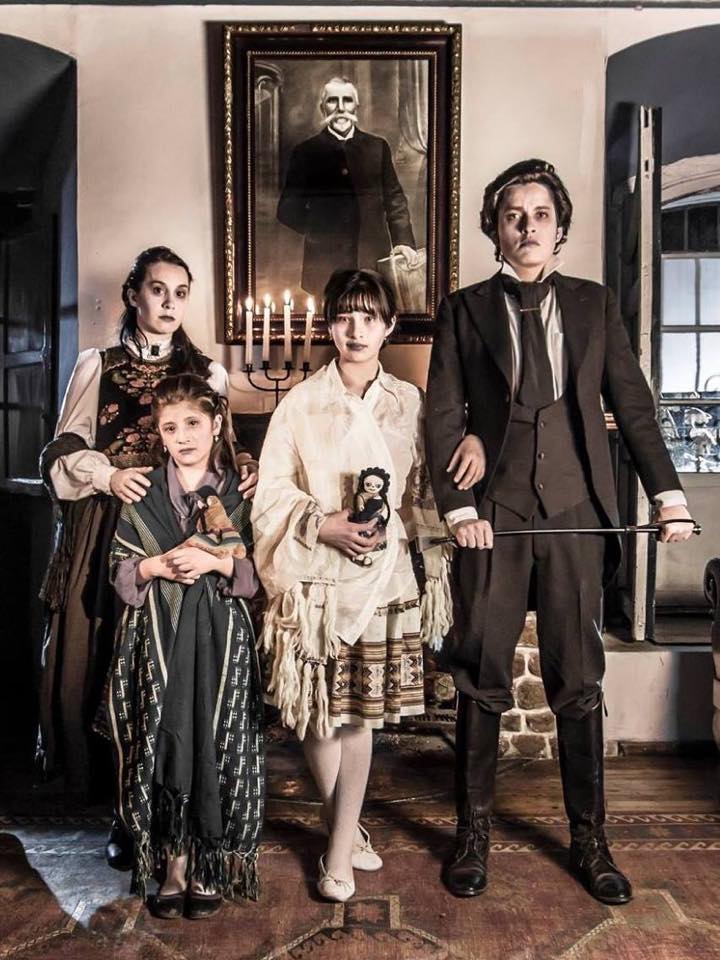
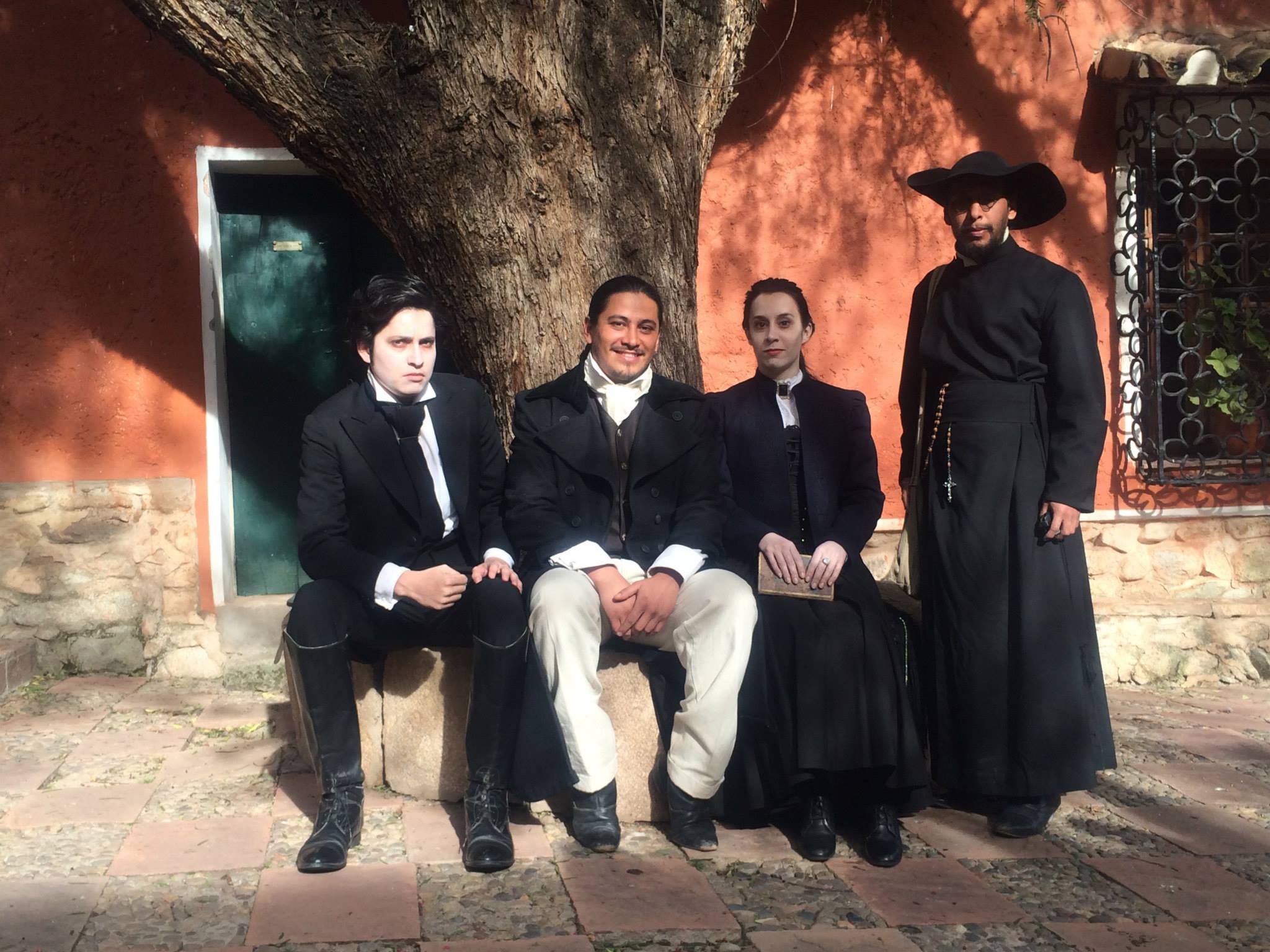
In place of the English officer, she puts a traveler named Roberto (Cristian Del Rio) in the 1800s sequences. Nathan, the family’s guest when the narrative shifts to the present day, is a wartime photojournalist played by Luis Almanza.

Felipe is a dual figure: the younger version is played by Alejandro Loayza A and the older by Jac Avila who is superb as the family’s enforcer.

Alejandro Loayza A, Cristian Del Rio, Amy Hesketh, Rhobess Pierre

Alejandro Loayza A, Cristian Del Rio, Amy Hesketh, Rhobess Pierre

Lastly, the padre (Rhobess Pierre) serves the same function in both versions of the story.

Other characters are added. There is Olalla’s sister, Ofelia (Mila Joya), the aunt (Maria Esther Arteaga), the “twin” uncles (Beto Lopez L and Fermin Nunez), and the young Olalla and Ofelia (played by sisters Valeria and Rosario Huanca)

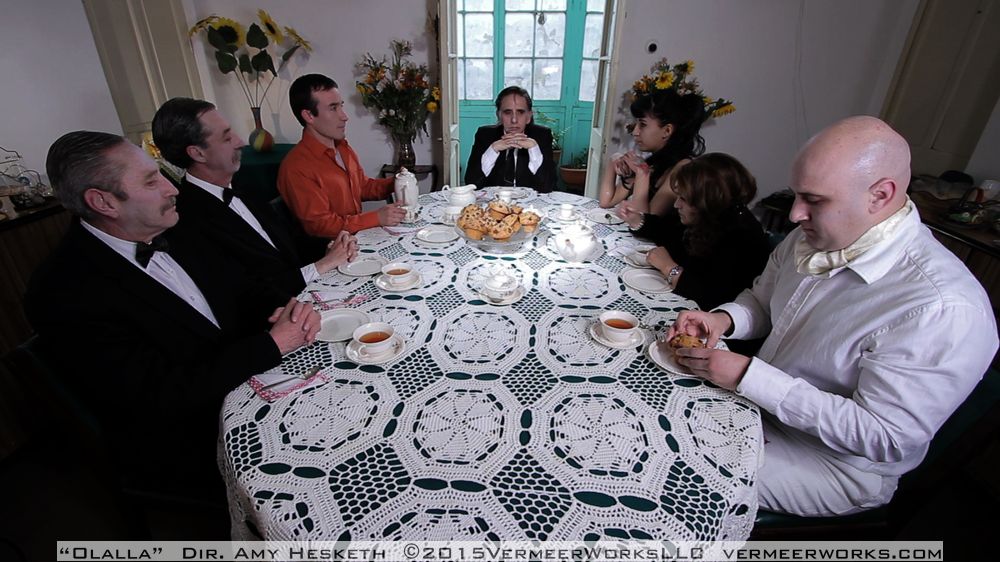
Finally, Erix Antoine is terrific as Bruno, the family member who tries his best to keep the house and everyone around him on the edge of normal. Pay close attention to the “muffin verses sweet cake” debate between Bruno and the uncles. The humorous innuendoes are priceless!

The family enjoys their sweets. (L to R) the uncles, Nathan, Uncle Felipe, Ofelia, the aunt, Bruno.

The family enjoys their sweets. (L to R) the uncles, Nathan, Uncle Felipe, Ofelia, the aunt, Bruno.

Of course, Olalla as mother replaces Stevenson’s character in the filmed version and has daughters who appear as youngsters. They grow up to be the modern Ofelia and Olalla when the narrative moves to the present time.

10942315_10205021517911476_4009634890043350938_o

The film expands on the family as a pack of depraved miscreants. In his story, Stevenson informs the reader that the mother sits in the sun against a pillar and other than brushing her hair, hasn’t “the least spark of energy.” Amy Hesketh’s take on the household presents an indolent aunt and uncles who are robotic without purpose, moving in unison with nowhere to go.

The updated Olalla does change one important element. In a nod to Stevenson’s tale, the mother indeed bites Roberto’s hand, but the impulsive act inflames the villagers and ushers in her death, as we will see.

The Vampire Question

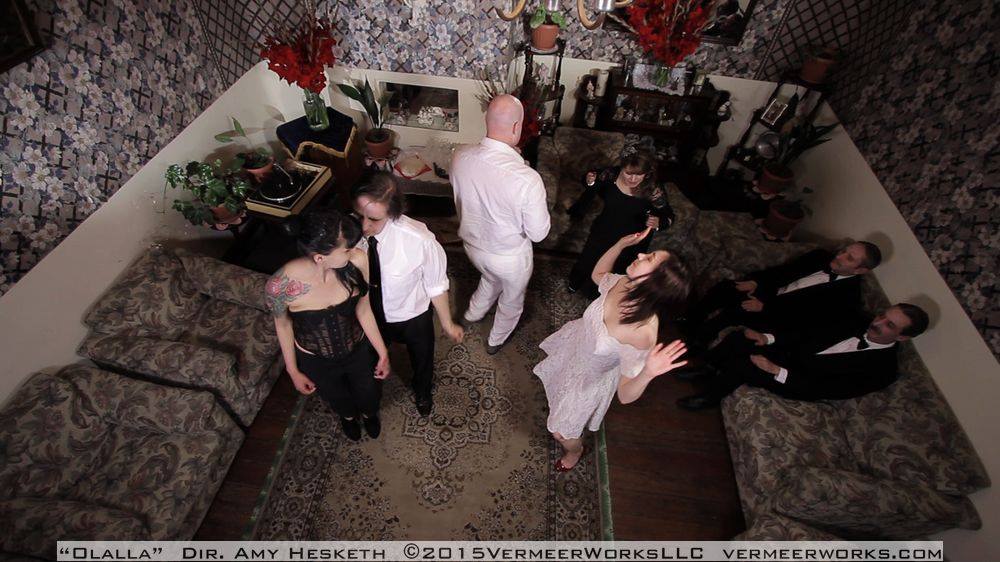
As suggested in the first part of this analysis, the family members are not vampires in the popular sense, but they aren’t vampire-free either. It’s an in-between identity the padre defines as a collection of “strange customs.” Even their dancing at the party is zombie-like, stilted and ludicrous to the point of hilarity.

Party scene with a high angle shot.

Party scene with a high angle shot.

The family cannot determine their destiny because they are as refrigerated as the bags of blood that await their cocktail hour. They’re in a time warp that repeats itself just as the uncles are aimless and without purpose. How else could two little girls grow into young women and take a century to do it?

1505228_10151835599527882_1712782730_nOn the other hand, what of Olalla? Does she have a blood fetish, what might be considered clinical vampirism, or is she a killer whose sins her mother paid for in a sadomasochistic show compliments of the Grand Guignol?

According to Psychology Today (November 2012), the German physician Richard von Krafft-Ebing established over a century ago the connection between blood and sexuality. He cites a case in which a man allowed his wife to suck the blood from his arm before they had sex. It aroused her apparently.

Of note is that Krafft-Ebing reached this conclusion in the mid-1880s. Perhaps this is the source of Stevenson story, an account of compulsion, erotic energy, and the fear of monsters. If so, the film version of Olalla has its artistic place in literature while exploring human perversion as applicable to the social sciences.

Modern Vampires are Sexier

One more point is significant. If we assume Olalla is a vampire, she hovers between the Nosferatu genre of German Expressionism and Dracula.

Like “Nosferatu” (The Bird of Death), she bites, but her victims simply die and do not become vampires themselves. This is a departure from the Stoker model that Jac Avila uses in Dead But Dreaming.

On the other hand, Nosferatu’s  “Count Orlok” is linked to Dracula in one respect. nosferatu (1)He vanishes forever when caught in toxic sun light, whereas Dracula is only repelled by it. In either case, it’s a phenomenon that has no effect on Olalla.

So where does this leave us? Ofelia summarizes the film’s dilemma when she says to Bruno, “Olalla is a danger to all of us.”

Does this mean she is the only real vampire in the family? Or, is the brood afraid her habits will lead to the pitchfork crowd as happened with her mother?

One thing becomes painfully apparent as the film progresses. Olalla commits murder and will do it again.

Later when Ofelia interrupts her sister and Nathan watching Nosfertu, she furthers the vampire question with, “Modern vampires are sexier, don’t you think, Olalla?”

Nathan, Olalla, and Ofelia talk about vampires

Nathan, Olalla, and Ofelia talk about vampires

Nathan interjects that he and Olalla like the old version of the undead, whereupon Ofelia declares that those vampires always die “because they’re monsters who can’t control themselves.”

It’s a well-placed jab at her deviant sister.

There we have it. Olalla is like her family, caught in an in-between contradictory state (an “undead” purgatory, perhaps?) that is of the spirits and intangible and centers on evil rather than peace. And, in the end, we really don’t know if they are leftover Stoker sycophants, Count Orlok parasites struggling to survive, or simply blood freaks who are more than a little weird.

Or, perhaps they are a clan of murderers who will symbolically crucify Olalla on her bed to protect themselves . . .

OlaSc19_21_00012216

And that is exactly what links Amy Hesketh’s film to the classic enigma of Victorian literature and establishes its credentials for scholarly study.

Producers Amy Hesketh and Jac Avila

Amy Hesketh and Jac Avila are also Olalla’s producers.


*          *          *

By the way, my interpretation of this film is just one point of view. Everyone should check it out for themselves and reach their own conclusions.

In the next post, we’ll examine time as a motif in this film.

https://www.youtube.com/watch?v=tr4hIzWvgPs

Leave a comment

Filed under Uncategorized

Olalla, Part One: A Half-Lingering Terror

by Rich Moreland, July 2016

Olalla is an erotic horror film from Pachamama Films and Decadent Cinema. The movie is written and directed by Amy Hesketh. The dialogue is a combination Spanish and English and comes with the option of closed captioning.

Based on Robert Louis Stevenson’s short story by the same name,  Amy’s adaptation weaves Stevenson’s tale into a visual narrative so compelling that I believe it is worthy of academic study.

Though I don’t use a rating system for my reviews, I highly recommend Olalla.  The film is available from Vermeerworks and Amazon.

In this first post, we look at Olalla from a back story perspective.

*          *          *

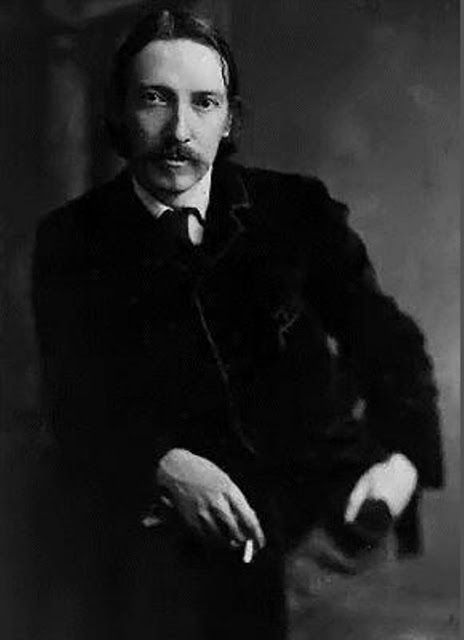
1991712-gfRobert Louis Stevenson published “Olalla” as a short story in 1885. It’s the first person account of an unnamed English officer wounded in war, most likely Napoleon’s 1807-1814 Peninsular Campaign in Spain. The soldier recuperates at a “residencia” belonging to a once noble family.

Remnants

When he arrives, the officer learns the remnants of the family consist of a mother who is “sunk in sloth and pleasure,” a “very cunning, very loutish” son named Felipe, and a daughter, Olalla, whose presence is felt but not seen.

Upon first encountering Felipe, the soldier finds him to be “a child in intellect [and] stunted in development.” He also describes him as secretive, perhaps being more than he seems. All the while, the daughter remains a mystery.

During his stay, the Englishman notices a portrait of a woman in his bedroom. She appears, by way of her antiquated dress, to be “long since dead.” Nevertheless, she is striking in an ominous way, causing the soldier to remark that “to love such a woman were to seal one’s own sentence of degeneration.”

As time passes, the portrait begins to “cast a dark shadow” on him. He is thankful the woman is “safe in the grave,” then comments, “And yet I had a half-lingering terror that she might not be dead after all, but re-risen in the body of some descendant.”

Reacting to his uneasy feelings, the officer concludes the ‘family blood’ seemed to be “impoverished,” probably from inbreeding, and accounted for the strangeness of Felipe and his mother.

How they are connected to the portrait remains vague, but the soldier’s lengthening stay at the residencia reinforces his growing anxieties.

Bestial Cries

The Englishman eventually meets Olalla and they develop a rudimentary friendship.

The story’s turning point occurs when the soldier cuts his hand opening a casement window. Seeking help he approaches the mother only to have her fall upon him and bite his hand “to the bone.” He fights her off but she pounces again “with bestial cries” similar to those that had previously awakened him in the night. Felipe and Olalla appear and rescue him.

With the Felipe’s assistance, the soldier departs the home to find shelter in a local village. While there, he engages the old padre and asks about Olalla and her family. Not a good idea, apparently, because the village atmosphere becomes toxic for the Englishman. The residents avoid his presence which he attributes to their superstitions. Eventually, he strikes up a conversation with a “gaunt peasant” and learns that a villager died at that “house of Satan” where the family lives, though how and why is unknown. The soldier dismisses the story as more superstition.

Robert Louis Stevenson

Robert Louis Stevenson

The officer and Olalla meet a final time on a pathway that has a crucifix at its summit. Olalla has stopped to pray.

She thought he had gone, she says, and urges him to do so because the longer he stays the closer death stalks him and her family. Olalla knows the locals are aware of his love for her and that is dangerous.

When her prayers are finished, Olalla implores the Englishman to look up at the “Man of Sorrows.” She mentions the “inheritors of sin” and how everyone must endure a past “which is not ours.”

Though he is no Christian, the soldier is struck by her message. All sacrifice is “voluntary,” he laments, and “pain is the choice of the magnanimous,” so it’s “best to suffer all things and do well.”

Moving on, the Englishman heads “down the mountain in silence.” He turns to look back and sees Olalla “still leaning on the crucifix.”

Is this a Vampire Tale?

Victorians loved enigmatic storytelling because it protected sensibilities and forced uncertainty upon the reader. For example, there’s Henry James’ The Turn of the Screw. Is it a ghost story about possessed children or just the fertile imagination of a young governess who is a psychological wreck?

On the other hand, when Bram Stoker’s Dracula is published about the same time as James’ work (1897-98) subtleties are put aside. The vague becomes obvious.

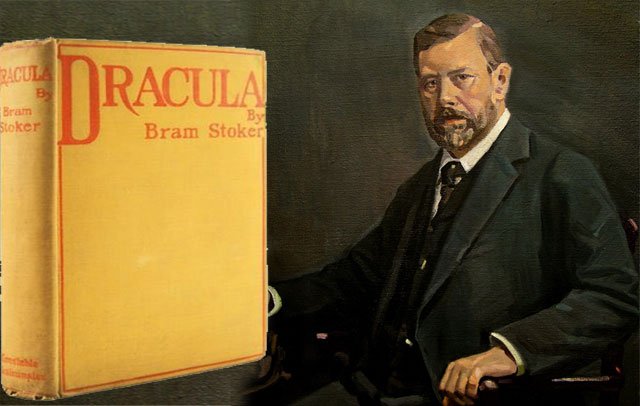
Bram-Stoker-3

We know Dracula’s bites are metaphors for the erotic and necessary to accommodate Victorian temperament, but the rest is pretty straightforward, a fantasy complete with fangs, a sun phobia, no reflections in mirrors, and on and on.

Hollywood has made a fortune on the Stoker model.

With Stevenson’s “Olalla,” we are left with a burning question? Is this a vampire tale or just a story about a deviant family of blood fetishists mixed with religious overtones and village superstition? Challenging, of course, because none of the standard Stoker’s mechanisms are in place and rightly so since Stevenson’s narrative predates Stoker by over a decade.

My inclination is go with the fetish explanation because everybody’s got one of some sort or another. But, of course, that won’t keep you up all night ready to cringe at the least gust of cold wind or that strange creature crawling up the wall of your bedroom.

The Grand-Guignolth

As for Amy Hesketh’s adaptation of Stevenson’s Victorian imagination, well, it’s pure Amy which means it’s innovative and terrific.

One more thought, I’m guessing Amy is a fan of Paris’ Theater of Horror, the Grand-Guignol (1897-1962), where amorality, brutality, sex, and insanity crept onto the French stage with just the right infusion of gore.  No supernatural here, it’s all realism at work.

As Amy Hesketh fans know well, she relishes whippings, crucifixions, rack torture, and burnings too much to rely exclusively on the supernatural as her literary modus operandi. Realism is her performance art and what stands her tall in the crowd of horror directors and storytellers.

*          *          *

Having introduced Robert Louis Stevenson, we’re now ready for the next post on this marvelous film. We’ll take a look at the vampire question a little further.

1 Comment

Filed under Uncategorized

Dead But Dreaming, Part 4: Horror or History?

by Rich Moreland, May 2016

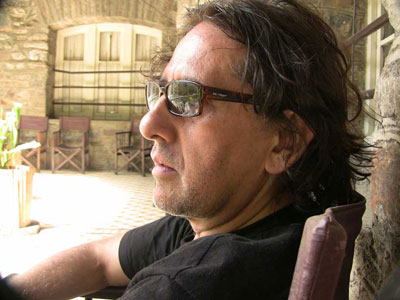
jacIn reviewing Dead But Dreaming, I have taken a limited perspective. The film, however, is rich with unexplored layers of meaning that beg for further interpretation. That’s the true measure of art and a salute to director Jac Avila’s innovative work.

*          *          *

Crucifixion and Confrontation

Dead But Dreaming is a film of contrasts and parallels in a narrative driven by the ordeals of Aphrodisia and Moire.

They come from distant lands but their appearances are quite different. Moire’s fair complexion and reddish blonde hair is a counterpoint to Aphrodisia’s fiery exotic look framed by her black hair and paradoxically sad eyes.

As we’ve seen, both are sexually assaulted while bound. Aphrodisia responds with anger; whereas, a stoic Moire endures her trauma.

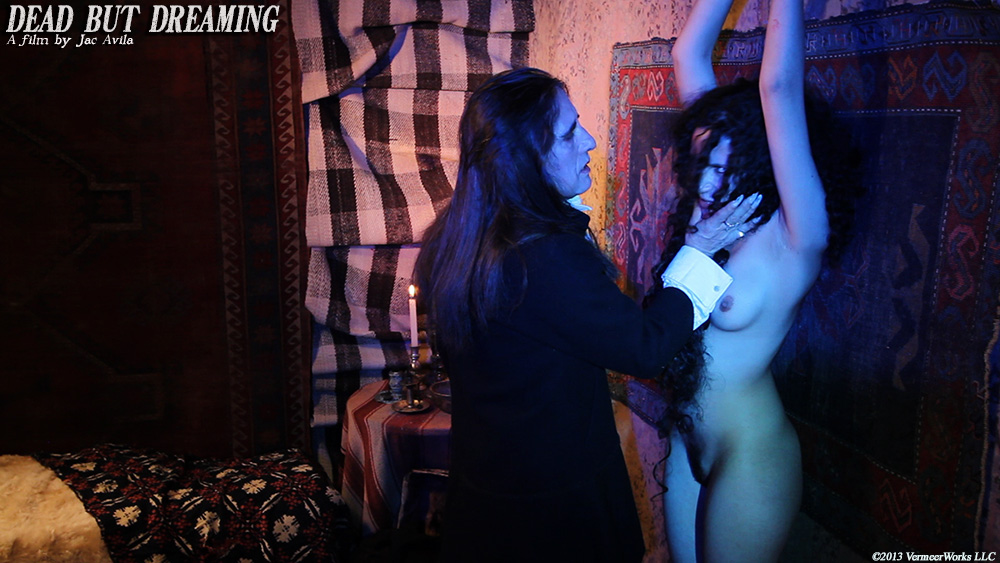
DBD00365718

On the other hand, both victims are visually eroticized when they are punished. Their differences lie in their humiliation, Moire’s being public, Aphrodisia’s the fate of a slave.

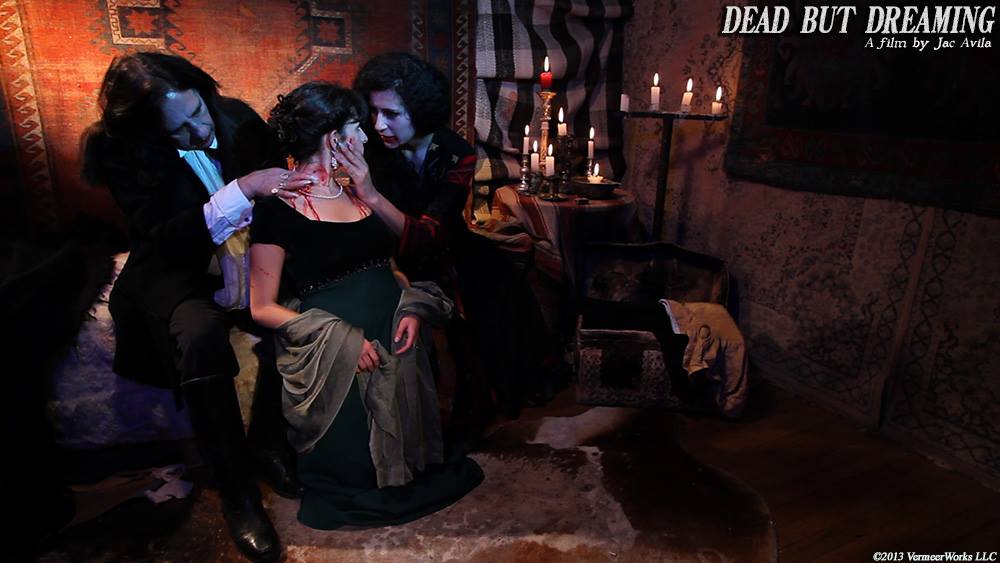
The story’s three crucifixions are also contrasting. Aphrodisia suffers a slave’s death on a cross; Moire is the victim of political persecution while Nahara faces an interrogation with a religious overtone (notice the wound in her side inflicted by a wooden crucifix).  Does vampirism feed off Christian mythology and is that what frightens the priest Ferenc so much?

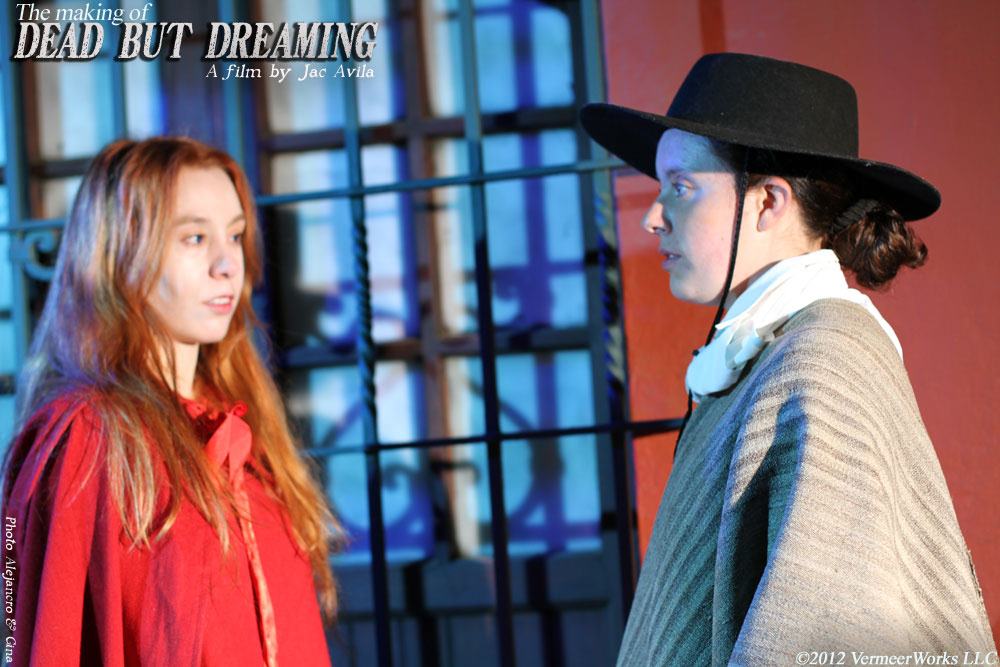
DBDMakingOf9903

Though Moire is resigned to her fate, Aphrodisia and Nahara are angry. Nahara pulls at the chains securing her to a box-like metal frame in an underground cavern compliments of Ferenc’s mission to stamp out evil.

Speaking of the priest, he and Nahara trade confrontational stares throughout the film in a reminder of Dr. Van Helsing’s pursuit of Dracula in the Bram Stoker novel. In effect, they are mythological parallels in contrasting poses.

Who is Varna?

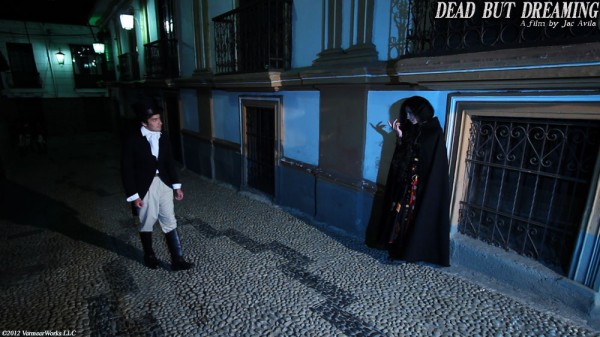
Varna, dressed in civilian clothes, meets Moire on the street with a less than astonished,  “You’re dead.” Moire’s now eternal state does not appear to surprise the former nun-in-training because she can no longer dismiss the supernatural.

463647_323430181049026_2101279728_o

Moire is concerned for Varna.

When I was dead but dreaming, Moire says, “I heard you,” referring to Varna’s promise to carry on her mission, and “I don’t want you to take my place.”

 Varna is warned. Stay out of the revolution because the whipping post awaits, and seek the church as a shield from Nahara, who has a talent for turning those who pray into prey.

DBD01235910-600x337

Wasted words because Varna is the independent woman celebrated by feminism. She makes her own decisions but will be forever hounded just as feminists have always suffered society’s condemnation.

As the film winds down, Varna  is seduced by Aphrodisia and ends up in the lair where earlier the vampires feasted on a local woman.

dead 8 in the lair

Rather than taste Varna’s virginity, Asa releases her in a nod to the next installment of Dead But Dreaming.

“She will lead us to Nahara,” he says to Aphrodisia.
dead 17

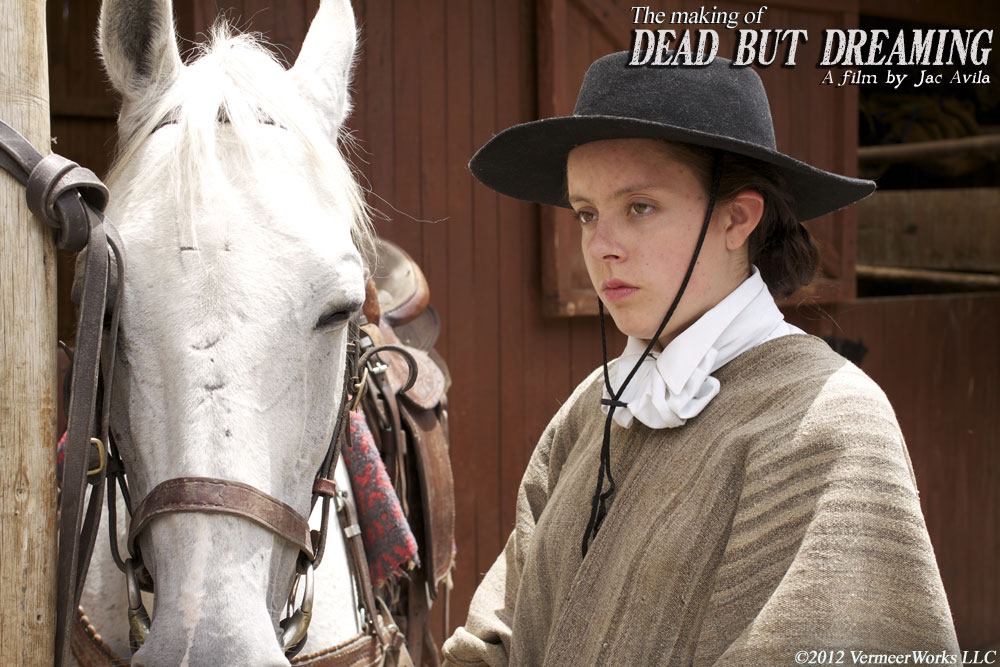
Unexpectedly, Varna shows up at the stable and wants to join Moire, who was anticipating Nahara’s arrival. The viewer learns that the Lamia was killed by Ferenc. But she cannot die, Moire says matter-of-factly, and we know what that means . . .

As they ride away, the Irish traveler warns Varna, “She will find us someday.” It’s a cat and mouse game playing out in vampire land.

So who is Varna?

 Throughout the film, this novice nun cannot look away, cannot confine herself to the safety of her cultural box because she sees perspectives beyond her own personal vision. She is the observer.

Simply put, Varna is us.

Budgets

Finally, Dead has endearing touches that make the film a pleasure.

Director Jac Avila cautions us to not go too far in willfully suspending our disbelief. Granted we are dealing with an indie film that suffers expected budgetary constraints that limit retakes. The upside of that inadvertently breaks the theatrical “fourth wall” by letting the viewer in on the game.

Here are a few really cool examples.

Though the sacrificial virgin in beginning (10,000 years ago) keeps her mouth closed, her metal braces are still visible. A close-up Moire’s feet at the whipping post reveals her pedicure. And in a vampire attack on a La Paz street, Aphrodisia loses one of her fake nails.

I love this stuff because nobody can waste a dollar in the indie business. If anything, it’s an artistic challenge Hollywood cannot appreciate.

Blue

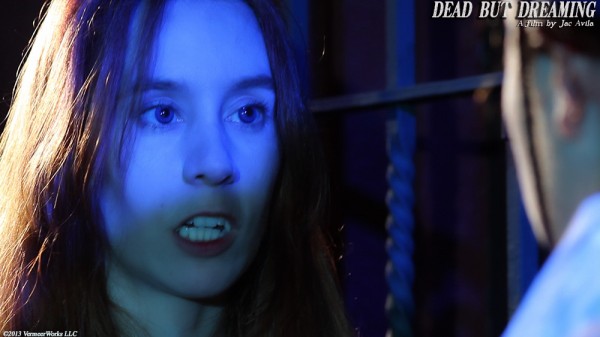
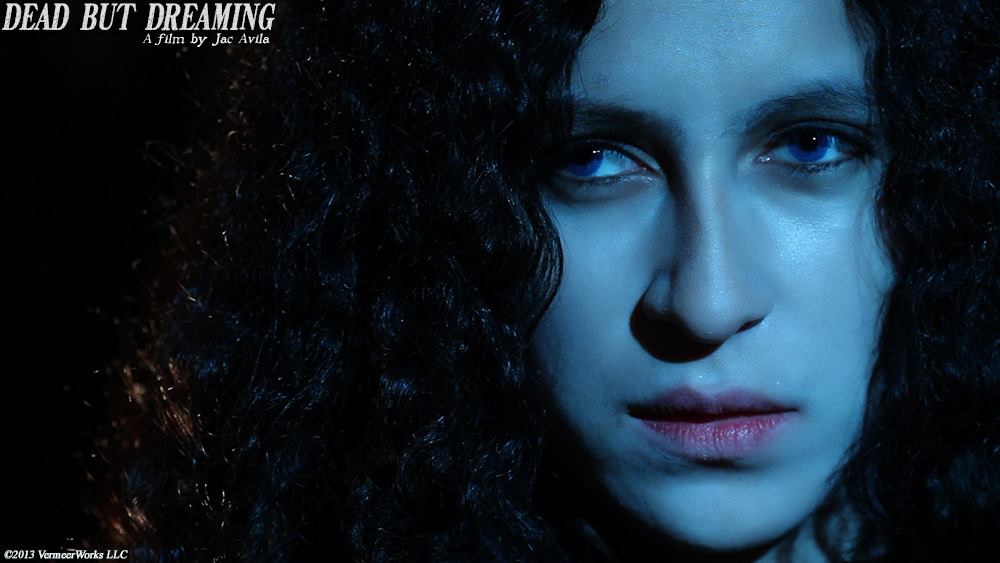
I’m left with only one question. Why do the vampires have blue eyes?

dead 9 blue eyes

Is blue a dreaming state because it is peaceful? Or, is “vampire blue” sad and depressing?

I’ve got a theory. In the Bram Stoker tradition, vampires are condemned to come out at night and, of course, can never again inhale the light of day. So the undead must carry the blue sky in their eyes as a cruel joke; their dilated black pupils push aside the ever present, but forbidden, daytime to see at night.

Another take on the color suggests the “eternal light” of Church doctrine must always be vigilant. Hence the blue crucifix hanging on the church wall and the street scenes shot in a blue hue.

Vampire blue ready to feast

That First Bloody Bite

In closing, my congratulations to the entire production team of Dead. The cinematography is impressive and captures costumes and settings that are authentic representations of La Paz in 1805.

Dead’s pace is lively and the intercutting supremely done to bring the story together. Only once did I think the movie strained itself. The extended scene between Demetrius and Chrysis in Antioch tended to drag with a somewhat flat dialogue delivery. But in the overall scheme of things, that’s minor.

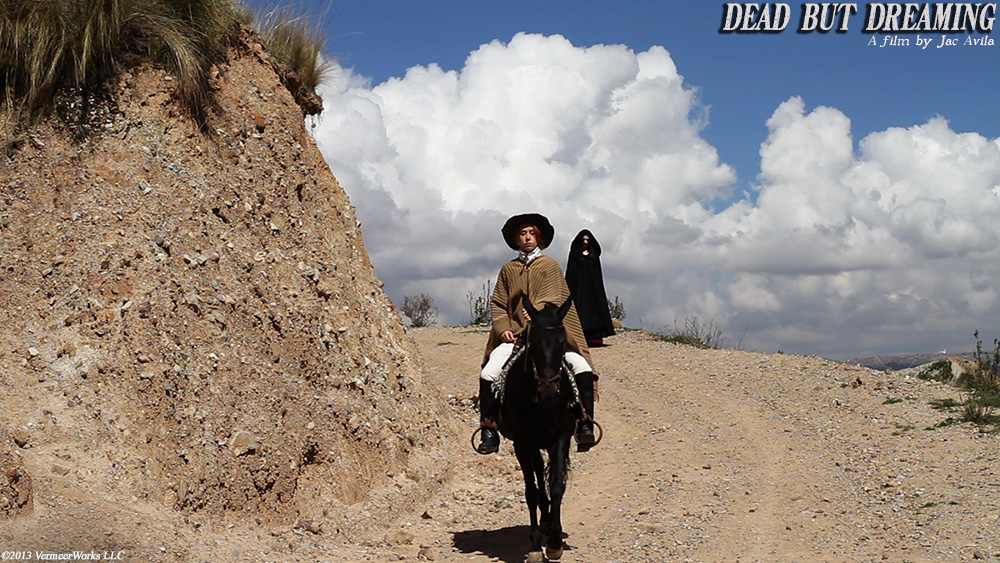
The Irish traveler descends the path with Nahara not far behind

The Irish traveler descends the path with Nahara not far behind

Incidentally, the opening credits offer a clever  indication that this film has a tale to tell. The motif is about travelers who are descending into something we do not yet know. Moire rides her horse down a path and is followed by the mysterious Nahara. When the scene shifts to Asa’s first appearance, he is going down a hill.
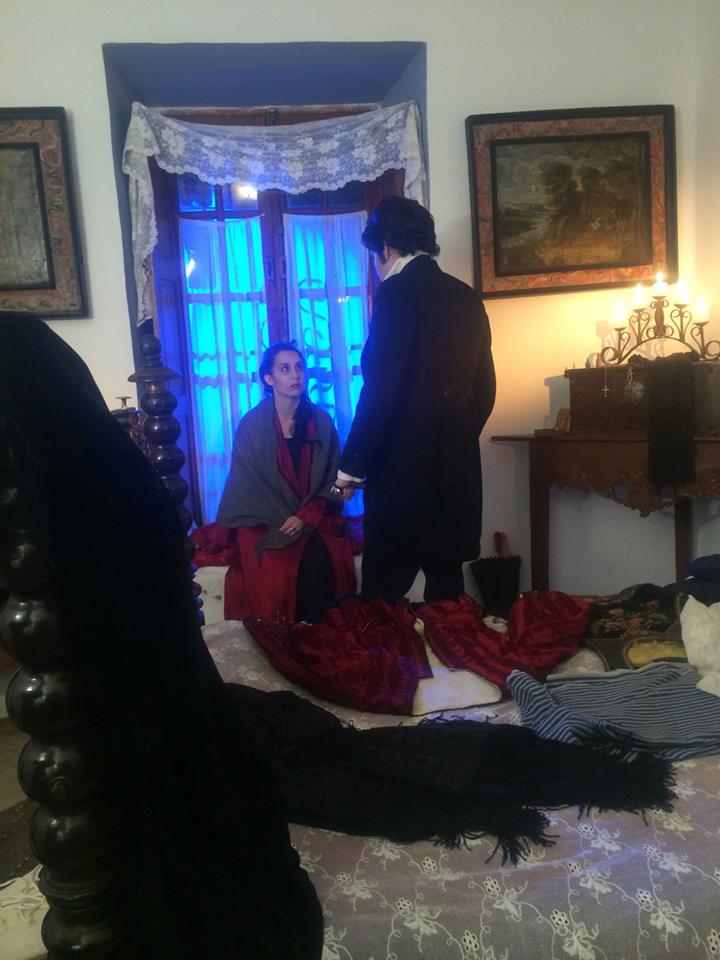
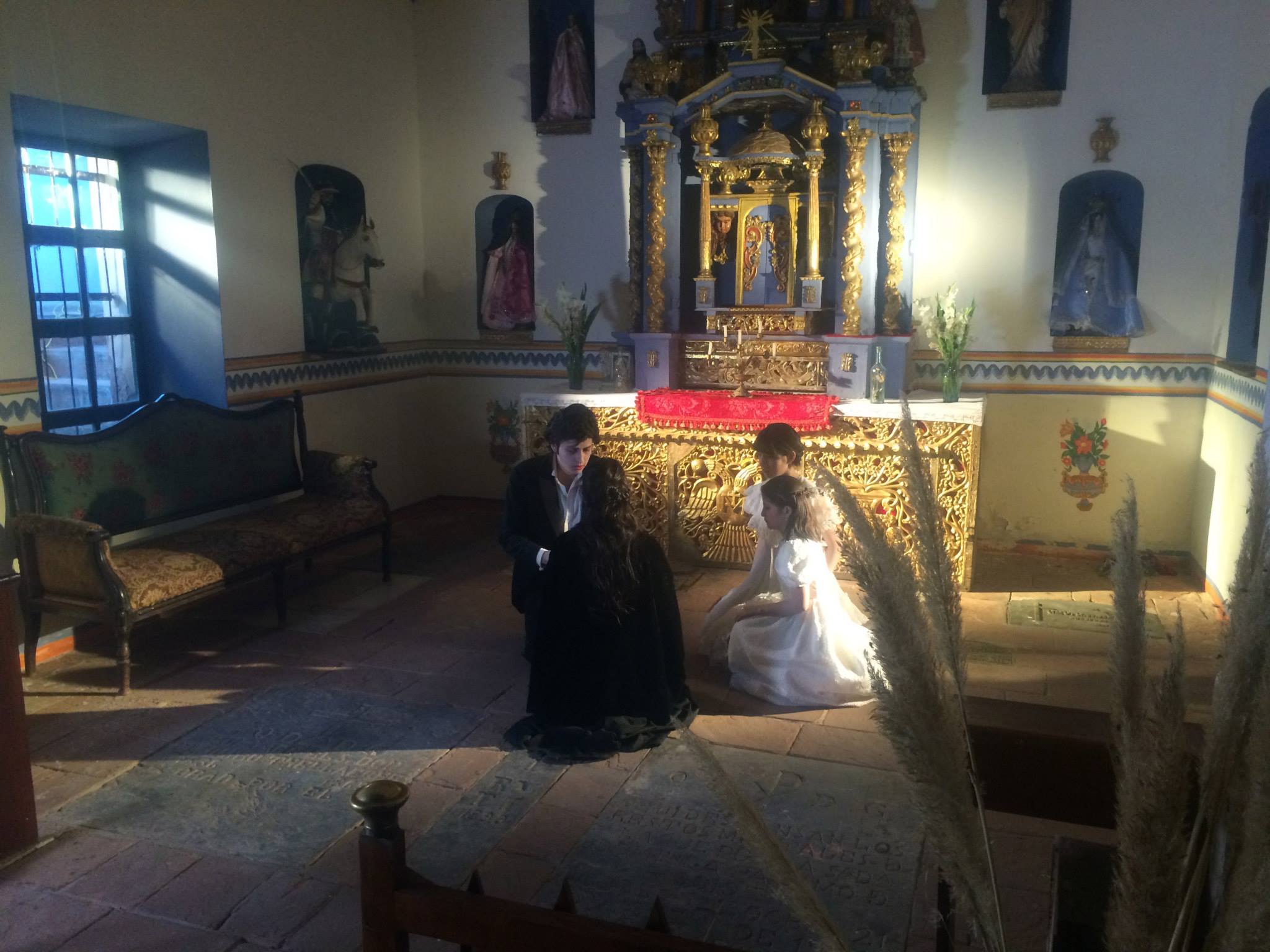
DBD00002712-600x337

Set up the viewer with a suggestion and Dead But Dreaming readies the audience for that first deliciously irresistible bloody bite into a terrific story.

Horror or History?

As I mentioned in the first post on this movie, I am venturing into new territory with this analysis. After repeated viewings, I’m reluctant to call Dead a horror film. It is more of a historical drama armed with a political message wrapped in a supernatural fantasy. Though I agree with Eric Antione who characterizes the movie as a “gothic adventure story,” I think it goes deeper than that. Much like Maleficarum, another Amy Hesketh film about victimization, Dead condemns a society that condemns women.

MV5BMTk5MDQyNzM4NV5BMl5BanBnXkFtZTcwNzk2ODUxNw@@._V1_UY268_CR3,0,182,268_AL_Speaking of  Maleficarum, two young women are tortured under the sadistic auspices of the Church because they don’t fit in. Amy and Mila Joy are innocent victims whipped, racked, and bloodied in realistic scenes. Yet, Maleficarum is not gratuitous violence. The film depicts the abuses society brings on those who drift away from the norm. Watch it with Arthur Miller’s The Crucible in mind because Jac Avila’s script and Miller’s story are based on real accounts.

The dungeons of Maleficarum offer Amy and Mila with their nudity and their punishments as treats for the sadomasochistic crowd. Dead dances around the edges of that arena with the same erotic S/M theme that permeates Maleficarum. Does that position both films in a special genre of horror, history, and softcore porn? Perhaps, but that may be a stretch (no rack pun intended), so check out both films and decide for yourself.

What I do believe is what Dead But Dreaming does so well, replay the female oppression theme of Maleficarum with a more forceful feminist message.

*          *          *

AmyHeskethI hope to review another Amy Hesketh production. She is a breath of fresh air unknown to many film fans.

For my tastes, any performer who comments on her nudity with, “My body is my instrument so I’m going to use it,” is quietly telling us she is more than attractively packaged female flesh.

Amy Hesketh is smart, talented, and lusts after each scene she shoots.

Congrats on a great movie and here’s betting that there’s a Dead II in the works.


2 Comments

Filed under Uncategorized