Tag Archives: Jac Avila

I Only See Darkness: Jac Avila’s Justine, Part One

by Rich Moreland, December 2016

Now that we’ve discussed Justine, the novel, and looked at what Jac Avila has borrowed for his version of the story, we’re ready to analyze the film.

SPOILER ALERT! The ending of Justine is included in this five-part review.

All photos are courtesy of Pachamama Films/Decadent Cinema. Performer names are inserted where appropriate.

*          *          *

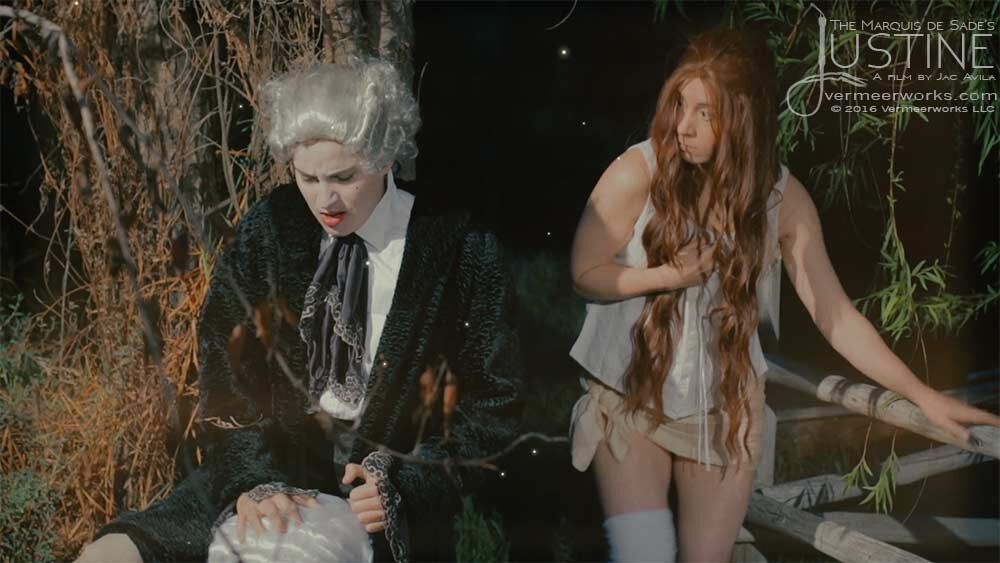
In a nod to the Marquis de Sade, Jac Avila’s cinematic version of Justine tells the story in flashback mode and sticks closely to the novel early on.

justineposterv04oficial-510x775However, the opening scene departs from Sade and establishes that this film will forge its own path in ways that reveal Justine dabbling in the libertine philosophy she supposedly abhors.

This is not to say Justine abandons her virtue, but the bottom line in this film is about defiance and empowerment that, contradictory to Sade, requires a woman of strength who endures her fate.

Jac Avila puts the abused lass on that trajectory.


Public Humiliation

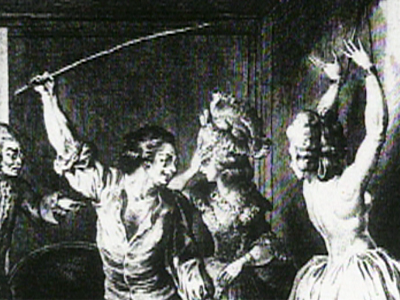
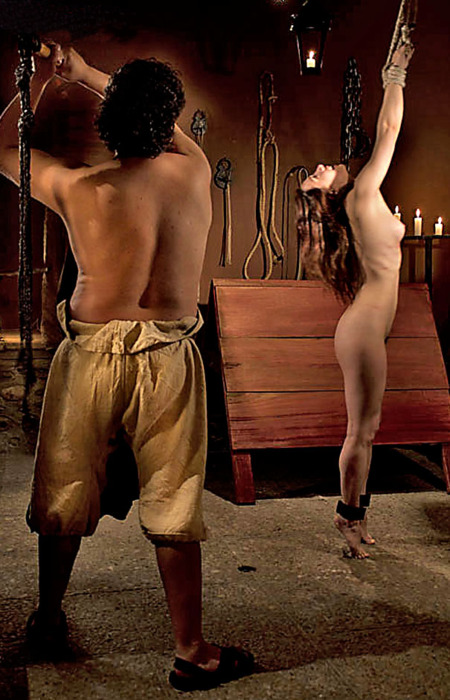
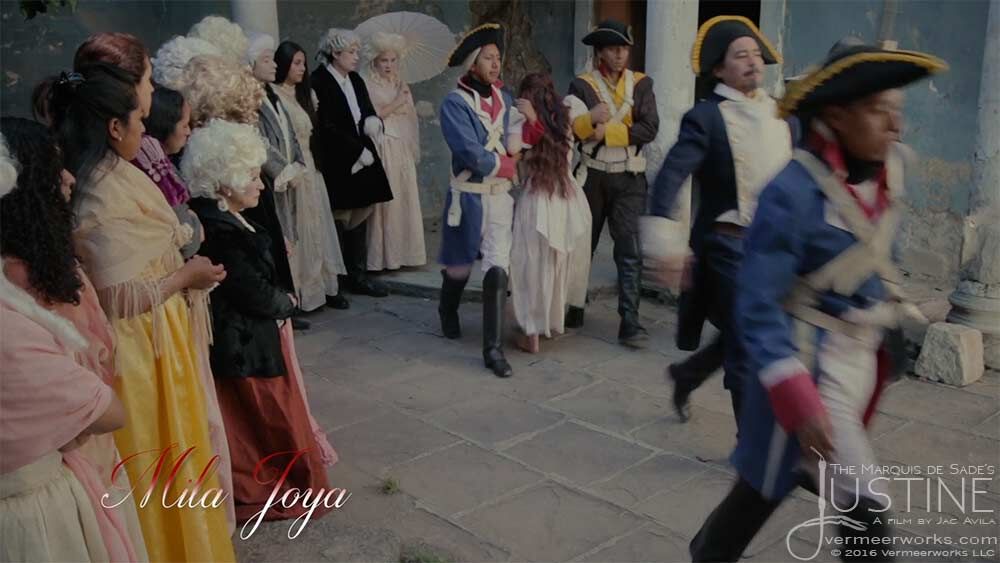
Justine (Amy Hesketh)  is brought into the town square for a public scourging. It’s announced she’s charged with prostitution and theft and will spend a night in the pillory before being sent off to a “hard labor” fate.
ja20

Prostitution? Sade mentions nothing of that. What’s more, there is no public humiliation at the whipping post in his novel.

ja24

The officer in charge (Gonzolo Konka) isn’t finished because the crimes of murder and arson are also part of the charges. Justine escaped from prison with the gang leader Dubois (Gina Alcon) during a fire which our heroine supposedly set.

Twenty-one people died and later Justine is blamed for a second murder, that of Madame de Bressac.

So the unfortunate girl is doomed.

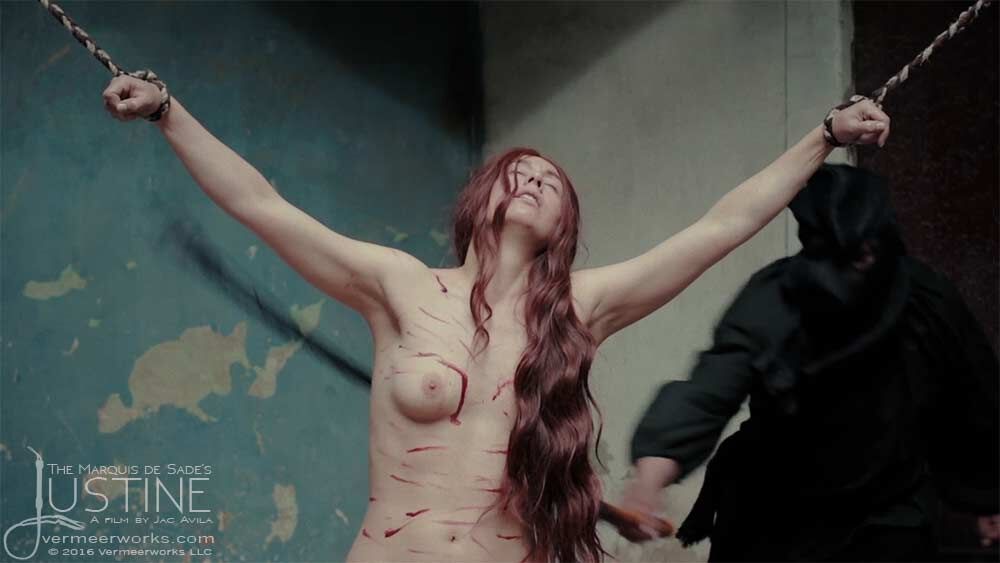
The flogging begins, the crowd counts the strokes, and Amy Hesketh initiates this provocative film in a fashion only she can orchestrate. It’s a superb scene and another cinematic triumph for an actress/director whose performance art we’ve come to take for granted.

ja28

Notice the crucifixion position of Justine as a criminal. That’s important because this film has a religious undercurrent that challenges the Church.

By the way, after receiving the thirty-ninth lash, Justine faints and has to be revived. Keep in mind the number thirty-nine, it is significant in understanding the film and will be mentioned later.
ja29

The Medieval Church

That leads us to the prostitution charge. Why is it there?

It’s not part of Sade’s story, but its inclusion here makes sense if we remember that Sade is an atheist and condemns the Catholic Church as the charlatan of illusionary constructs. (See Justine, Part One: The Novel).

On the other hand, Jac Avila’s cinematic version of Justine does not abandon Christian ideology, choosing instead to confront it particularly over the Church’s attitude toward women.

Is the virtuous Justine turned into a modern version of Mary Magdalene, the supposed woman of the evening, to argue this point?

ja23

If so, the flogging scene with the priest standing by tells us two things that set the tone for the film.

First,  doubts are cast on how we see Church doctrine when it comes to the female cause. After all, there is no real Biblical evidence that Mary Magdalene was an adulteress or profited from sex, though the patriarchal Medieval Church hinted otherwise.

Nevertheless, women were regarded as second class citizens, the Virgin Mary aside. She avoids what churchmen abhorred in the Early Middle Ages, the sensual woman. After all, she never really had sex.

Jac Avila challenges this minimalist view of the women in two other characters in the narrative, Rosalie (Mila Joya) and Omphale (Beatriz Rivera), who are present at Justine’s punishment.

ja30

Rosalie, Omphale, and Justine share the common bond of torture and pain, a point that becomes more important when the film delves into Rodin and his amusement with the fairer sex.

In fact, the girls are nervously watching a punishment that is already familiar to them.

That leads us to the film’s second theme: the empowered woman. Jac Avila’s Justine is hardly Sade’s innocent, hapless soul imploring Heaven’s Grace to save her.

She has her own will that leads to self-created problems . . . and she pays in the end.

But more on this feminist view later.

You Can Only Die Once

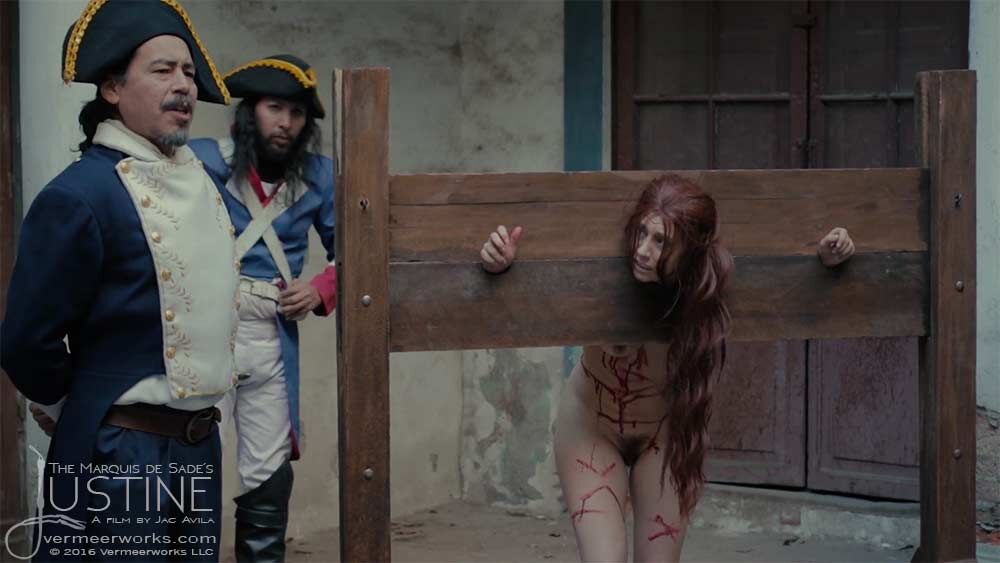
After her bloody punishment, Justine is taken to the pillory and secured to await the dawn.

The spectators are informed that by daybreak Justine’s execution will be settled upon since she has “but one life to live.” So much for the years of hard labor in the original sentence.
ja32

Juliette (Cortney Wills), a witness to the whipping, walks over and touches Justine’s cheek, asking how “you, with a very sweet face, find yourself in such a dreadful plight.”

ja35

A tearful Justine replies that were she to tell her story, she “would accuse the Hand of Heaven and I dare not.”

The dictates of her unwavering faith are understandable, though a bit over-the-top. But there’s more. Justine’s troubles are of her own making. Even for those who conceive of God as the great clock maker (popular with the Deists in Sade’s time), the miserable wretch has to bear some responsibility for her actions.

Sade would not disagree, but Jac Avila’s alternative look at an empowered Justine flies in the face of the French aristocrat.

Remember, empowerment means making choices.

Pounds of Flesh

The executioner (Eric Calancha) puts aside his whip and sodomizes his helpless victim.

ja33

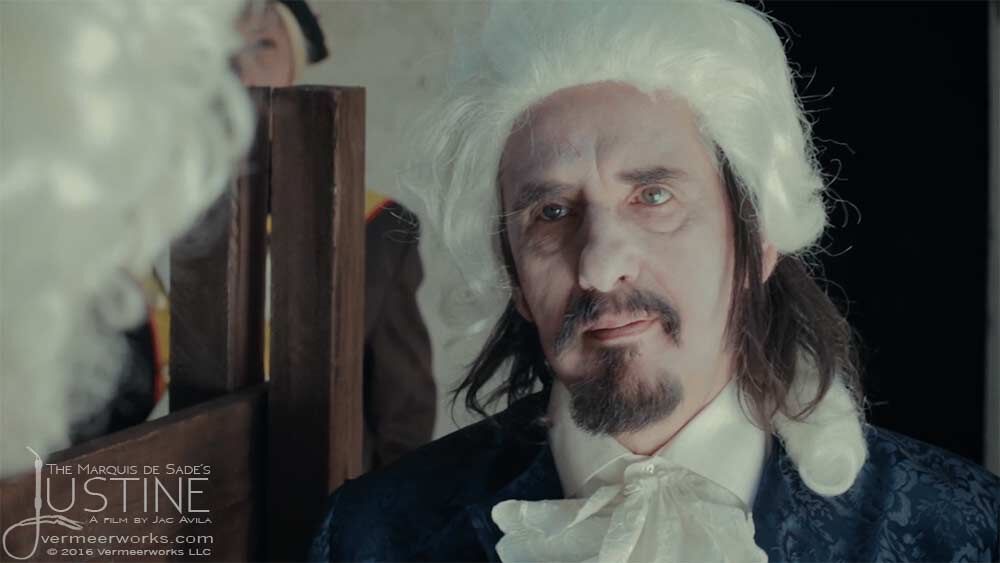
Rodin (Jac Avila as actor) approaches Juliette and introduces himself. She responds with “Madame de Lorsange.”

justinevidcaps00124821sm

By this time, the executioner has finished with his pound of flesh, so Rodin politely excuses himself to duck behind the stocks for his own Sadean go at Justine. Juliette looks on with patience, thoroughly amused.

ja38

In the face of all plausibility, Justine calmly begins as Rodin pumps away. Apparently anal violation at the hands of a pedophile sparks casual conversation. It’s a parody of Sade, of course, whose own narrative of Justine’s travails is so outré as to garner chuckles. But does Jac Avila also parody the Church in a way Sade ignores?

If that’s not enough grist for the mill, consider the film’s flashback narrators.  Justine, and later Juliette, break the fourth wall and talk directly to the camera, engaging the audience directly with a more pointed method than a simple literary first person.

ja34

What’s going on here?

A lot, actually, and it sets up a very entertaining and highly recommended film.

In the next post we’ll find out the details of Dubois, Saint-Florent, and Bressac.

*          *         *

One of the endearing aspects of indie film is the cooperation that is built into everyone connected with the project. When money and time are limited, the cast accepts responsibilities to assist the director of cinematography.

justinemakingofday13_15623

https://www.youtube.com/watch?v=uTSLhlAPgU8

3 Comments

Filed under Uncategorized

Justine, Part Two: Novel to Film

by Rich Moreland, December 2016

Jess Franco's Justine 1969

Jess Franco’s Justine, 1969

Justine as film is not new. The earliest version dates to 1969, two productions were released in the 1970s, and another followed in 1987.

To understand Jac Avila’s adaptation, a snapshot of Sade’s original work he borrows is helpful.

All quotes come from the Oxford University 2012 publication of Justine or the Misfortunes of Virtue.

All photos are courtesy of Pachamama Films/Decadent Cinema.

*          *          *

Film adaptations of novels can be daunting.

As a result, filmmakers must sort through characters and scenes to personalize their version of a story.

Justine is no exception, so here are the major characters Jac Avila selected out of the many in Sade’s work. I’ve summarized them as they appear in novel.

Juliette, the Sister

Sade introduces Juliette by her married name, “Madame the Comtesse of Lorsange,” and tells us she owes “her fortune to a pretty face and a great deal of misconduct.” When she and Justine leave the convent as young girls, Juliette reminds her sister that their “youth and looks” will make it “impossible for them to die of hunger.”

ja11

With morals that “are completely corrupted,” Sade writes, the older Juliette learns the ways of the flesh as a brothel “working girl.” At twenty she marries an older man, the Comte de Lorsange, whom she eventually murders for his wealth. Thus, Juliette’s life as a libertine and party girl begins.

Incidentally, never deterred by moral restraint, Juliette later offs “one of her admirers” to gain a “legacy” that enriches her further.

But she isn’t finished.

Throw in “three or four infanticides (abortions) to these horrors,” Sade says, and the dissolute Juliette becomes the poster girl for “prosperity can reward the very worst conduct.”

Immediately within the pages of Sade’s work, Juliette and her current sugar daddy, Monsieur de Corville, encounter a poor girl brought in chains to the inn where they are lodging. The wretch is accused of “three crimes, murder, theft, and arson” and is destined for execution in Lyons.

The aristocrats take pity and the prisoner offers to tell her tale. Thus, the devout Justine, who calls herself “Therese” to conceal her identity, begins the narrative that becomes the novel.

Bressac, the Gay Comte

ja18

Having escaped a gang of criminals who beat and anally rape her, Justine comes upon two men in the woods “drunk with lust.”

“The young master (the Comte de Bressac) was always the woman,” Justine observes. She later says he “possessed a considerable degree of wickedness.”

When the count and his valet, Jasmin, realize Justine is watching them, they tie ja7her nude and spread-eagled to four trees to frighten her.

But the count has plans to use her as a companion for his aunt. Justine stays in Madame de Bressac’s house for four years, but her doubts about the Comte never go away.

“An evil spirit lay concealed beneath (his) feminine charms” that fostered a “hatred for his aunt,” Justine says.

Not unexpectedly, she refuses to participate in a plot to poison the woman.

ja19

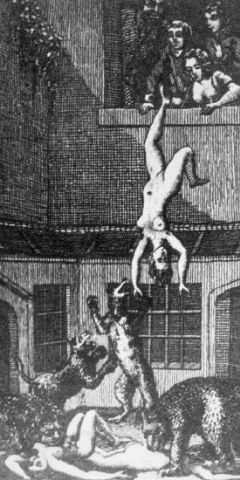
As punishment for her insolence, an enraged Bressac, with the help of Jasmin, takes Justine into the forest where she is tied naked to a tree. Admiring her “lovely bottom” and its “superb flesh,” the count predicts the stupid girl “will be an excellent lunch for my three hounds!”

The dogs are released.

“The cruel man walked away . . . I never saw him again,” Justine says.

Bloodied but alive, the abused girl finds her way to Saint-Marcel and a surgeon to treat her wounds. He is Rodin.

In the meantime, Justine discovers that Bressac does indeed carry out his deadly machination and she, the chambermaid, is accused of murder.

The Scientist and his Daughter

Rodin is a doctor “purely out of interest.” His passion is his boarding school. Students of both sexes provide the flesh he sadistically whips and debauches. Living with Rodin is his youthful daughter, Rosalie, who becomes Justine’s friend.

ja10

Rodin offers Justine a place in his home though she is suspicious because two pretty servant girls are already there.

“Why does he need a third woman,” Justine asks herself, “and why does he want pretty ones?”

From a crack in the panel boards in her bedchamber, Rosalie reveals to Justine her father’s Friday punishments. As they watch the spectacle, Rosalie confesses she is treated likewise and suffers incest.

Concealed again later, Justine watches the same whipping and carnality this time with the two servants and Rosalie, who is sodomized by her father.

Sade tells us, “Drunk with passion, the libertine dares to taste the sweetest pleasures that incest and infamy have to offer.”

Confiding in Justine, Rosalie says she is now fifteen and ripe for sacrifice in the name of science. Her father and a colleague are going to use her for experiments; her destiny is determined and nothing will save her.

ja12

When the fellow doctor questions Rodin about his indifference toward his daughter, the depraved scientist replies, “I, in love with a girl?” Referring to Rosalie as “that little bitch,” he adds, “it’s time she paid for putting an end to my intoxication with her life.”

Rosalie disappears for days before Justine discovers her tied to the posters of a bed. Furious, Rodin grabs Justine and brands her with a mark that “will get her hanged,” he declares.

Helpless, Justine is left at the edge of the forest. Faced with her own pain and troubles, Justine abandons Rosalie to her fate.

Omphale and the Monastery

After fleeing Rodin, Justine comes upon a hidden monastery deep within the woods where depraved monks imprison young women for pleasure, torture, and sex. In this society of vice, the monks are “quite sure their crimes will never be revealed.”

Justine’s string of bad luck predictably continues and she is put into the ranks of the abused.

ja13

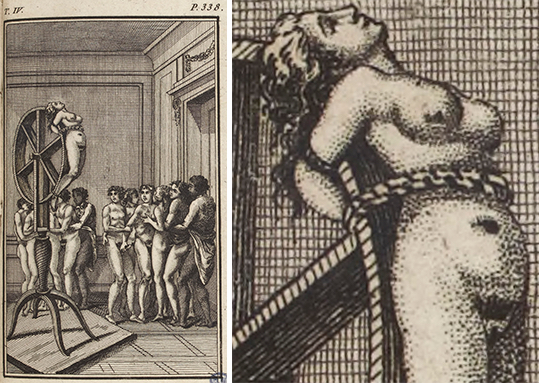
All sorts of horrors befall her but she does find a friend, Omphale, who, like Virgil guiding Dante through the Nine Circles of Hell, shows Justine everything, including exaggerated and whimsical punishments that would quickly kill any human being.

But this novel is pure fantasy, so the girls survive and their bodily marks simply disappear leaving them fresh for another round of torture, flogging, and sex.

The only way out of this hellish existence is to be among the mysterious “discharges,” Justine learns, the girls who are dismissed and sent away. Despite their promises to help those still imprisoned, these unfortunates are never  heard from again.

This fate befalls Omphale.

Later when Justine manages to escape in total darkness, an improbable turn in the tale, she traverses the six walls that conceal the monastery. Along the way, she finds a skull in the dirt and believes she’s come upon “the cemetery where these torturers throw the bodies of their victims . . . This skull was perhaps that of my dear Omphale,” she laments.

Though she is free, Justine never returns to rescue the tormented girls she leaves behind.

Others

ja14There are other characters Jac Avila places in his film: Dubois, the female gang member who helps Justine escape from prison and the traveler Saint-Florent, whom Justine rescues from the gang.

After treating her with care, Saint-Florent takes Justine into the forest as darkness closes in and knocks her unconscious with his walking stick.

ja16

When Justine regains her senses, she finds herself “bruised, bloodied . . . and dishonoured,” her virginity gone.

It is at this point she comes upon Bresssac and his man, Jasmin.

ja17

*          *          *

Chris Boger's Justine, 1977

Chris Boger’s Justine, 1977

We are now ready to examine Jac Avila’s treatment of the story. He keeps Sade’s narrative in tact at the beginning before exploring his own take on Justine’s character.

That, after all, is the nature of an adaptation.

*          *          *

Justine is available for purchase at Vermeerworks.com.

Jac Avila can be contacted at Pachamama Films or via his blog.


1 Comment

Filed under Uncategorized

Justine, Part One: The Novel

by Rich Moreland, December 2016

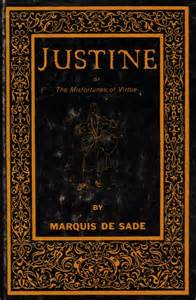
Jac Avila’s adaptation of the Marquis de Sade’s novel, Justine, is now available from Pacahamama/Decadent Films. Before taking a critical look at the movie, it’s helpful to have an understanding Sade’s work.

All references to the original story, Justine or the Misfortunes of Virtue, posted here come from the Oxford University Press paperback edition published in 2012. The translator is John Phillips.

*          *          *

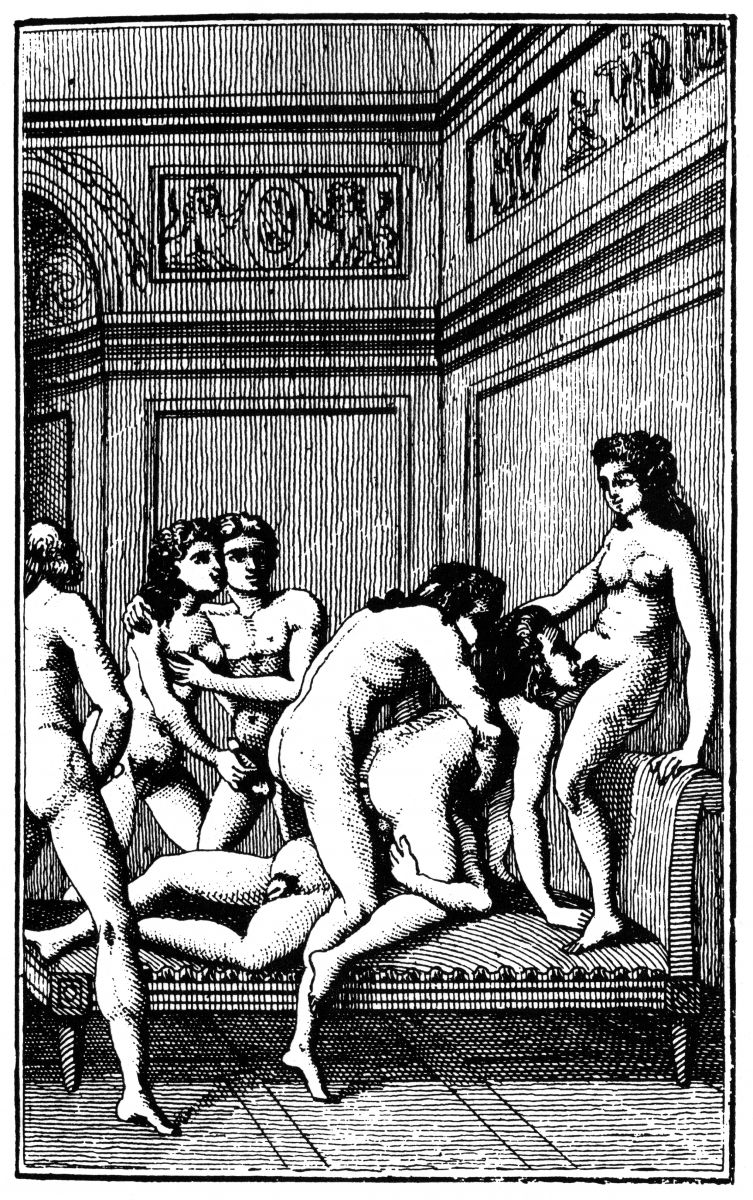
ja200Born in 1740, the Marquis de Sade was a French aristocrat during the Age of Enlightenment. His proclivity for debauching young girls and his fascination with sodomy (anal sex) landed him in prison on more than one occasion.

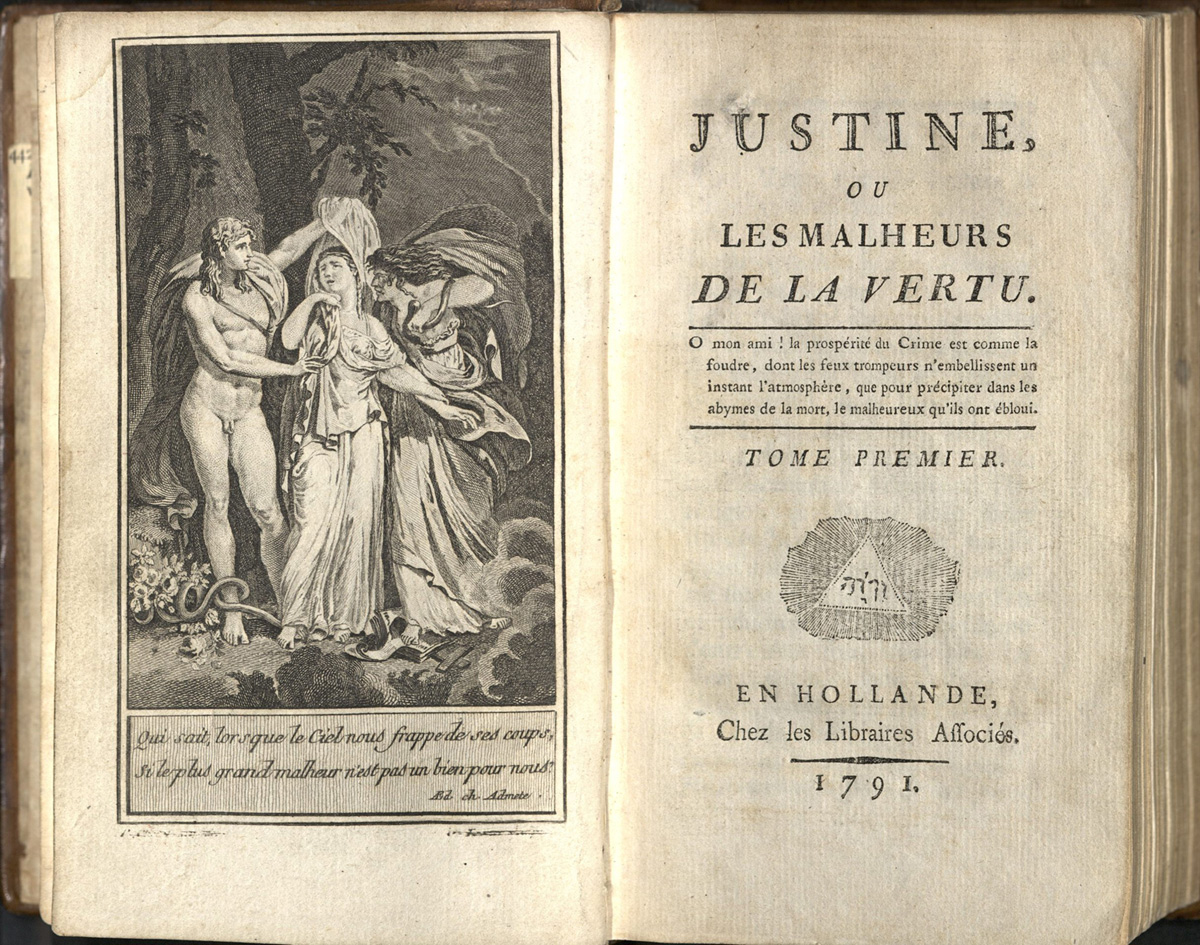
During his time in the Bastille, the prolific author and playwright penned Justine. Published in 1791 after the French Revolution, the novel is an early example of pornography, eighteenth century style.

Sade’s story is a satirical work. ja201The marquis rails against the Church and society and marvels at the libertine (free thinking) way of life.

He uses Justine, a pathetic girl who tries to preserve her virtue in the face of overwhelming vice, as the punching bag to justify his philosophy.

The Story in Brief

At age twelve Justine and her older sister Juliette fall upon hard times. Though born of nobility, they are orphaned and penniless and forced to go their separate ways after leaving the protection of a convent. Fifteen years later, they meet again when Juliette is thirty and Justine well into her twenties.

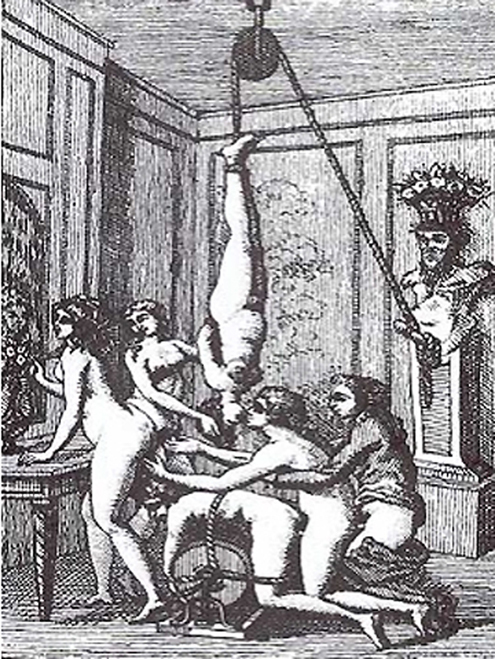
sade_etching_1Juliette lives a pleasurable life of vice, Justine a miserable one of virtue. Despite her desperate pleas to Heaven to protect her, Justine suffers a series of tribulations that include graphically described tortures and repeated sodomy.

Her tormenters come from all corners of society: criminal gangs, aristocrats, and churchmen among them.

Imprisoned by disreputable characters who abuse her incessantly, Justine is accused of various crimes, branded a whore, and is in the hands of the authorities when Juliette, known now as Madame de Lorsange, rescues her.

The novel is a flashback in which Justine recounts her miseries. Virtue is rewarded only briefly, however, as the poor lass is struck dead by a lightning bolt.

Influences on the Novelist

The Marquis de Sade was undoubtedly familiar with the fairy tales of fellow Frenchmen Charles Perrault, particularly “Little Red Riding Hood” and “Bluebeard” and incorporated elements of both (as well as sordid legends from around the world), in his novel.

justine

Justine is often lost in the darkness of the woods, a terrifying experience and a reminder of Little Red Riding Hood’s dire straits.

Falling into the hands of one “bad wolf” after another, she ends up in foreboding environs typical of the Gothic writing of Sade’s day such as castles, forbidden rooms, and hidden monasteries where tortures occur.

marquis-de-sade

Because Justine is trusting and gullible, she is often abandoned after being abused setting her up to be easily duped by the next person who comes long.

As this abysmal cycle continues, Justine meets other young women who likewise suffer indignities and sometimes death as do Bluebeard’s wives.

sade_donatien_alphonse_francois_marquis_de_justine_ou_les_malheurs_de_d5840801gThe Libertine

Justine is as much a philosophical statement as a decadent novel about libertine sexuality and anti-Church diatribes.

Incidentally, during the Enlightenment period, “libertine” originally referred to those who considered themselves atheists. Over time, the label was expanded to include sexually obscene written works.

Sade explores this further when Justine morphs into the lengthier , The New Justine, published in 1797. It is more pornographic than its older cousin.

Sade’s Message

The Marquis’ original Justine carries two prominent themes.

marquisdesade2The first justifies its libertine leanings. Virtue is of little account. When Justine escapes prison with the help of Dubois and her gang, she is told, “abandon the path of virtue which has never brought you success.” Trust your instincts, the gang believes, and advises Justine that “moral feelings are deceptive, only physical sensations are true.”

In other words, vice is rewarded, a message Justine hears throughout the novel.

The second theme centers on religion. Sade is an atheist in a time when the hegemony of the Catholic Church in France is coming under fire.

The “creator” is a fantasy, the gang informs Justine. The only reality is the here and now and like a dog, they assert, why should we “abandon the bone for the shadows and renounce real pleasures for the sake of illusions?”

If anything in the state of nature (the time before societies existed according to the French philosopher Jean-Jacque Rousseau) is bad, why does nature allow it to exist?

This is Sade’s central question.

But the author is not finished. Later when Justine is under the thumb of the perverted monks, one of them, Clement, takes pride in their impiety, finding pleasure in the “egoism, cruelty, and debauchery” that offends “the mythical God.”

260c1b95dac55720bcb251a30a113aa7Rebirth

All of this is not to say that Sade believes that an end is an end. In fact, he has his own version of regeneration or eternal life, if you will.

The Comte de Bressac tells Justine that matter is “reborn in other guises” because “all men, all animals, all plants . . . grow, feed, and are destroyed.” They go back into the earth where they “never truly die but merely undergo variation and modification.”

Later Rodin justifies murder using the same logic.

“If nothing dies or is destroyed, [or] is ever lost in Nature,” he says, it’s “just waiting “to reappear immediately in new forms.”

To deny this process (even if it is what society calls murder) is the “real crime,” the scientist claims.

Finally, Sade accounts for man’s perversities.

From Clement, the defiled Justine learns that “there are no tastes (sadomasochism included) that do not derive from the kind of make-up we have been given by Nature.” He expands on this inborn deviancy by stating the “pleasures of the senses are always dependent on the imagination.”

a0995

When Justine assails him for his “taste for cruelty and horror,” Clement retorts, “If Nature were offended by these tastes it would not inspire us [to express them].”

*          *          *

So we have Justine, a novel that tackles Jean-Jacque Rousseau’s social contract popular in eighteenth century France. Man is born into a State of Nature where there are no moral laws and must enter into communities to preserve himself.

Of course, Sade has his own libertine opinion on the outcome.

Next we’ll look at the characters from Justine Jac Avila has taken for his adaptation of the narrative.


1 Comment

Filed under Uncategorized

Barbazul, Part Three: I Want to Go Away

by Rich Moreland, September 2016

The cinematography in Barabazul is expansive and invigorating. Often indie film companies are handicapped by lack of funds which can show up in the technical aspects of their work, but Pachamama/Decadent productions manages to overcome that shortcoming with finely crafted shots equal to those of big budget studios.

*          *          *

You Were Perfect

Barbazul now moves into its flashback stage. Soledad reads through the journal and meets each of Bluebeard’s previous women.

The first is Annabelle (Veronica Paintoux). She’s doing a fashion shoot for the slave-driving Paul. Soledad is also present, assisting the cameraman but hardly to his satisfaction.  He criticizes her as a “nappy-haired cunt.”

barbazul00373601

After a round of poses, Annabelle chats with Bluebeard.

She wants his opinion of her work.

“It was perfect. You were perfect,” he says.

Annabelle suggests he must have paid handsomely to be on set because Paul doesn’t want clients hanging around when he’s shooting.

“I like seeing the action,” Bluebeard replies.

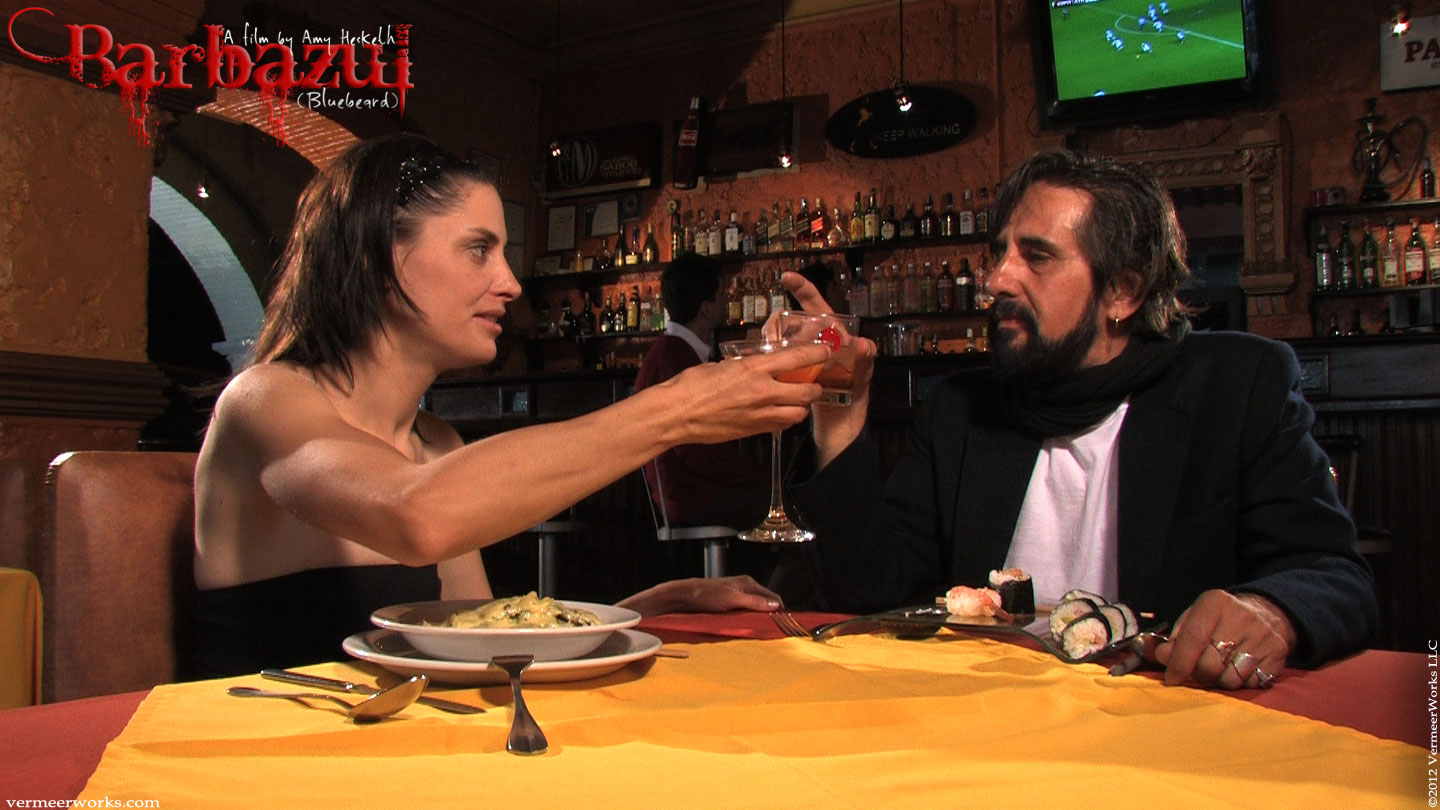
So does she, apparently, and invites him to dinner. Eating, a Freudian interpretation of sexual interest, is a major motif in the film.

barbazul00405027

Conversation revolves around her talents. Her photos “will last forever,” Annabelle says, because modeling is an art that requires “using your body, knowing how to move, knowing yourself.”

barbazul00463429

“To understand your own beauty is not that easy,” she remarks with a knowing smile.

Annabelle is self-confidence personified, a statuesque charmer quite the opposite of Soledad who is socially reserved despite her exotic, understated look. Elegant and cosmopolitan, Annabelle seduces Bluebeard.

barbazul00540425

She even tells him his scarf is all wrong and in a moment integral to the film, gives him hers. It’s black and will become the pivotal image for the rest of the narrative.

Director Amy Hesketh has set the table, so to speak, in this restaurant scene. We know what is to come.

Suicide?

As expected, the boat ride and hotel sex follow. Annabelle is far less reticent than Soledad about stripping down before crawling across the bed to Bluebeard.

barbazul00474117

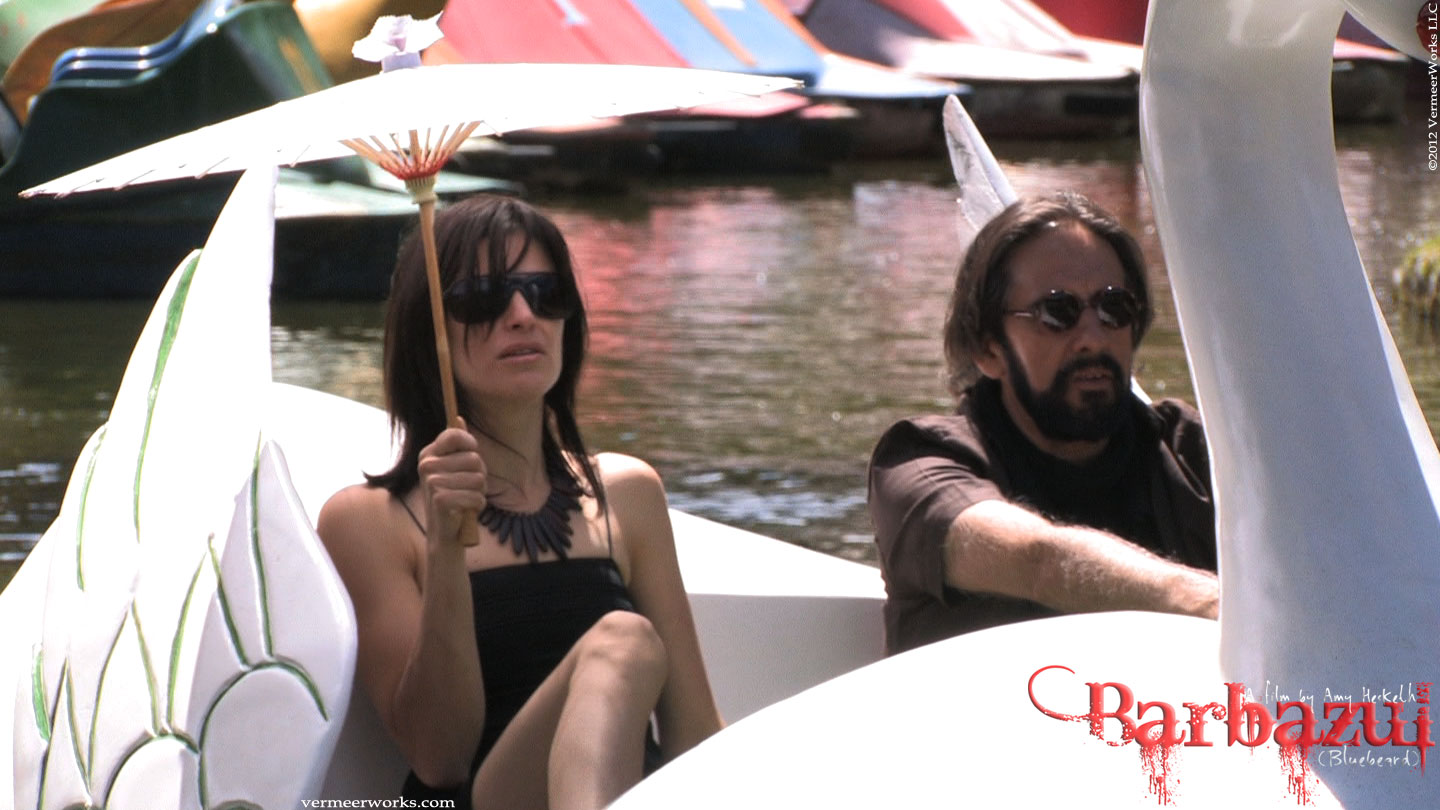
Annabelle’s demeanor on the boat also differs from Soledad’s girl-next-door image. The craft requires pedaling. For Annabelle, donned in a black mini-dress, modesty is of no importance. On the other hand, Soledad wears a lengthier garment, keeping her hand modestly placed between the folds of her outfit to ensure nothing is revealed.

barbazul00434716

Incidentally, Veronica Paintoux is a natural beauty, the perfect choice for Annabelle. She wears no make-up and holds a conversation with refinement and grace. What man would not be attracted to her?

Later, Annabelle tells Paul she’s getting married because “this won’t last forever,” a reference to her modeling. He concedes she’ll lose her looks but is that any reason to commit suicide?

“It’s not suicide,” she says. Well, it’s close.

A Dusty Mouse

After their marriage (in the city, not on the plantation) Bluebeard takes Annabelle to the hacienda over the familiar dusty roads. She holds an open parasol to preserve her complexion.

477835_427652487270156_453559660_o

During the tour of the wine casks, she is indifferent, unlike Soledad who is impressed with facility.

barbazul00191509-600x337

When the camera shows a close-up of her steps at ground level, Annabelle walks by a cobweb-covered carcass of a mouse that reveals much about the film. She doesn’t notice it.

Moments later she recoils at the sight of the bats on the ceiling. Her reaction is disgust, unlike Soledad who finds the night creatures fascinating.

Later Bluebeard offers Annabelle the same bike ride Soledad enjoyed, the lithe model waves him off and heads up the steps.

barbazul00514705-600x337

To her credit Annabelle is wonderful when the arrangement calls for her charm, glamour, and role-playing. On an outdoor picnic, she amuses Bluebeard by creeping seductively like a tigress stalking her prey. But it is a performance that raises the question of who is the real quarry?

Inevitably,  Annabelle, the gorgeous model who is as urbane as they come, has “the great realization.” The plantation is not her kind of place. Her decision to marry was self-centered and hasty, perhaps driven by her desperate fight against a force she cannot control: the passing of time.

No problem really, her worries will soon be put to rest.

Do You Need Help

Annabelle’s self-absorption hints at her demise. Wearing her signature little black dress, she enters the bedroom with a portfolio of photos, the same one Soledad later discovers. The aging model lays out the glossies on the bed with care. Three nudes lead the way.

Bluebeard comes in. He picks out one he likes and unzips her dress. They fall together on the photos.

barbazul00551010

When he asks if she loves him, the snapshot immediately to her left is telling. It’s a close-up of Annabelle’s face; it has a wide-eyed look devoid of animation.

barbazul1019

Over dinner Bluebeard and Annabelle fall out. She takes off her clothes and goes to bed, but that doesn’t silence the  argument.

barbazul00585906

“I want to go away. I’m leaving you, I want to live my life,” Annabelle declares. The plantation is an emotional desert; she has no friends, no real satisfying existence.

Bluebeard, in a moment of disbelief, responds, “You have me.”

She looks away. It’s the ultimate insult and rejection.

In a manner that borders on pleading, he offers her a baby. Not for her, she wants to work and teach modeling. This is the most sincere and honest conversation in the entire film.

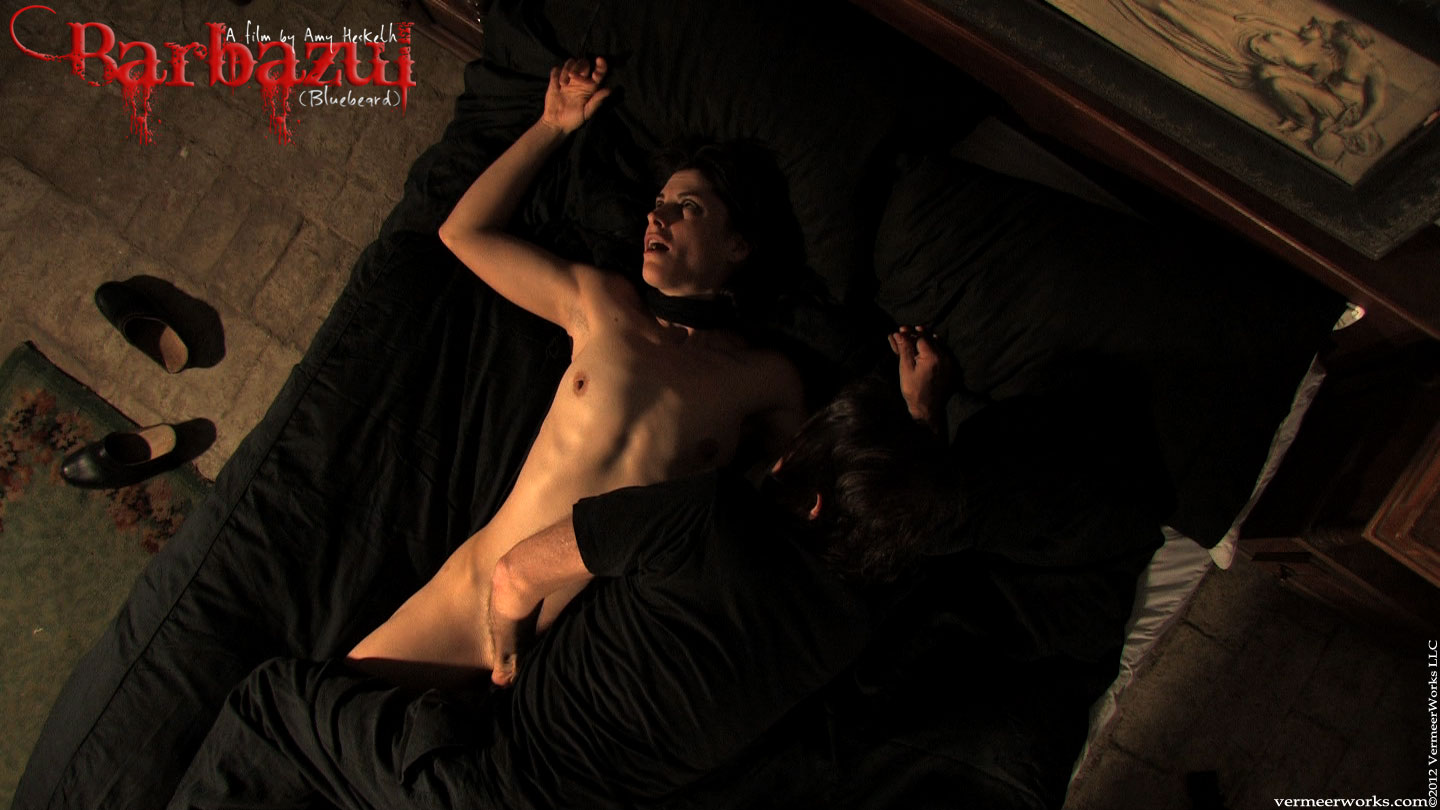
Annabelle suddenly gets up to leave. Bluebeard uses the scarf she gave him to corral her around the neck and force her back onto the bed where he strangles her. An anguished Bluebeard utters a painful cry as Annabelle’s life slips away and the image in the photo comes alive. In an act of necrophilia, he penetrates her in a confusion of desire, rejection, and revenge.

barbazul01001913

Metaphorically, Bluebeard has killed off part of himself. Disconsolate, he sits outside the bedroom on the porch. A blank stare covers his face.

Walter peeps in the bedroom and asks, “Do you need help with this?” Bluebeard nods.

This episode is Jac Avila’s acting at its finest.

A Menagerie

Barbazul first kills because he is rebuffed by someone he truly loves or thinks he does. Cleansed of the shame of rejection, he will degenerate into a sadist who, in his own contradictory way, is looking for redemption. He is sorting through the layers of his shadow, reducing himself to his once naïve, child-like state that lives within him, thus his attraction to the barefooted Soledad. By the way, Bluebeard’s final intended victim, her sister Ana, is barely out of childhood at eighteen.

barbazul00085903

From Annabelle to Ana, the women get progressively younger. Notice Ana is a take down of Annabelle, as if the extra letters in her name are parts of Bluebeard’s personality he will snuff out.

It’s not quite that simple, of course. Bluebeard’s women are a menagerie of dresses on a rack, victims of his fantasies that yield their lives to a wealthy man’s search for his soul.

Amy Hesketh brings Bluebeard’s sadism to fruition step-by-step through cleverly constructed glimpses into his emerging psychological brutality. As he passes from one woman to the next, Bluebeard’s sex acts become increasingly rape-like with hard, violent thrusting.

Only Jane seems to enjoy that scenario. She initiates Bluebeard to her kinkiness and takes everything a step further when the whip orchestrates the sex.

But first we have two brief stopovers: gore with Maga and a crucifixion of sorts with Agata.

*          *          *

Before we get the final part of this review, here is an interesting note about making Barbazul.

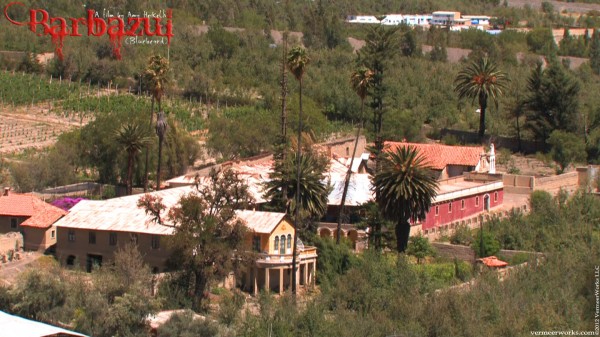
In a recent correspondence, Jac Avila told me, “The hacienda in Barbazul is in a valley, near La Paz, known as Chivisivi. It is still to this day used to make wine and vinegar. It’s an active vineyard. For Amy it was very important that the place gave some of the mood of the characters. In Barbazul each woman has a different color in the decor of the place and the way they dress and so on. Barbazul is very particular about that.”

To get an impression of the plantation’s magnificence, here it is.

barbazul00490325-600x337

And like every good director, Amy Hesketh strives to capture the perfect scene.

barbazul11581


Leave a comment

Filed under Uncategorized

Barbazul, Part One: Cut Off Her Head

by Rich Moreland, September 2016

At Jac Avila’s recommendation, I watched Amy Hesketh’s Barbazul, a Pachamama Films/Decadent Cinema production. The film is a thought-provoking drama that dances between erotic horror and a psychological thriller.

In this first installment of a four part review, we take a look at the original story.

*          *          *

The fairy tale as we know it today is a product of the Golden Age of Hollywood, cleaned up by the Disney people so as not to offend. But what about the original tales? They come from all cultures though the ones we’re most familiar with have European roots that reach across the continent.

The most popular stories come from the Brothers Grimm, who lived in Germany in the 1800s. But there are early well-known versions from France via Charles Perrault, a 17th century lawyer who turned his hand to writing. He specialized in morality tales and penned stories such as Mother Goose, Cinderella, Little Red Riding Hood, and the subject of this review, Bluebeard.

0_942da_3d44e4ec_origWhat we forget is this. Perrault’s narratives are grisly in nature. Little Red Riding Hood is stalked by a sexual predator when she ventures alone into the woods. Don’t we warn our children about strangers?

In Sleeping Beauty, the prince revives his beloved, they marry and have two children. The mother-in-law (Queen Mother) is not pleased and demands the children and their mother be cooked and served well done.

When that culinary plan falls through, she prepares to toss them into a vat of “vipers, snakes, and serpents,” Perrault writes. Her vengence will be satisfied and the little slithering rascals will enjoy a pleasant, but perhaps overly crowded, feast of their own.

Keeping all of this in mind, let’s take a further look at Bluebeard, a tale of dripping blood and curiosity that went too far.

The Dropped Key

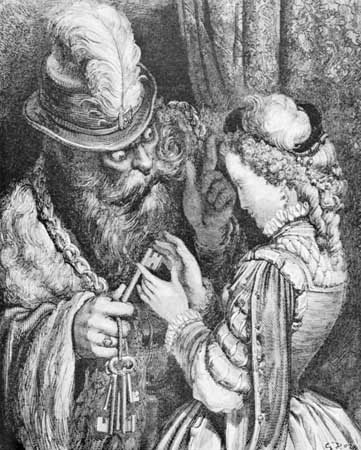
Bluebeard, as the story goes, is a man “so ugly and frightening that women and girls fled at the sight of him.” Nevertheless, this man of means marries the youngest daughter of a “high-class lady” using his wealth to woo her with “picnics and parties.” The outcome is a May-December marriage.

Illustration by Gustave Dore

Illustration by Gustave Dore

Later Bluebeard takes a trip and leaves his wife the keys to the house with instructions to stay away from a certain room “at the end of the gallery.” Bluebeard’s warning reflects 17th century thinking. Women were expected to act within established boundaries and ask no questions.

“Open everything, go everywhere, but I forbid you to enter that little room,” he says, promising she will a pay price if she disobeys.

Not surprisingly, curiosity gets the best of the young woman and she searches out the room despite knowing punishment awaits her. “The temptation was too strong for her to resist,” Perrault writes.

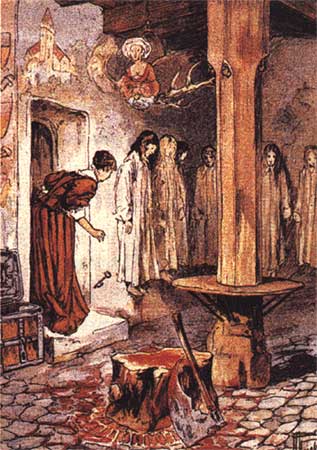
Unlocking the door, she discovers the floor “sticky with clotted blood.” Reflected in this glistening pool were “the corpses of several women, hanging up along the wall.” They were Bluebeard’s previous wives “whose throats he had cut, one after another,” Perrault tells the reader.

Illustration by Hermann Vogel

Illustration by Hermann Vogel

Terrified, the bride drops the key which is quickly doused in the red stuff. She tries to clean it repeatedly, but it becomes “enchanted” and the stain never goes away.

When Bluebeard returns, the girl is quickly outed by the bloody key. Pressed for an explanation, her denials are unconvincing, sealing her fate.

“You will take your place beside the ladies you saw there,” he shouts, but does concede her a little time before his cutlass will do its work.

All seems lost though the lass does have a chance. She entreats her sister to keep watch for their brothers who are due to arrive at any moment. Desperation sets in as the final hour creeps closer and closer. But good fortune intervenes. The brothers break in just as Bluebeard is “ready to cut off her head.”

The day is saved and the young wife, despite her disobedience, becomes “mistress of all his belongings” because Bluebeard had no heirs.

A Paltry Pleasure

Perrault leaves the reader with the moral of the tale. “Curiosity has its lure,” he says, but it is a “paltry kind of pleasure and a risky game.” Simply put, this episode is the fault of the young bride who doesn’t understand her place in the household.

But, it is a fairy tale, uncomplicated and straight forward. Explanations for cruel behavior are unneeded in a patriarchal society. In the 1600s women were to do as they were told.

In her film, Barbazul, writer and director Amy Hesketh explores what is unsaid in Perrault’s narrative. She builds a back story around each of the wives and offers the viewer a surprising and chilly ending that leaves more questions than it answers.

In doing so, she explores the mind of a killer in ways unimagined in the Frenchman’s time.

barbazulposter2-300x389

Artfully done, Barbazul gives the initial impression of following Charles Perrault. The young wife, Soledad, like Perrault’s creation, is the subject of the film, or so it seems. But that is not Amy Hesketh’s intention.

You see, Barbazul is about Bluebeard and his attempts to exorcise his demons. The film is a strange, dark, psychological journey of man who has a personality disorder at best and is a serial killer at worse.

One more point.

Bluebeard is a misogynist in Perrault story, we suppose, but there is no convincing explanation. Does Amy’s film verify that label for her Barbazul and does that define his murderous inclinations?

In the next three posts, we’ll take a look.

Leave a comment

Filed under Uncategorized

Jac Avila, Part Three: The Body in Pain

by Rich Moreland, August 2016

My thanks to Jac avila for sharing his views on film making and culture. I look forward to reviewing more of his work in the future.

All photos in this and the preceding posts are courtesy of Pachamama Films and Decadent Cinema. Vermeerworks is their distributor.

*          *          *

Jac and Amy on the set of Justine

Jac and Amy Hesketh on the set of the upcoming film, Justine

A Set of Values

In Jac Avila’s films there is a distinct theological undercurrent. In helping us understand how it complements his work, Jac begins with a snapshot of religion and society.

“Catholicism in South America and most of Europe, particularly Italy and Spain, is more a part of culture than religion,” he explains. For many of the faithful, it’s “a set of values,” a good mixture of  belief with “plenty of mythology” tossed in, “most of it not taken seriously.”

“However, when one grows up inside Catholicism, one is taught to love that culture,” he declares, though it “tries unsuccessfully, to repress a large part of one’s humanity, like sexuality.”

Of course, Christianity is closely linked to suffering . . . a natural human state. But, then again, so is sexuality. Is there a connection?

Blood Sacrifice

“In Catholic culture, the body in pain plays a crucial role with Christ at the center,” Jac continues. It’s really “blood sacrifice as redemption.”

This idea dates back to the Early Middle Ages as the church was making the transition from its birth in the Roman Empire to its place as Europe’s centralized institution.

But we need to remember that crucifixion, the ultimate “body in pain” statement, was around long before Christianity. That Christ and some of the Saints were crucified is more coincidental to their condemnation during Roman times when dying on the cross was the established demise for society’s outcasts and outlaws.

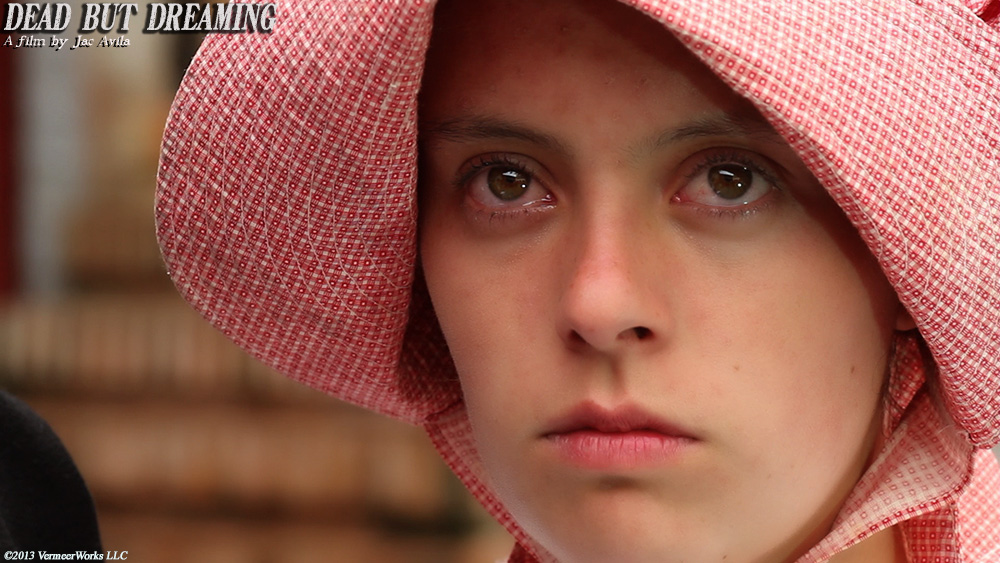
Roman times. Mila Joya in Dead But Dreaming.

Mila Joya’s character faces death in Dead But Dreaming’s flashback to Roman times.

From there, the diabolical combination of torture and death moved out of the Roman Empire into the next historical period.

“In medieval times this (The Body in Pain) symbol took over. Executions were cruel and public, so was penance,” Jac reminds us.

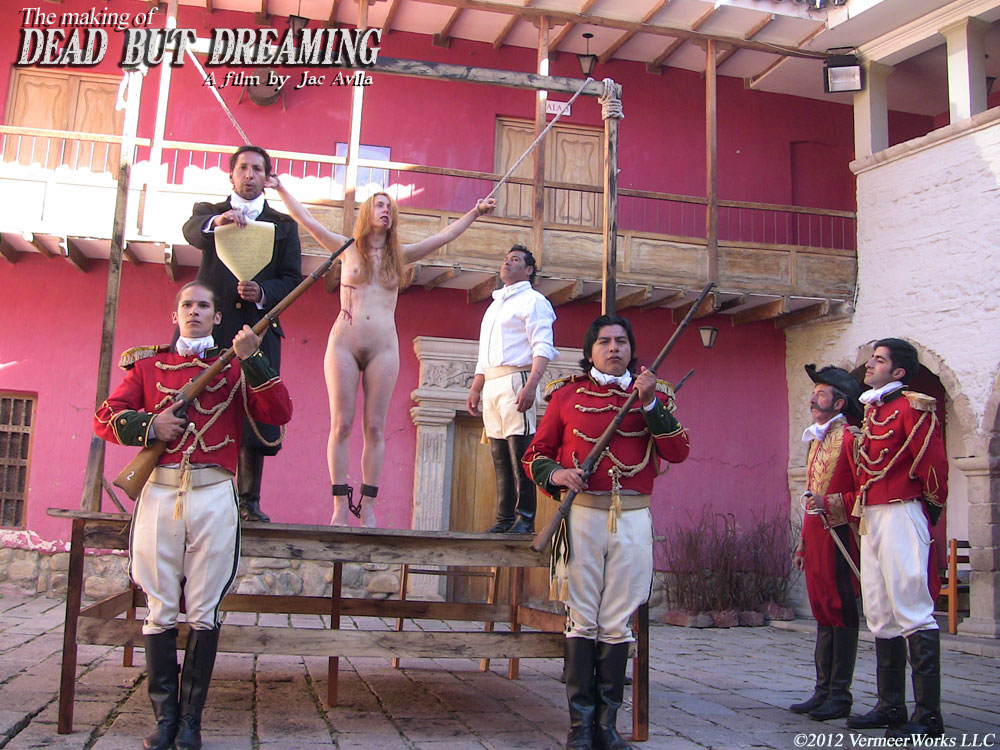
Incidentally, the public fascination with death lingered into the 19th century as Jac illustrates in Dead But Dreaming when the Irish traveler is garrotted before onlookers.

img-1409813635

Jac then cites the distinction between the Catholic and Protestant interpretation of sexuality.

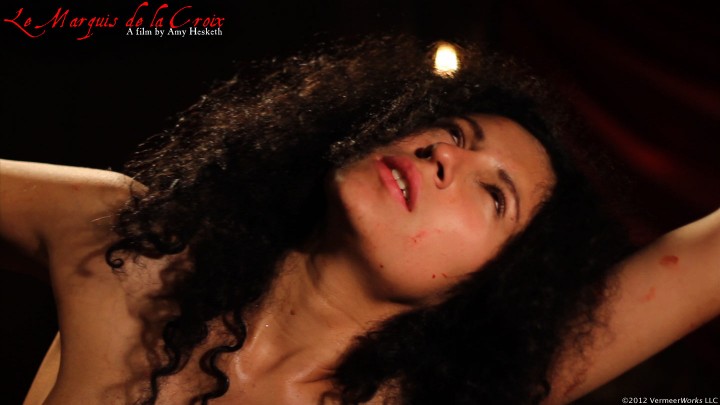
“Catholic imagery is full of The Body in Pain, a beautiful body, always, either male or female, almost nude or totally nude, with an expression of bliss in the very moment of martyrdom.”

LeMarquisTeaseCaps01223212-720x405

Elaborating on the visual impact of a crucifixion, Jac explains, “The school I attended was full of those images. Beautiful paintings expressing exactly that. Catholicism is far less repressed sexually than Evangelical, Calvinist, Lutheran Christianity.”

He follows that thought with a quick history lesson.

“The framing of the body in medieval Europe, was intrinsic to the historical moment.  Humanity was moving from an agrarian culture to the beginnings of city culture. Social interactions were changing dramatically. The image of the body as symbol became pervasive,” he says.

Jac regards the 12th century (1100s) as a pivotal time in the emergence of the body as art.

“The Church had the most power in influencing most everything,” he notes, which lasted until the Renaissance, a time “when art flourished and thought was liberated by Thomas de Aquinas (Catholic theologian and Scholastic) when he gave some long overdue importance to humans.”

For the most part, Medieval art is purely religious with Christ “an overpowering figure taking up the entire frame,” Jac suggests.

In other words, man is not celebrated. The heavenly bliss of eternity and the proper way to get there occupied Medieval artists, who, incidentally, never signed their work.

By the Renaissance, change was on the horizon. The ideals of humanism were infused into culture, at least in the Italian City-States where money patronized the arts. The result? Art and literature achieved a secular focus.

As for art’s theological representations, Jac gives us this example. We see the Virgin Mary as “a real woman breast-feeding a child,” a cultural broadening influenced by Aquinas.

And somewhere along the way, our sexual fascination with crucifixion and suffering took hold.

Feminism

So, what about the sacred feminism popular in pre-Christian cultures?  I suggest the Church patriarchy had some issues with this idea. Jac spins it less severely.

“Catholic doctrine did not do away with the Divine Fem all together. Mary was and is an object of worship almost equal to God, she’s more accessible; she is the mother. But yes, women were repressed of course, but so were men. The great fear is the true liberation of mankind. We’re all afraid of freedom. I don’t think we’d know what to do with it.”

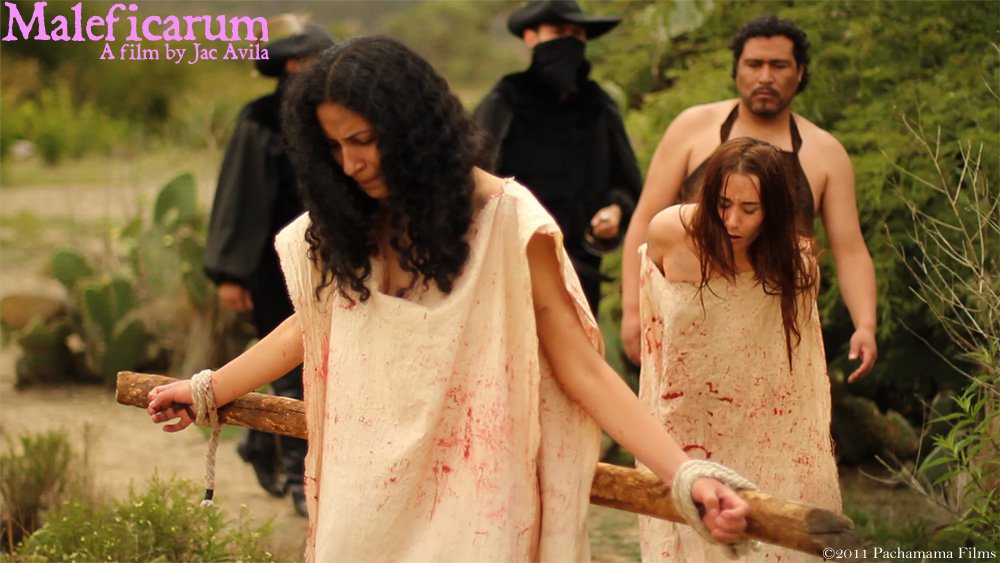
Mila Joya and Amy Hesketh in Maleficarum's execution scene, a reminder of the Church's fear of witches.

The Church’s fear of witches and it’s repression of women in Maleficarum’s execution scene.

I agree with the repression/freedom argument. Certainly the Church did not abide heresies and especially witches and warlocks. By the 15th century the Inquisition (the subject of Jac’s film, Maleficarum) was holding court. Credit Spain’s Ferdinand and Isabella for making sure everyone toed the religious line.

The Church court extracts a confession from Amy's character in Maleficarum.

Inquisition torture extracts a confession from Amy Hesketh’s character in Maleficarum.

Regardless, Jac steps up his defense of the Sacred Feminine.

“In Catholicism women have a high place because of the Virgin, The Mother of God herself. Catholicism is not as patriarchal as it may seem to be. What we may be expressing is that women, just like men, have the same or more capacity to suffer for humanity.

“In that sense, female martyrdom gets equal treatment… or better yet, takes the main role. The strongest character in Catholicism is Saint Eulalia. She’s crucified twice.”

Of interest is that the original St. Elulia, the reference in Jac’s film Martyr discussed in a previous post, was, according to legend, a teenage virgin tortured and crucified on a St. Andrew’s Cross.

Carmen Paintoux

Carmen Paintoux in Martyr.

So there we have it. Do the images from Jac’s films energize the sexual question?

The Guignol Again

Despite the Church’s efforts, the uneducated retained their superstitions and out of this, particularly in Central Europe, phantasmagoric visions and stories emerged of evil forces beyond human control.

“As you know, most of the horror stories, like vampires, come from the old tales of old Europe, which come from far back in time,” Jac points out.

Veronica Paintoux

Veronica Paintoux as the Lamia.

And as we move from Medieval into modern times, with stops for the Enlightenment and Romantic Periods, superstition and the supernatural forces that go bump in the night linger in the human psyche.

It’s not a leap to understand that our world is still fascinated by cruelty, especially sexual torture, and can’t look away.

Our repressed blood lust comes to life with vampire stories and today’s slasher films which tap into horror as it emerged out of the Victorian Age into modern Europe.

10265587_486401324822610_8032003204742406405_o

But we don’t need the fantastic to energize our sexual interests. Human depravity played out realistically on a stage will do.

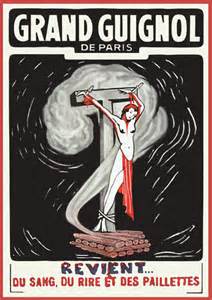
th“The Grand Guignol has its roots in that period of time where executions were performances for the masses. That’s why Guignol was also described as the Theatre of Cruelty,” Jac explains.

In fact, the Parisian stage and the fascination with crucifixion fuel the star power of Amy, Mila Joya, and the Paintoux sisters, Carmen and Veronica.

Brew the mixture of history, religion, and sex into a cauldron of savagery and sadism and what emerges is a new version of the erotic horror genre that is distinctly Jac’s and Amy’s, Olalla being the latest in a line of powerful films.

Framing the Body

“Not everything medieval was cruelty, of course,” Jac continues.

“There was a nurturing, serene, body sharing space with a conflicted body torn by desires, fantasies and that other body, the one in pain, dismembered, racked, whipped. The education of the masses by framing the body became all important.”

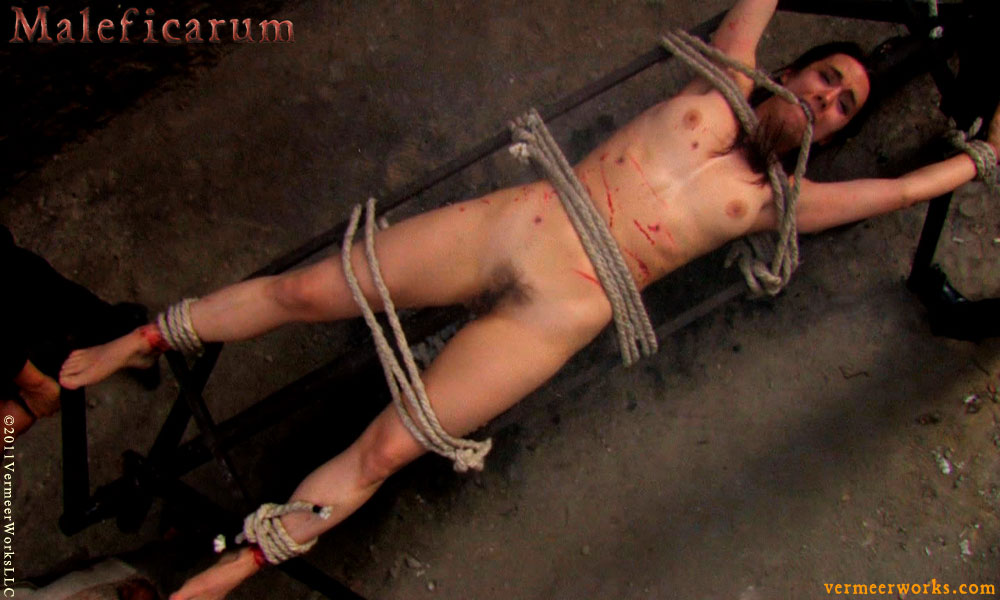
Mila Joya tortured in Maleficarum

Mila Joya’s character exemplifies “the body in pain” in Maleficarum . . .

Finally, the native Bolivian offers these comments on Amy’s Hesketh’s approach to her acting.

“As far as Amy’s performance in the films, like in Dead But Dreaming or Olalla I can say that those scenes are the way they are because of the stories. This goes to the Body in Pain discussion. The body as a central symbol in culture, but as it was seen in medieval culture, where much of the representations we have now originate.”

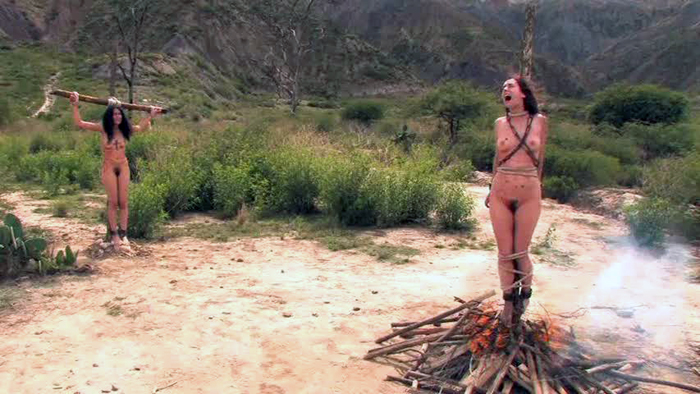
Maleficarum's roasting scene.

. . . As does Amy Hesketh in the film’s roasting scene, a particularly difficult and emotional shoot.

That is where Amy seduces the camera like no other actor.

To reassure the fainthearted, Jac leaves us this note about female performers in his films. Yes, they illustrate the Grand Guignol stage, as noted above, and all its perceived brutality, but there is more.

“Acting in these movies is, in a sense, empowering. The actress has complete control over her body, mind, and soul, to do anything she wants to do.”

That in itself is an empowering feminist statement.

Amy, Jac, and Mila.

Amy, Jac, and Mila . . . artists, innovators, and a new film intelligensia.


Leave a comment

Filed under Uncategorized

Jac Avila, Part Two: That Fantastic Thing

by Rich Moreland, August 2016

In this post, we’ll find out about Jac Avila’s background and his view on the female characters he creates.

*          *          *

Jac Avila as actor.

Jac Avila as actor.

Jac Avila is of international stock. His father was from Holland and his mother, Bolivia, giving him a heritage that is Dutch, Spanish, Basque, and French.

Born in Bolivia, Jac grew up in a Catholic society, a culture that takes on its own identity and values which many Americans don’t grasp. We tend to compartmentalize religion, often limiting it to merely attending church, and don’t see it as a larger social/cultural ingredient in our lives.

On the other hand, a Catholic society is overarching, emphasizing spiritual issues without negating worldly values. For example, it insists that learning take center stage in a child’s life.

“I was educated in the most exclusive Jesuit school in La Paz,” Jac points out with pride. “The education was secular with a big emphasis on science. No conflict there. As a matter of fact, Jesuit priests were very much ahead in everything. The religious aspects of our education was a mixture of ethics, morals, mysticism and the understanding that a great part of the Bible is rather symbolic and mythological.”

Sadly, his mother passed away before Jac entered his teenage years. His father moved Jac and his brothers to New York City where the future actor/director/producer studied movie making, art, and photography.

The Blue Buick

“After graduation I started working at CBS and later at a photo studio specializing in advertising. I quit my job in 1979 to become an independent filmmaker. By 1982 I was making my first film in Haiti and Cuba by way of New York and Miami,” Jac explains.

The film premiered at Cannes in 1988.

“It took me that long to make it,” he confesses, not surprising under the circumstances.

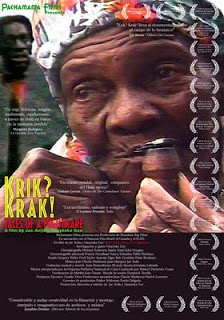
krikKrakPosterFacing expenses that can easily derail projects, Jac spent most of his time doing what indie filmmakers learn is part of the game: meeting the right people and raising money.

The film was Krik? Krak! Tales of a Nightmare which Jac co-produced and directed with Vanyoske Gee. Jac characterizes the production as “a surreal/expressionist docu-nightmare” about the brutal regime of Haiti’s Papa Doc Duvalier that includes the spiritual aspects of Haitian culture.

The work, though difficult, answered “a more political, radical call” for him, Jac declares, and was definitely a “challenge.”

And rewarding . . . the critics received it favorably.

“Le Cahiers Du Cinema, foremost film magazine in France described it as a great horror film in the tradition of Witchcraft Through the Ages,” Jac remembers.

From there he made a television mini-series and a handful of documentaries before shooting a “‘performance'” video, an inexpensive “project that started something unexpected that built everything” he is currently doing.

Jac explains how it happened.

When he was visiting Cuba, he developed a script about a young woman during the island’s colonial days who “has fantasies about being a martyr,” a practice common in “the traditional holy week procession.”

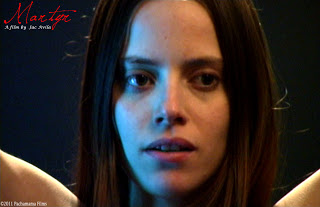
Carmen Paintoux had the lead role in Jac’s mini-series at the time and they discussed staging the girl’s fantasy for video. “During that process, she created Camille who is the central character in Martyr,” Jac says.

Martyr011244-300x194

The short film was born and the budding filmmaker’s career took on a new direction.

A remarkable journey for a little boy who saw his first movie at age four. Its violence left an impression. The Film? Walt Disney’s Bambi.

“I don’t remember anything before the movie. I remember everything after the movie, even the song that was playing on the radio when my uncle drove us back home in his blue Buick.

“From that moment on all I wanted in life was to know about that fantastic thing I experienced that day.

Magic to Art

Considering what he’s told me, I ask Jac if he designs his films to be political and religious commentaries.

“Not necessarily,” he begins. “Art is beyond those limiting systems. While religion tries and fails to interpret the unknown and the mysterious, politics often try, earnestly, to fit a square into a triangle, with fatal results.”

Having said that, Jac admits his explanation may sound  “a bit simplistic, since both religion and politics are mechanisms humanity uses to organize itself into something manageable.”

“In a way, mankind created gods to control itself,” he believes. But in time, more practical attitudes took shape and the overarching role of the gods receded in favor of elected leaders in civilizations like Classical Greece, for example.

Nevertheless, there is a magic to art, Jac insists.

“Art interprets what we see and turns everything on its head, art can also imagine a million futures and a million pasts. We don’t mock religion or politics [in our films], it’s just our artistic view of humanity.

“I honestly hope that our audience enjoys our movies for what they are and take from them what they feel like taking. I don’t really mind if they hate our movies. I love it if they love them. I hate it if they are indifferent.”

The Heroines

Fair enough. Now what can we say about women as they are presented in a Pachamama film? Are they captives of their own compulsions, unable to forge their own destinies, as might seem at first glance?

Jac gives us his view, beginning with Ollala.

“Olalla and Ofelia (Olalla’s sister) are not weak because women are not weak. This nonsense of the weaker sex is just that, nonsense. Patriarchy is a response to that strength. At one point men felt the compulsive need to control women first and other men second.”

10295096_486400914822651_2960701464743764157_o

With a moment’s pause, he adds, “Religion and politics are attempts to control, to make everything fit a pattern that can be controlled. That’s a very primitive view of life.”

It just so happens that when it comes to Church and society, the simpler, the better.

“There’s nothing more scary than women taking over, like in Olalla when she sucks the blood out of her boyfriend. It scares even women, so they have to burn Olalla’s mother,” Jac says.

OlallaVidCaps01291605

What about the other films we’ve mentioned?

Jac has his thoughts.

“The female vampires in Dead But Dreaming survive cruel torment, the accused witches overcome their death sentences in Maleficarum.

bts dead 5 on our way

“Is Varna [in Dead But Dreaming] taking the route Moira took? Will Justine go on after her ordeal is over?”

dbd00470222

Jac states that women in his films are his main focus, and I might add, his source of strength.

“The principal characters in all my movies, including Krik? Krak! are, for some reason, women. They are the heroines in all my stories. Men take second place either as aggressors or victims.

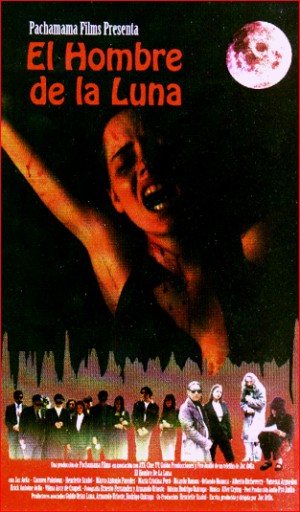
“Even in the miniseries El Hombre de la Luna, where I play the central character, an attorney/painter investigating the death of a young woman, the women in the story solve the problem and rescue the attorney from certain death.”

hdlposter04-300x512

But Jac’s women do suffer and it seems to have a sexual theme. So how does pain work into the art he and his filming partner Amy Hesketh create?

We’ll look at that next.


Leave a comment

Filed under Uncategorized

Jac Avila, Part One: A Working Relationship

by Rich Moreland, August 2016

Recently I’ve reviewed two erotic horror films, Dead But Dreaming and Olalla, products of the independent film companies, Pachamama Films and Decadent Cinema.

This post begins a three-part series on actor/producer/director Jac Avila whose business imprint is Pachamama Films.

Here he discusses his professional relationship with Amy Hesketh.

*          *          *

Martyr

Jac Avila and I have some common theatrical interests, among them the Parisian theater of fear and terror, the Grand Guignol. Pachamama’s take on the horror genre is influenced by the Guignol stage.BarbazulJac001tiny

“We’re very much inspired by Grand Guignol,” Jac tells me. Since the 1990s, the producer/director has shot “a series of performance videos” that reflect the theater’s unique stamp on shock and violence.

As his evolution in film progressed, Jac’s work drew the attention of Amy Hesketh, who was building her own erotic on-screen resume.

MartyrPosterSmall2One of his films, Martyr or The Death of St. Eulalia (2002), became the catalyst for the their artistic collaboration. Though it was made in New York, (Jac maintains dual residences in NYC and La Paz, Bolivia), Amy saw the movie in South America in 2005.

“It made a huge impression on her and that’s when she decided to join me in this adventure,” he recalls.

At the time, Amy was more into photography than modeling, Jac explains, and had aspirations to write and direct.

Martyr stars Carmen Paintoux, a French actress, whose history with Jac dates to the 1990s. The themes of Christian sacrifice, sadomasochistic relationships, and suffering drive the film and captured Amy’s interest.

Martyr001242

Subsequently, Jac began a working relationship with Amy, who picked up acting again. She joined French performers, Carmen and Veronica Paintoux, to create a new and innovative indie film narrative.

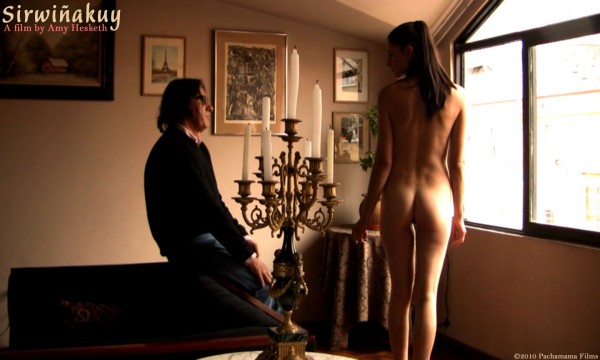
Amy’s first feature as writer and director was  Sirwiñakuy, a tale involving an older man and a younger woman in a BDSM relationship. “She wanted Veronica to play the lead character,” Jac mentions.

Sirwinakuy236-600x360

Later films like Barbazul, Dead But Dreaming and Olalla, saw Amy step in front of the camera. Not unusual, he adds, because Amy “puts herself in the more difficult roles” much to the delight of her fans.

In the movies I’ve seen, Amy dominates the lens. I asked Jac about her motivation to play parts which appear, at least on the surface, to be masochistic. Jac has some suggestions, but makes it clear he cannot speak for her entirely.

Catharsis

“The characters she plays appeal to her, yes, and at the same time scare her,” he begins.

Jac mentions Justine, a character in a film by the same name yet to be released. It’s based on the de Sade novel, so the sadomasochistic corruption of the innocent steps forward as one would expect.

JustineMakingOfDay01_2585

Due to Justine’s “religious stubbornness” Amy doesn’t have a glowing opinion of the girl as she appears in the novel, Jac remarks. In fact “Amy thought she was an idiot.” However, he adds, “as in any art, a part of us is in those characters and a part of our experience is expressed in them.”

“In some cases it becomes cathartic,he believes.

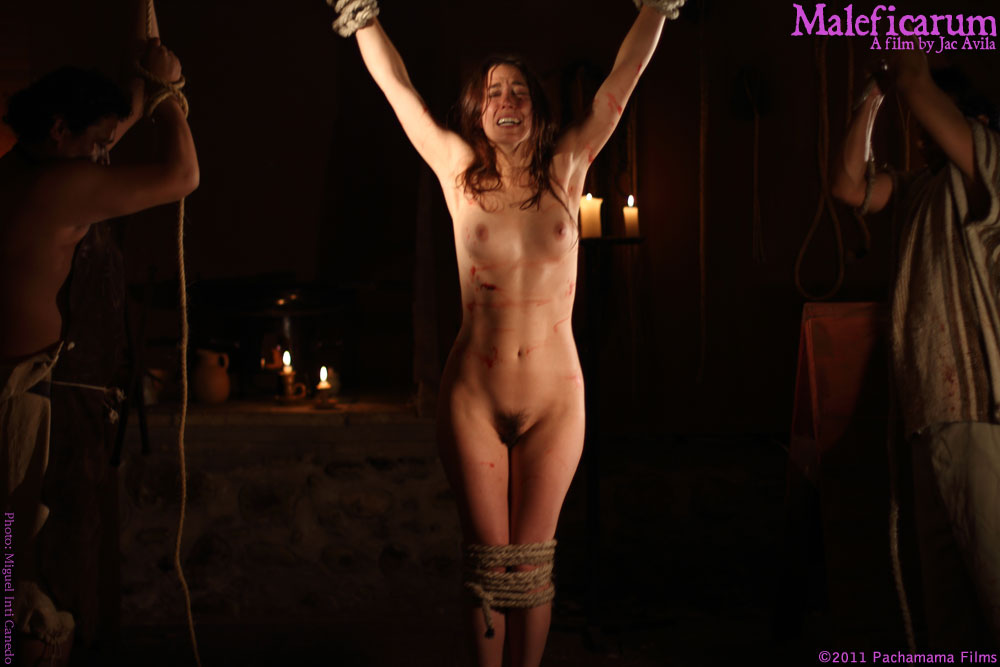
An interesting thought which I think is clear in Amy’s portrayal of Olalla and her role in Maleficarum, a film involving witch torture.

According to Jac, “Amy plays what appears to be submissive roles, although I see them more like women in peril type of characters, they do not submit, they are forced into their particular ordeal. I can even say that some do not go quietly into their ‘doom.’”

Maleficarum6344

As heroines, Justine and Olalla are united in that respect, but by different circumstances. Perfect, I might add, for Amy Hesketh’s talent.

How much more of that talent we will see on-screen may be waning because Amy is now concentrating on writing and directing. But she has an impressive resume as an actress.

“The way she prepared herself for her roles in the movies we made is impressive,” Jac remarks.

Bodies and Minds

That brings up another topic which needs clarification. Amy Hesketh and the other actors in the Pachamama troupe, Mila Joya and Veronica Paintoux, in particular, are whipped, tortured and crucified. So, are they the darlings of the BDSM crowd who might flock to see their films?

Sirwinakuy0012-300x389“I don’t think our films fit into what would be the traditional BDSM genre, except perhaps for Sirwiñakuy, which is about an S&M relationship, and Pygmalion, that has those elements too,” Jac observes.

As a director and actor himself, Jac notes that everyone in the troupe gets to “display different personalities in different filmswhich is diverse enough to move beyond the dominant/submissive formula.

“When they do get into their characters, they do go into them with intensity and completely, they become those characters for the time of the shooting. In other words, they do put their bodies and minds into them.”

Then he offers up a dose of reality.

tumblr_litvpumDNz1qhi6wuo1_500“I can also say that they do suffer, physically and mentally, during the difficult scenes. The whippings hurt, the crucifixions are very, very uncomfortable and even painful. There’s a lot of real suffering going on. I do not think that any of them enjoy that, they put up with it for the art.”

The Liberating Part

Of course, Pachamama/Decadent productions have their share of naked female flesh that some viewers may consider to be on the border of softcore porn.

Jac presents his take on that interpretation by referencing the Sexual Revolution of the 1960s and its counterculture.

The films of that era represented “an explosion on the face of Catholicism,” he notes. They were a part of the “cultural movements of the time,” in which new artistic and strident voices captured the day.

“In Europe and South America the rallying cries were the movements of liberation from whatever people felt they needed liberation from. Soon, in both worlds, the sexual revolution took over.”

With that, Jac Avila is blunt.

“Nudity in our films is the liberating part. People are still traumatized by nudity, it baffles me, so we put in on their face, warts and all.”

Sirwinakuy169-600x360

That is good news for all of his and Amy’s fans.

*          *          *

Jac Avila can be found online at jacavila.blogspot.com.

All Jac and Amy films are distributed by Vermeerworks.


Leave a comment

Filed under Uncategorized

Olalla, Part Five: The Portrait

by Rich Moreland, July 2016

This post wraps up a few details about Olalla as I’ve interpreted the film.

Here we consider the portrait’s importance in the story and take a look at some of the cinematography.
*          *          *

Gothic

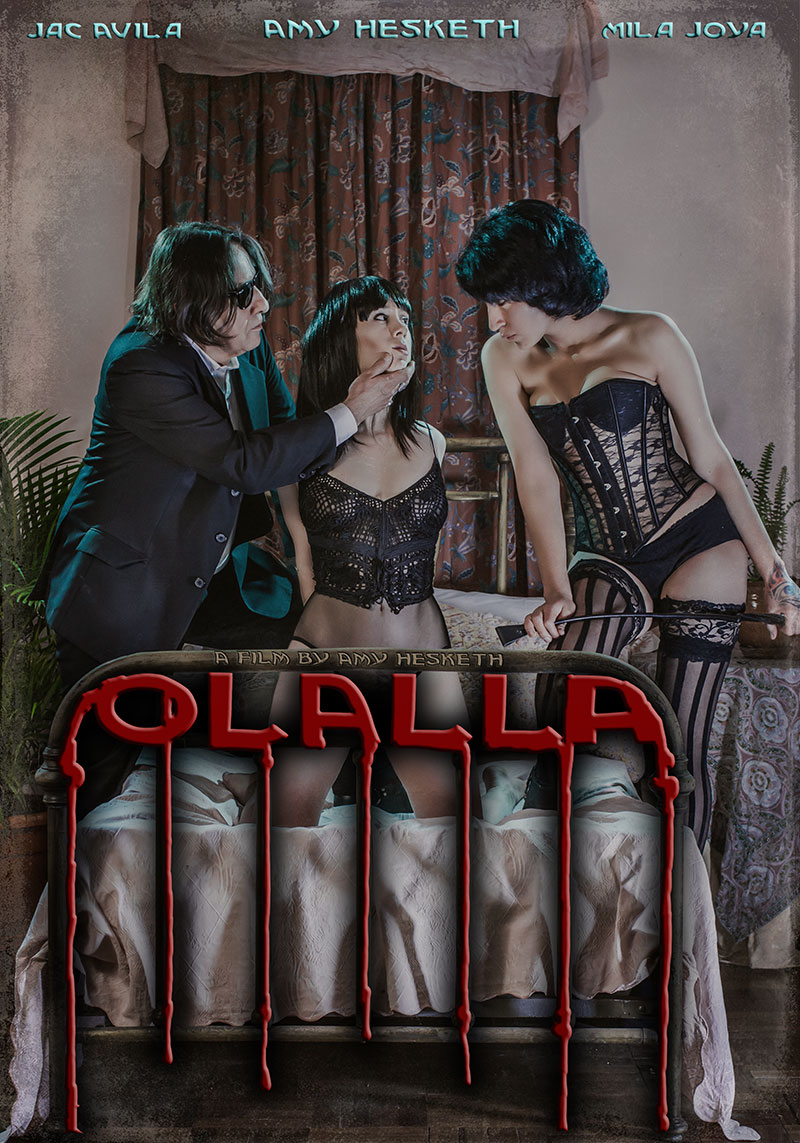
OlallaPoster800The central image in Robert Louis Stevenson’s “Olalla” is the portrait in the English soldier’s bedroom. It presents “a woman, still young” whose body is “very slim and strong.” Yet, she is “marred by a cruel, sullen and sensual expression,” the Englishman notes, and he fears the lady may still exist “in the body of some descendant.” Nevertheless, he is drawn to her.

In the film, the portrait travels across time. It is in Roberto’s bedroom in the 1885 setting and then in Nathan’s in the modern era.

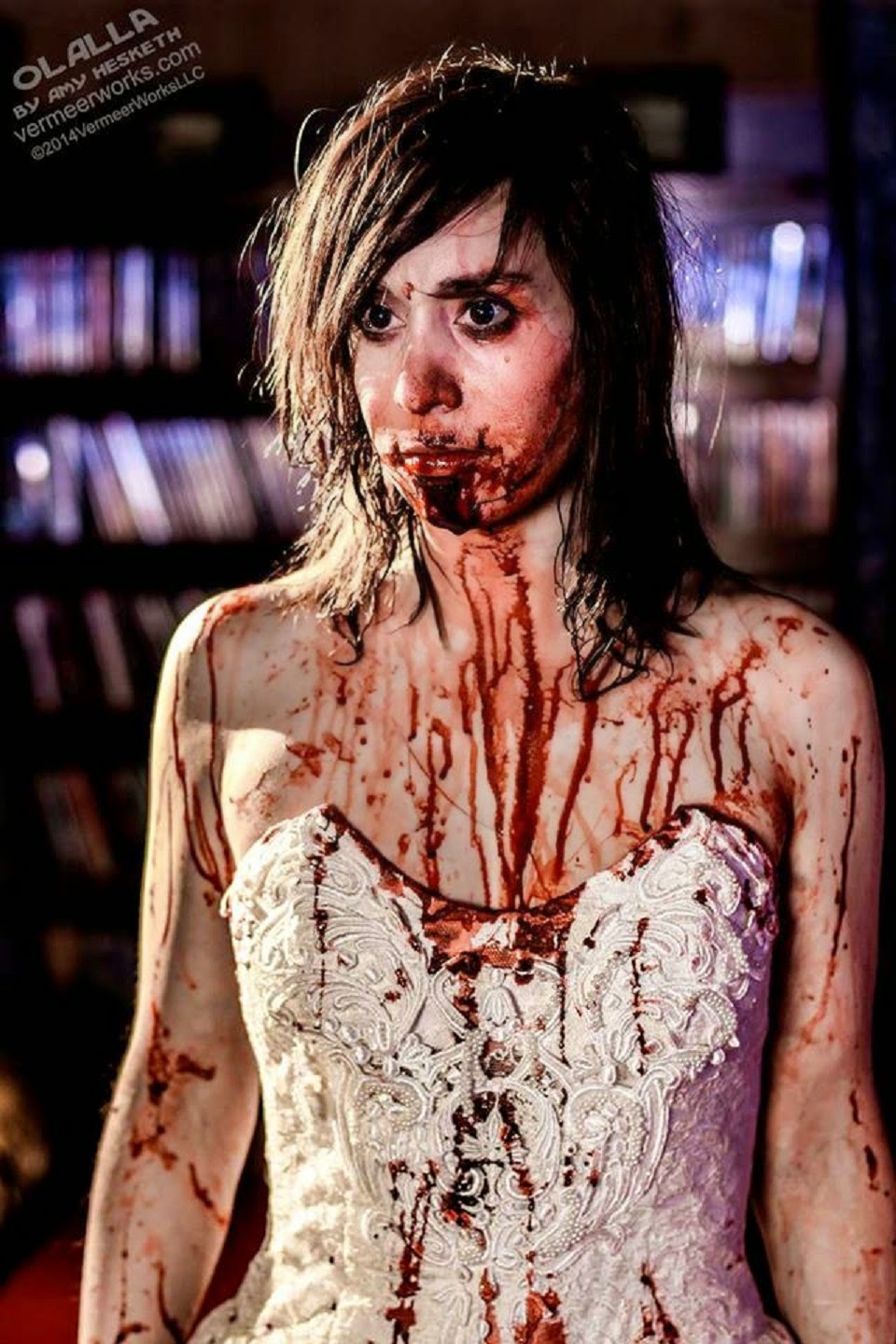
At one point, Nathan, who is the final incarnation of the house guest, gives credence to the Englishman’s apprehension. He gazes at the woman’s face and it fades into Olalla’s, a bit of blood dripping from her mouth.

Like the English soldier who is “haunted by cries of pain” in the night, Nathan hears Olalla’s whimpering coming from her room. Could it be that Felipe is his sister’s abuser in Stevenson’s mind? Amy Hesketh lets us in on that secret in her updated version of the story.

Later, Nathan wants to photograph Olalla using his tablet. She resists at first, but gives in, and the photo reveals much.

First, her image is there, questioning the traditional (Bram Stoker) interpretation that vampires aren’t reflected in mirrors. Then, there is Olalla’s comment that she appears pale, perhaps denying any self-recognition that she is vampiric. Nathan counters her remark with the word “gothic,” an interesting concession to Stoker.

That strikes a chord with Olalla because she responds with one the film’s major themes. “I want to look normal.”

A test for angle and shadowing.

A test for angle and shadowing.

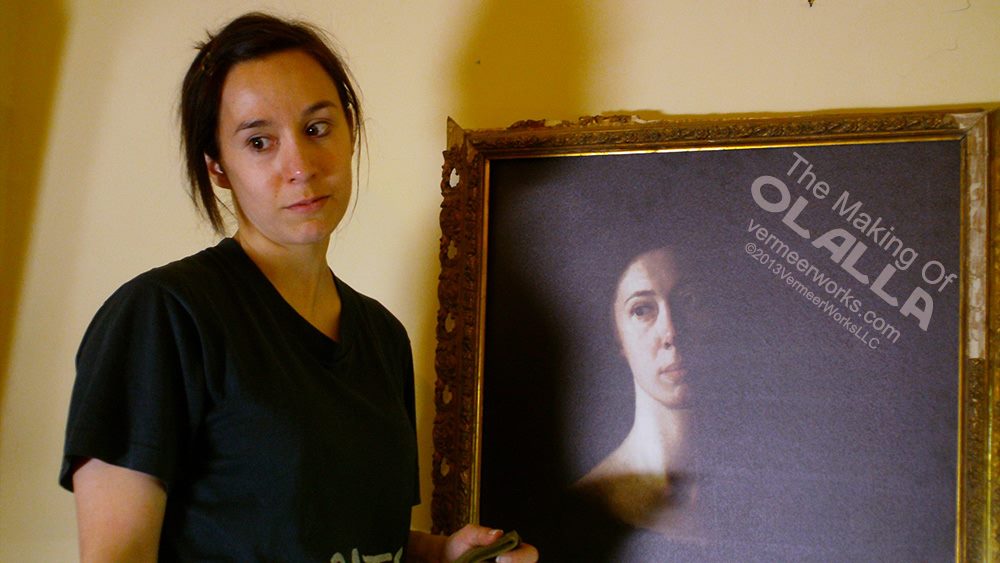
The portrait and the photo solidify the Olalla story. Both have the same shadowing that mutes the left side of the face. Olalla, like her ancestor, is crushed by a past she cannot escape. It’s the darkness that has engulfed the family for generations.

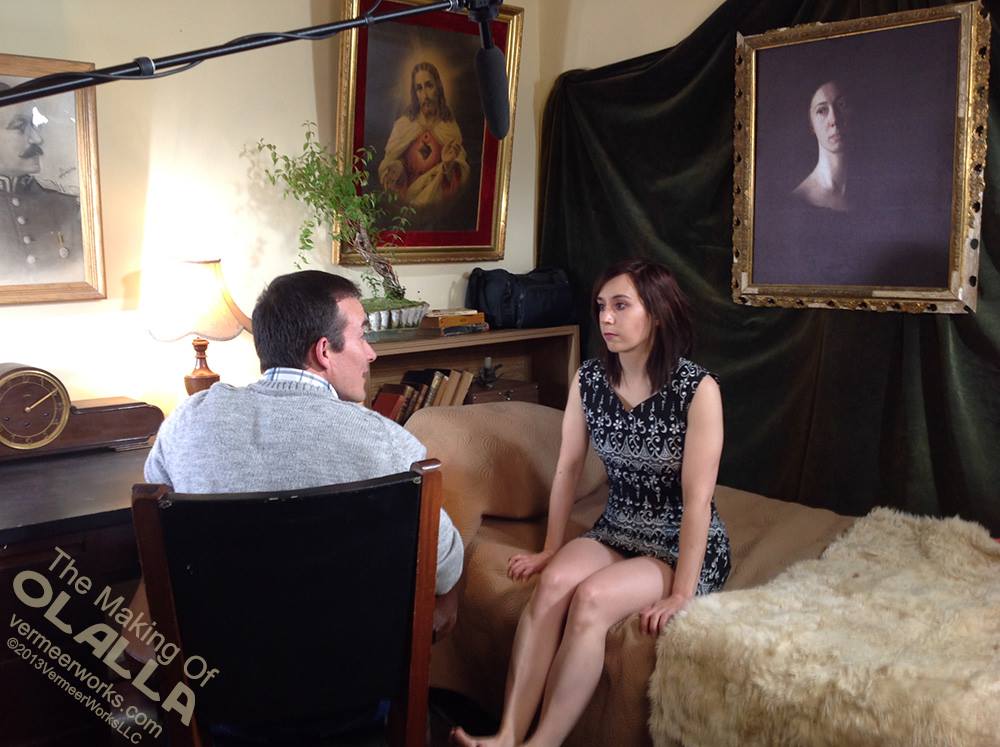
Coincidentally, there is a portrait of Christ immediately to the left (from the camera’s perspective) of Olalla’s ancestor. This foretells a cinematic ending that magnifies the conflict between suffering for sin and yielding to evil.

The images are together

The images: the soldier, Christ, and the ancestor

To bring all the images together, there is one more picture in the room, a soldier taken in profile. It’s a tribute to Stevenson’s original English officer, though the photo is of Victorian origin that fits with Amy’s interpretation of the Olalla back story.

As an aside, there is one more observation concerning Nathan’s tablet. Like the flat screen TV in the apartment Olalla shared with her boyfriend, the tablet is modern technology. However, the family hacienda lives in another era as we’ve seen. Only when someone from the outside, like the boyfriend or Nathan, appears in the narrative does Olalla experience what she desires, the freedom to break away and be “normal.”

Then, in a never ending cycle of entrapment, she kills off her chances of escape with deadly fits of blood lust.

Feeling Alive?

Throughout the film, the camera captures important details that help us interpret the story. Here are a few examples.

Olalla is frequently barefoot, understandable since uncle Felipe derides her as a “stupid little girl” confined her to adolescence. In the family’s presence, Olalla’s body language assumes the awkward posture of a child. Her hands and her feet are restive in an atmosphere that clearly makes her uneasy . . . as children often are among adults.

10492294_510837182379024_5957775856219147208_n

In the living room, a glass curio cabinet is filled with bric-a-brac, much of it religious, such as the porcelain Madonna and angels.

Can we assume the family’s blood-thirst clashes with a faith they’ve long put on the shelf? Or, are the religious relics merely socially acceptable trinkets for display, not to be taken seriously? On the other hand, perhaps their blood cocktails are more sinister . . . a perversion of the blood of Christ celebrated in church ritual.

Taking this into consideration, we are inclined to believe that the crucifixion of Olalla’s mother, who committed no crime, was an act of redemption that gives the family a pass to be their wonderfully deviant selves.

Olalla and Nathan talk among the images within the cabinet.

Olalla and Nathan talk among the images within the cabinet.

Nathan and Olalla are united in one respect. He tells her that he has seen so much death that he can’t “feel alive anymore.”

The reality of that statement is ready to be tested by the family who is itself a reflection of his thought. Soon the party will begin and a table neatly organized with napkins, glasses, and the like is prepared. The arrangement is a set-up for a violent end: a pistol is centrally positioned among the dinner ware.

Nathan’s arrival is eagerly anticipated as one would the daily farmers’ market where fresh fruits and vegetables tempt the taste buds.

A Few Words about the Production

Olalla is a finely crafted film. Numerous close-ups connect the viewer with the characters. Additionally, Amy favors overhead and high angle shots, putting the family in a metaphorical fishbowl that invites us to watch their goings on with a mixture of macabre humor and pathos. Cinematographer Miguel Inti Canedo’s work is impressive.

A superb example is Olalla’s first appearance in the long hallway. It’s shot in single point perspective from high above with her a small figure at the opposite end moving toward the camera.

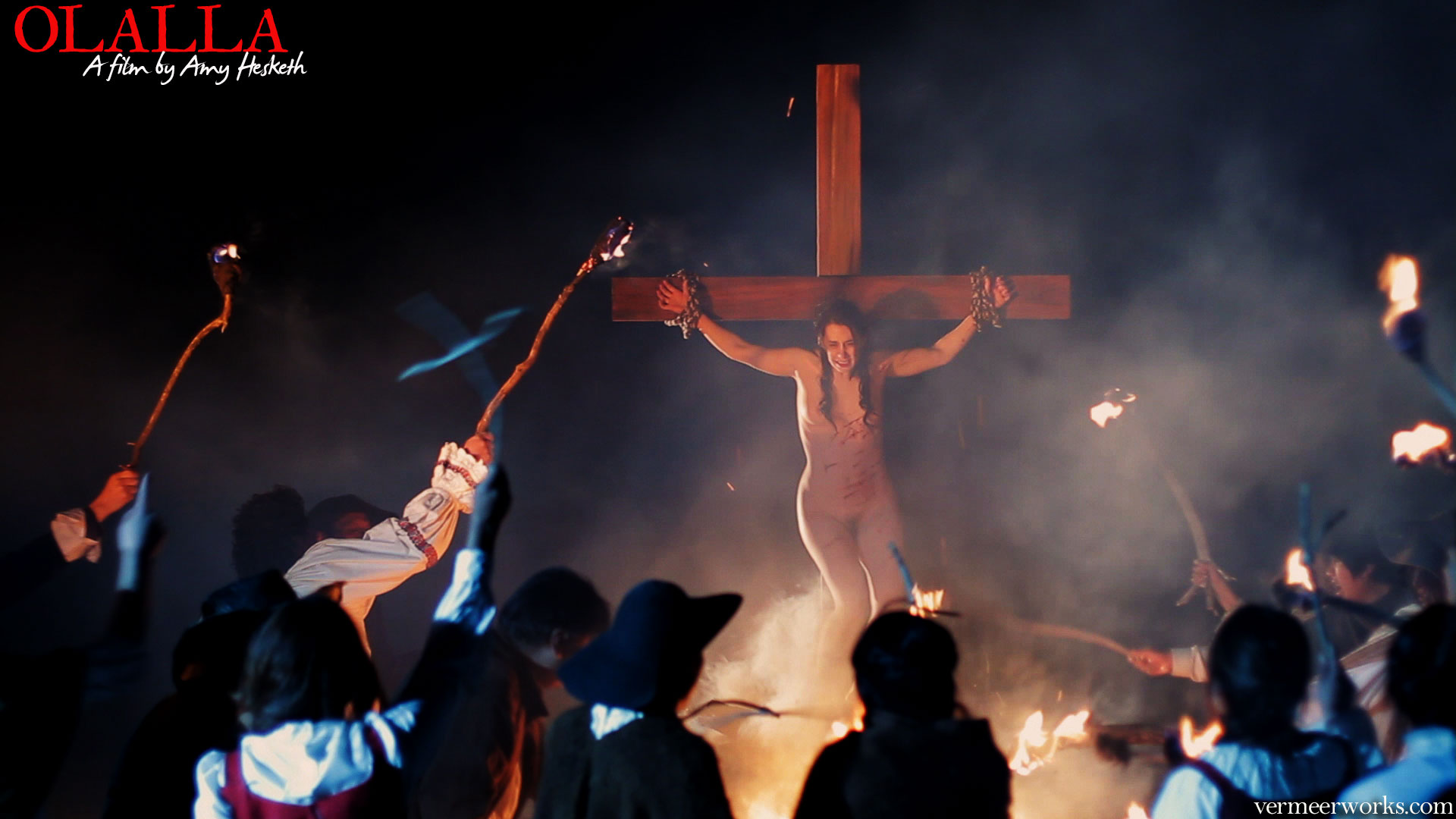
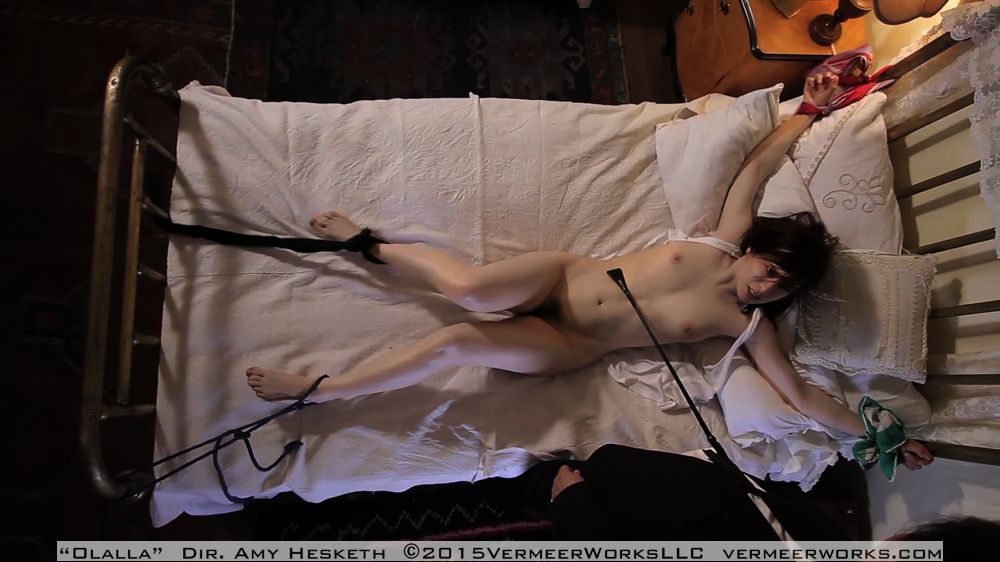
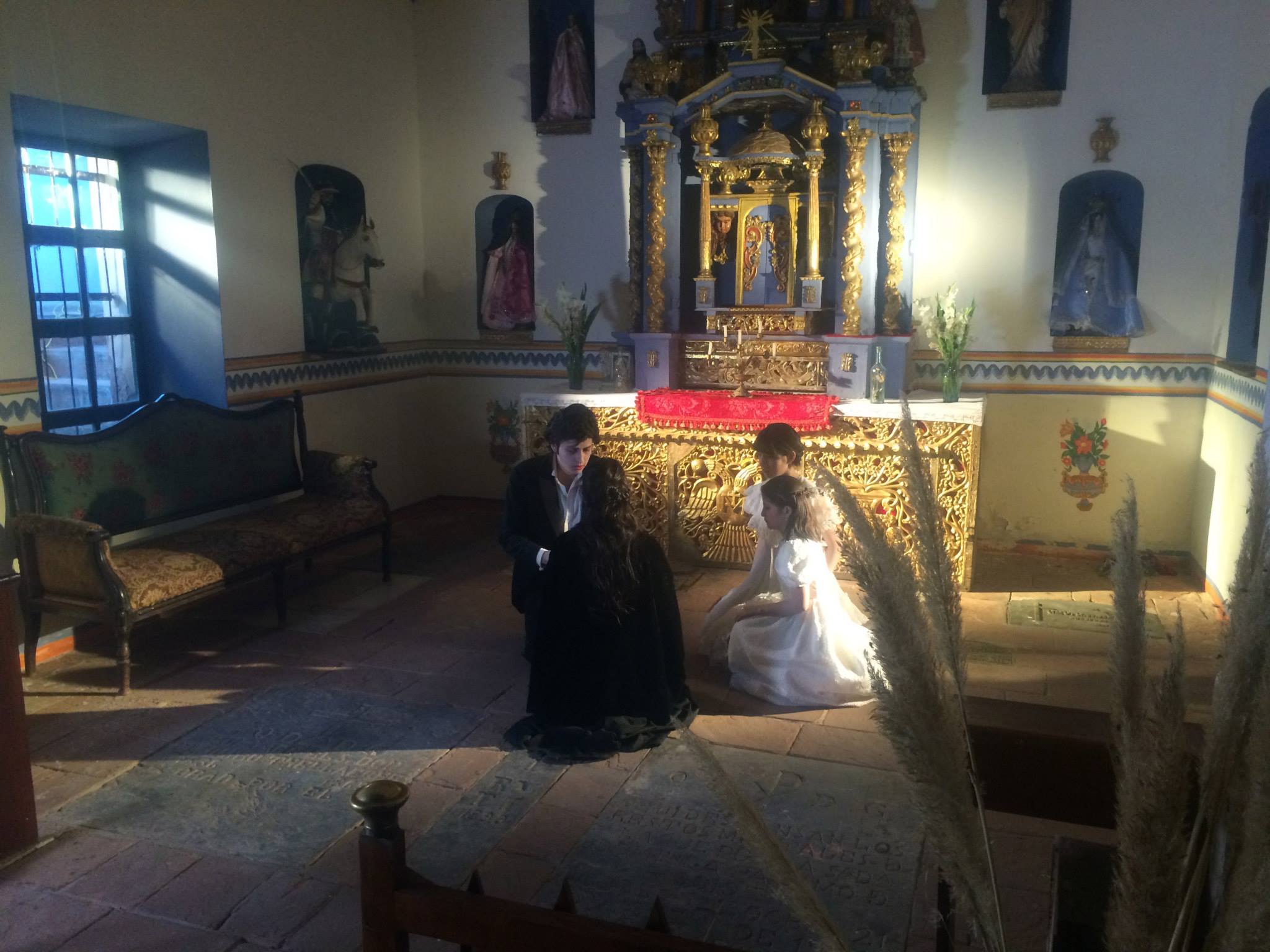
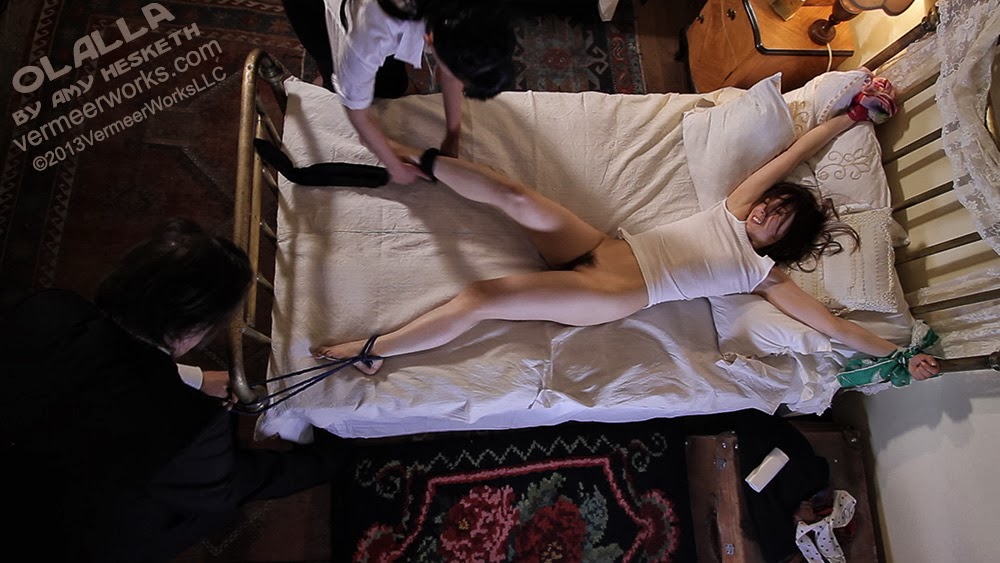
Later when Uncle Felipe overpowers Olalla, he binds her in a crucifix posture that references her mother’s death. The overhead shot tells us she may someday suffer a more grisly fate than a few beatings to reestablish her submission.

OlallaVidCaps00194209

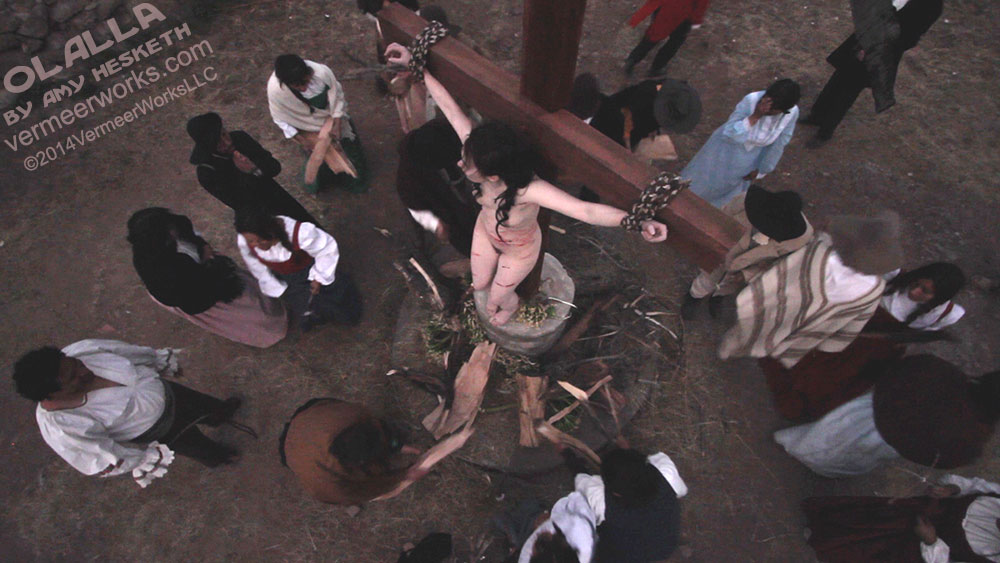
Nearing the end of the film, another overhead shot shifts the focus to the pitchfork crowd in the 1880s. Notice that the whip marks on Olalla’s mother replicate the strokes inflicted on a tied down Olalla. Mother and daughter are forever united.

Oh yes, don’t forget that the Englishman’s final memory of Olalla in Stevenson’s story. He sees Olalla “leaning on the crucifix;” Amy puts her put on it.

OlaSc62_2809_00003408-Promo

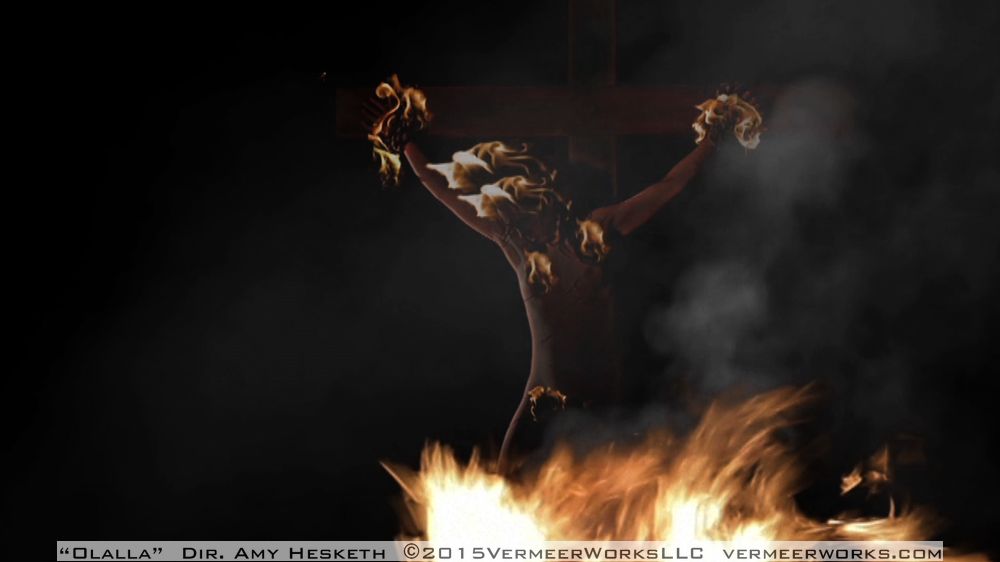
Olalla is a horror film, of course, but one that does not rely on special effects. Nonetheless, there is one spectacular moment when Jac Avila’s editing steps forward to show the fires that consume Olalla.

OlallaVidCaps01315708

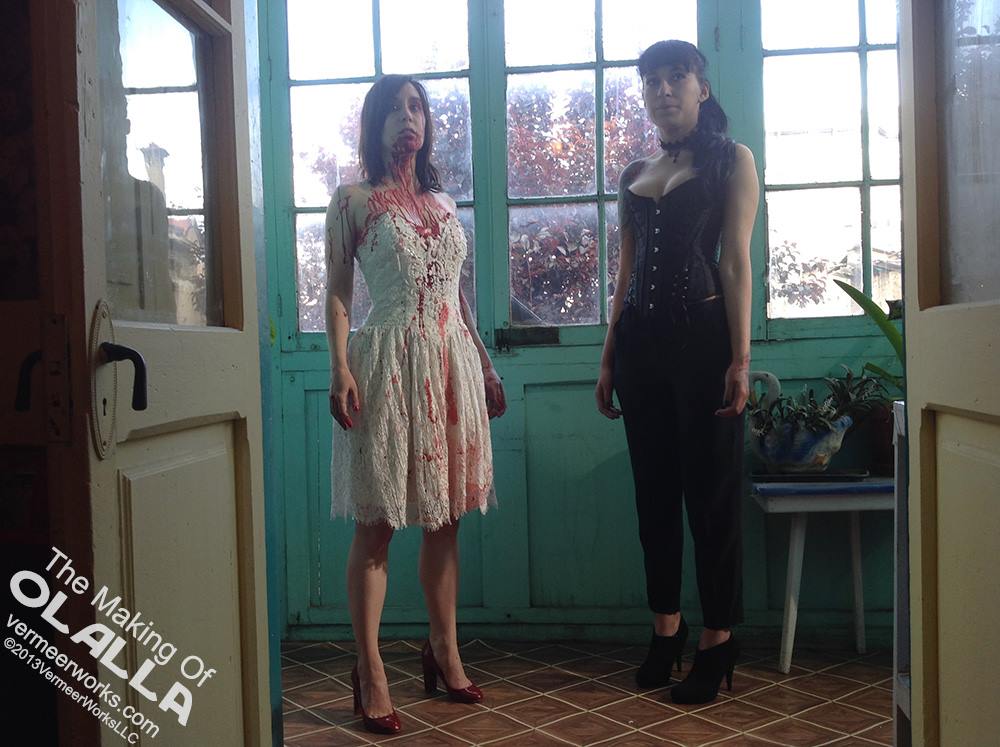
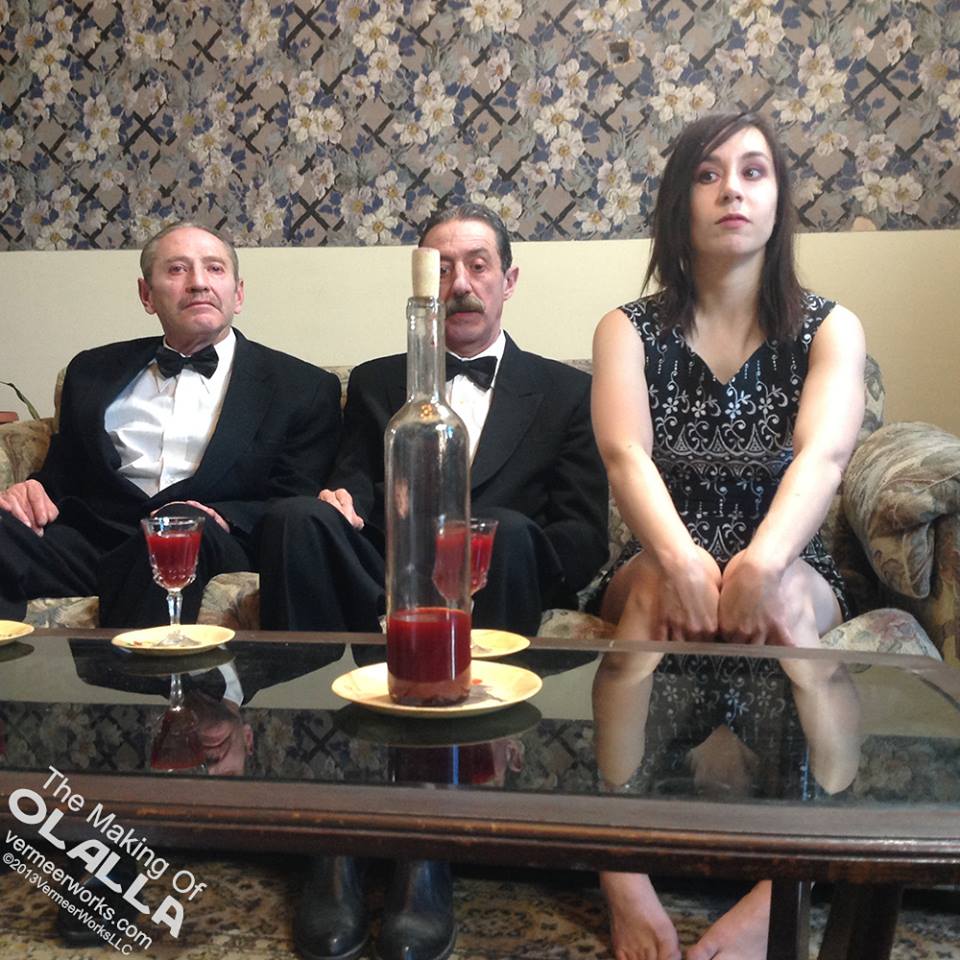
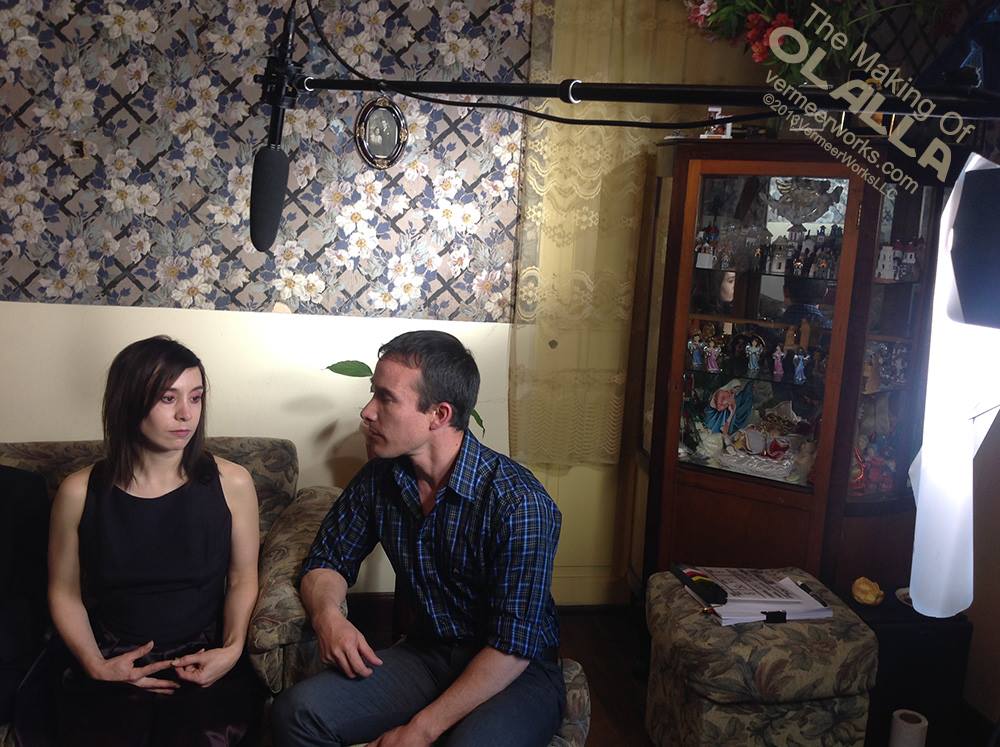
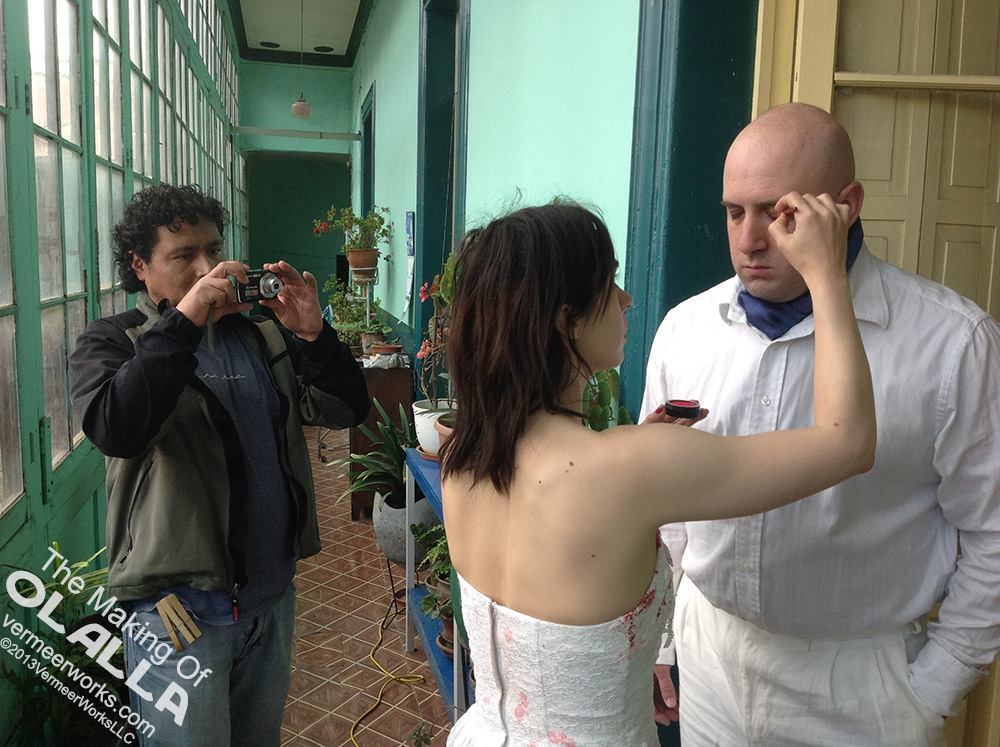
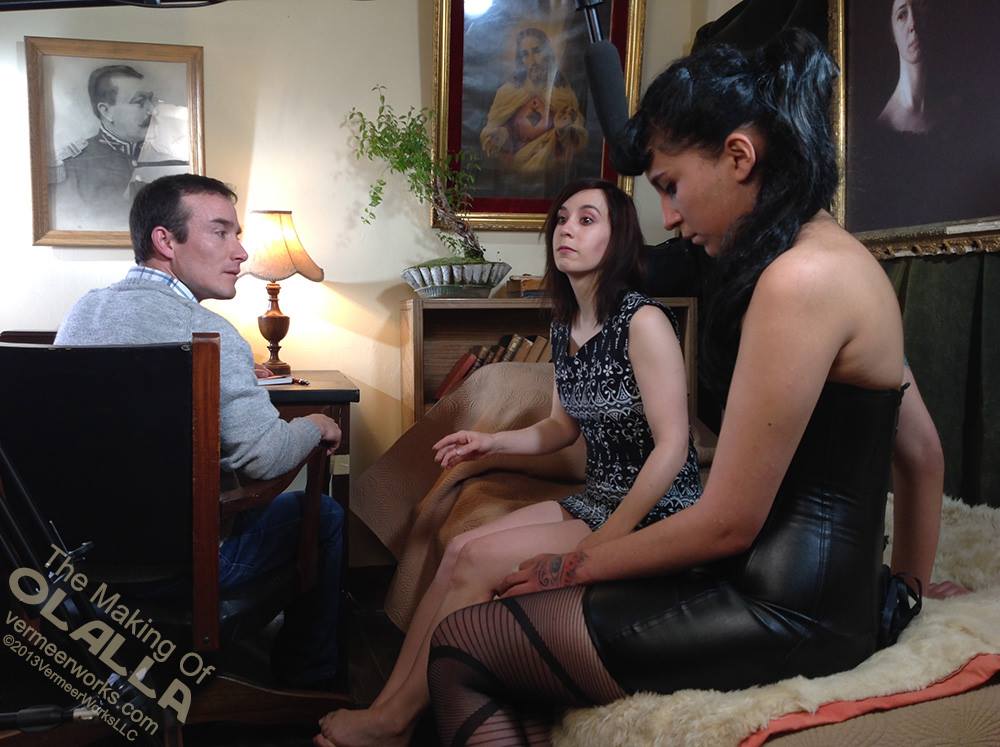
A note for anyone who doubts the versatility of indie film projects. Everyone does everything. Actors do make-up, take on the jobs of PA’s, build sets, capture the film grabs (production stills) and operate technical equipment when needed.

A director has many jobs!

A director has many jobs . . .

It’s the closest thing we have to neighborhood theater, a truly refreshing experience.

Which includes set construction . . .

Which includes set construction . . .

And speaking of performers, Jac Avila’s and Amy Hesketh’s Pachamama/Decadent Films is also an acting troupe. Revisit the second post in this series for the names of the talented people who do their very best to make every film a first-class production.

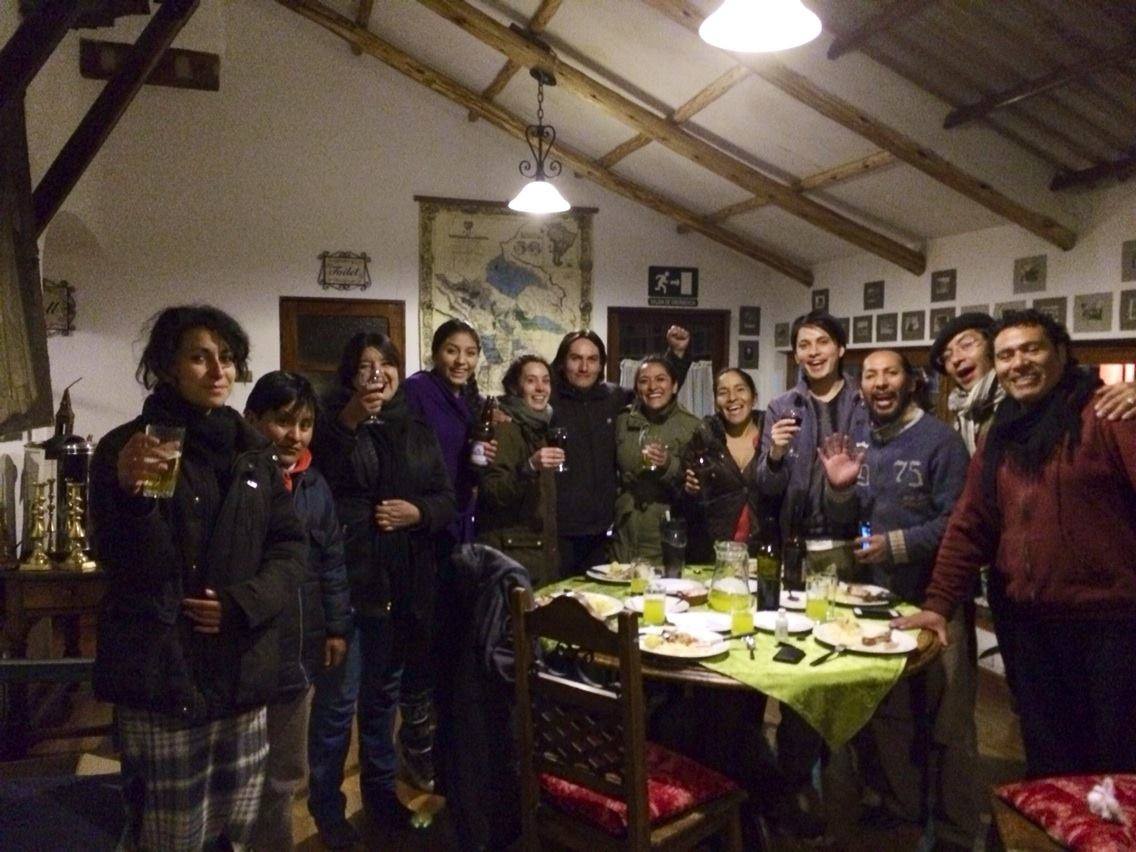
A celebratory moment!

A celebratory moment!

The Budget

Finally, indie productions must deal with the bane of budgetary restrictions. Considering that, Olalla is exceptional. Though the outdoor sequences are not elaborate, they more than adequate to supplement the story.

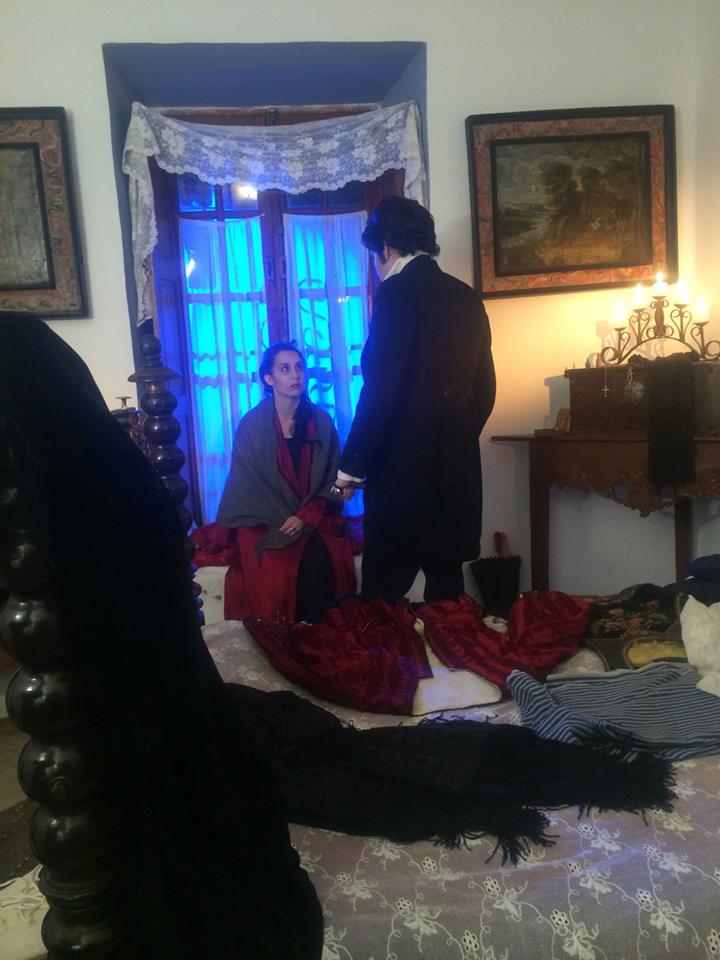
10417775_10153193597846840_8578639109230206091_nOn the other hand, the indoor shots of the family hacienda in modern times are the real driving force of the film.

By comparison, the 1800s flashback scenes emphasize the family’s once wealthy position that Stevenson establishes in the original story.

Their home is well-appointed.

Also, the church that becomes Olalla’s last refuge is visually impressive. Both are awash in color.

10960199_10153192480561840_838958167466423371_o

Because I mainly review films in an industry that operates outside mainstream Hollywood, I’m well aware that talented directors rarely have the money to bring their projects to the screen in the fashion they’d like.

Despite whatever financial hurdles they face, Amy Hesketh and Jac Avila create narratives that are intriguing interpretations of timeless stories produced with an innovative modern feel. As a team, they and their troupe deserve the highest accolades.

*          *          *

There is on more post to come. It centers on Amy Hesketh’s performance in Ollala.

To learn more about Amy and Jac, visit their twitter accounts at @Amy Hesketh and @Jac Avila.

Leave a comment

Filed under Uncategorized

Olalla, Part Two: Depraved Miscreants

by Rich Moreland, July 2016

Olalla is billed as a vampire film, but how do we define vampire in the context it presents? Let’s take a look.

All photos are compliments of Amy Hesketh and Vermeerworks.

*          *          *

Credit to the Troupe

Robert Louis Stevenson’s original “Olalla” hints at vampirism without any real overt evidence. Keeping this in mind, Amy Hesketh borrows just the right amount from the Victorian short story to expand the narrative without misplacing its thread.

ah4

In place of the English officer, she puts a traveler named Roberto (Cristian Del Rio) in the 1800s sequences. Nathan, the family’s guest when the narrative shifts to the present day, is a wartime photojournalist played by Luis Almanza.

Felipe is a dual figure: the younger version is played by Alejandro Loayza A and the older by Jac Avila who is superb as the family’s enforcer.

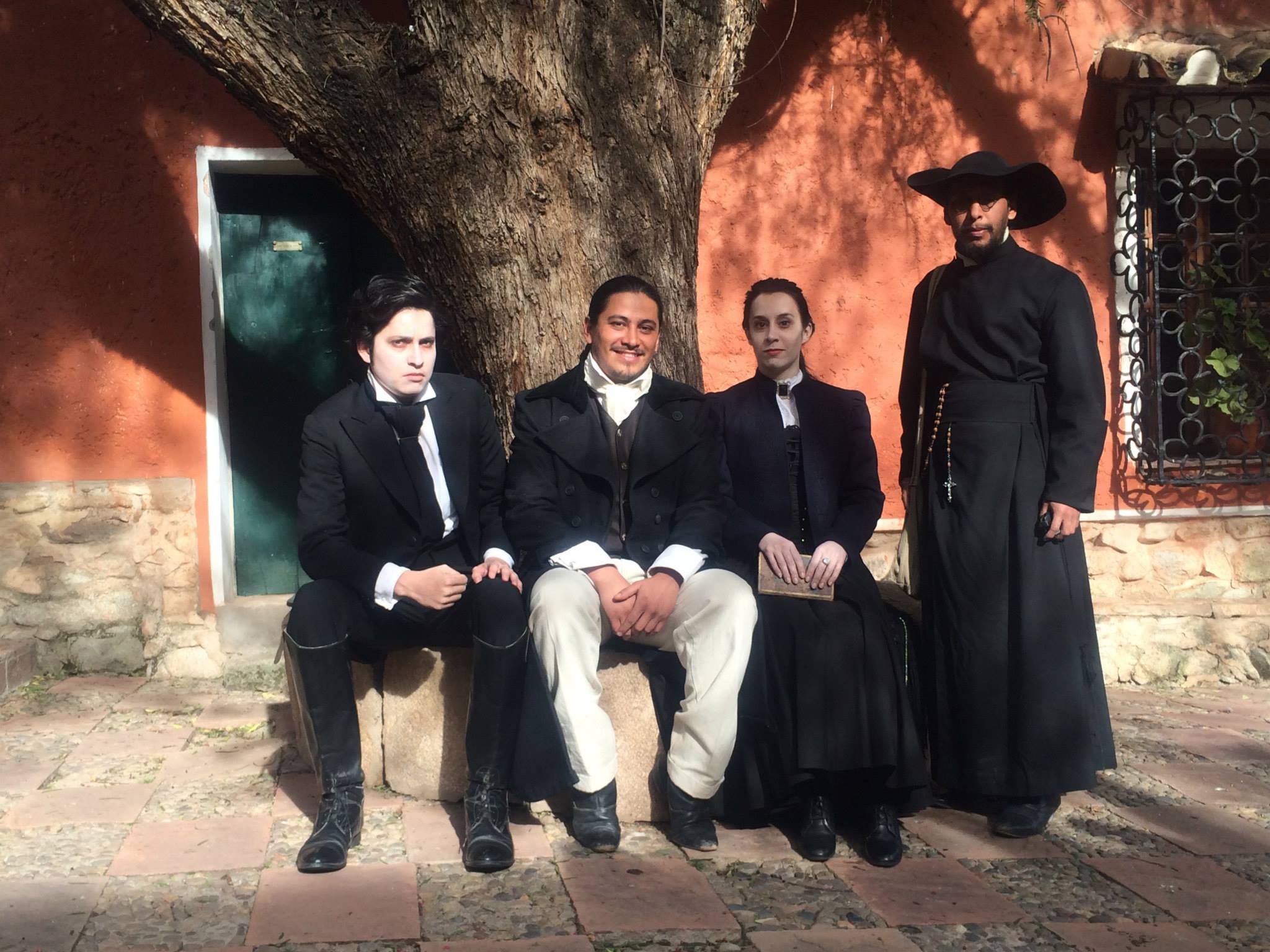
Alejandro Loayza A, Cristian Del Rio, Amy Hesketh, Rhobess Pierre

Alejandro Loayza A, Cristian Del Rio, Amy Hesketh, Rhobess Pierre

Lastly, the padre (Rhobess Pierre) serves the same function in both versions of the story.

Other characters are added. There is Olalla’s sister, Ofelia (Mila Joya), the aunt (Maria Esther Arteaga), the “twin” uncles (Beto Lopez L and Fermin Nunez), and the young Olalla and Ofelia (played by sisters Valeria and Rosario Huanca)

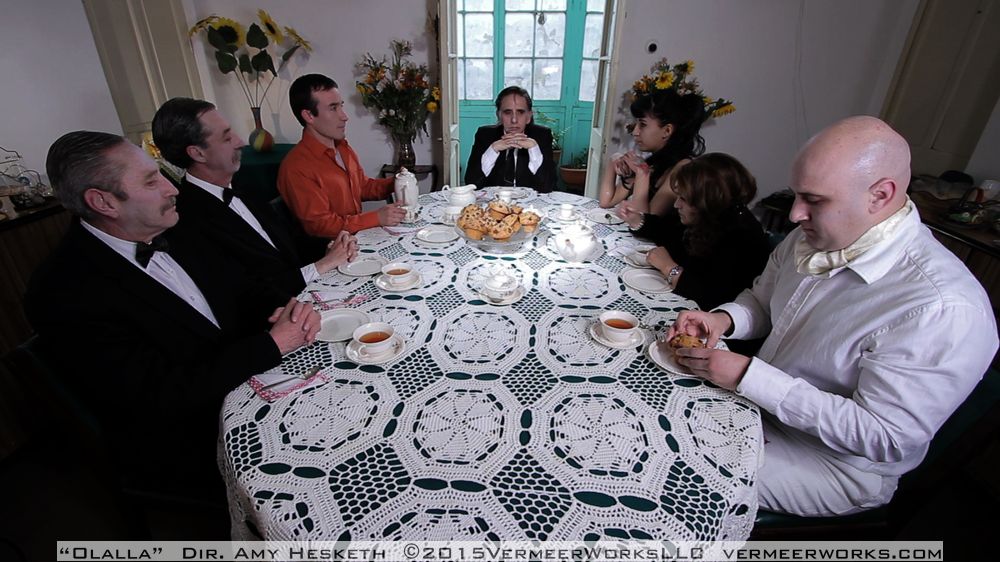
Finally, Erix Antoine is terrific as Bruno, the family member who tries his best to keep the house and everyone around him on the edge of normal. Pay close attention to the “muffin verses sweet cake” debate between Bruno and the uncles. The humorous innuendoes are priceless!

The family enjoys their sweets. (L to R) the uncles, Nathan, Uncle Felipe, Ofelia, the aunt, Bruno.

The family enjoys their sweets. (L to R) the uncles, Nathan, Uncle Felipe, Ofelia, the aunt, Bruno.

Of course, Olalla as mother replaces Stevenson’s character in the filmed version and has daughters who appear as youngsters. They grow up to be the modern Ofelia and Olalla when the narrative moves to the present time.

10942315_10205021517911476_4009634890043350938_o

The film expands on the family as a pack of depraved miscreants. In his story, Stevenson informs the reader that the mother sits in the sun against a pillar and other than brushing her hair, hasn’t “the least spark of energy.” Amy Hesketh’s take on the household presents an indolent aunt and uncles who are robotic without purpose, moving in unison with nowhere to go.

The updated Olalla does change one important element. In a nod to Stevenson’s tale, the mother indeed bites Roberto’s hand, but the impulsive act inflames the villagers and ushers in her death, as we will see.

The Vampire Question

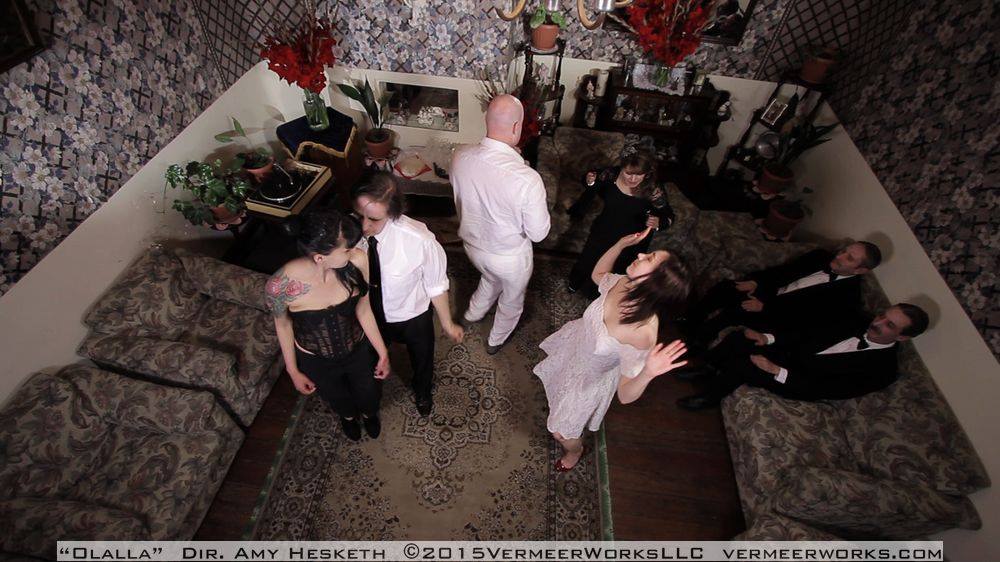
As suggested in the first part of this analysis, the family members are not vampires in the popular sense, but they aren’t vampire-free either. It’s an in-between identity the padre defines as a collection of “strange customs.” Even their dancing at the party is zombie-like, stilted and ludicrous to the point of hilarity.

Party scene with a high angle shot.

Party scene with a high angle shot.

The family cannot determine their destiny because they are as refrigerated as the bags of blood that await their cocktail hour. They’re in a time warp that repeats itself just as the uncles are aimless and without purpose. How else could two little girls grow into young women and take a century to do it?

1505228_10151835599527882_1712782730_nOn the other hand, what of Olalla? Does she have a blood fetish, what might be considered clinical vampirism, or is she a killer whose sins her mother paid for in a sadomasochistic show compliments of the Grand Guignol?

According to Psychology Today (November 2012), the German physician Richard von Krafft-Ebing established over a century ago the connection between blood and sexuality. He cites a case in which a man allowed his wife to suck the blood from his arm before they had sex. It aroused her apparently.

Of note is that Krafft-Ebing reached this conclusion in the mid-1880s. Perhaps this is the source of Stevenson story, an account of compulsion, erotic energy, and the fear of monsters. If so, the film version of Olalla has its artistic place in literature while exploring human perversion as applicable to the social sciences.

Modern Vampires are Sexier

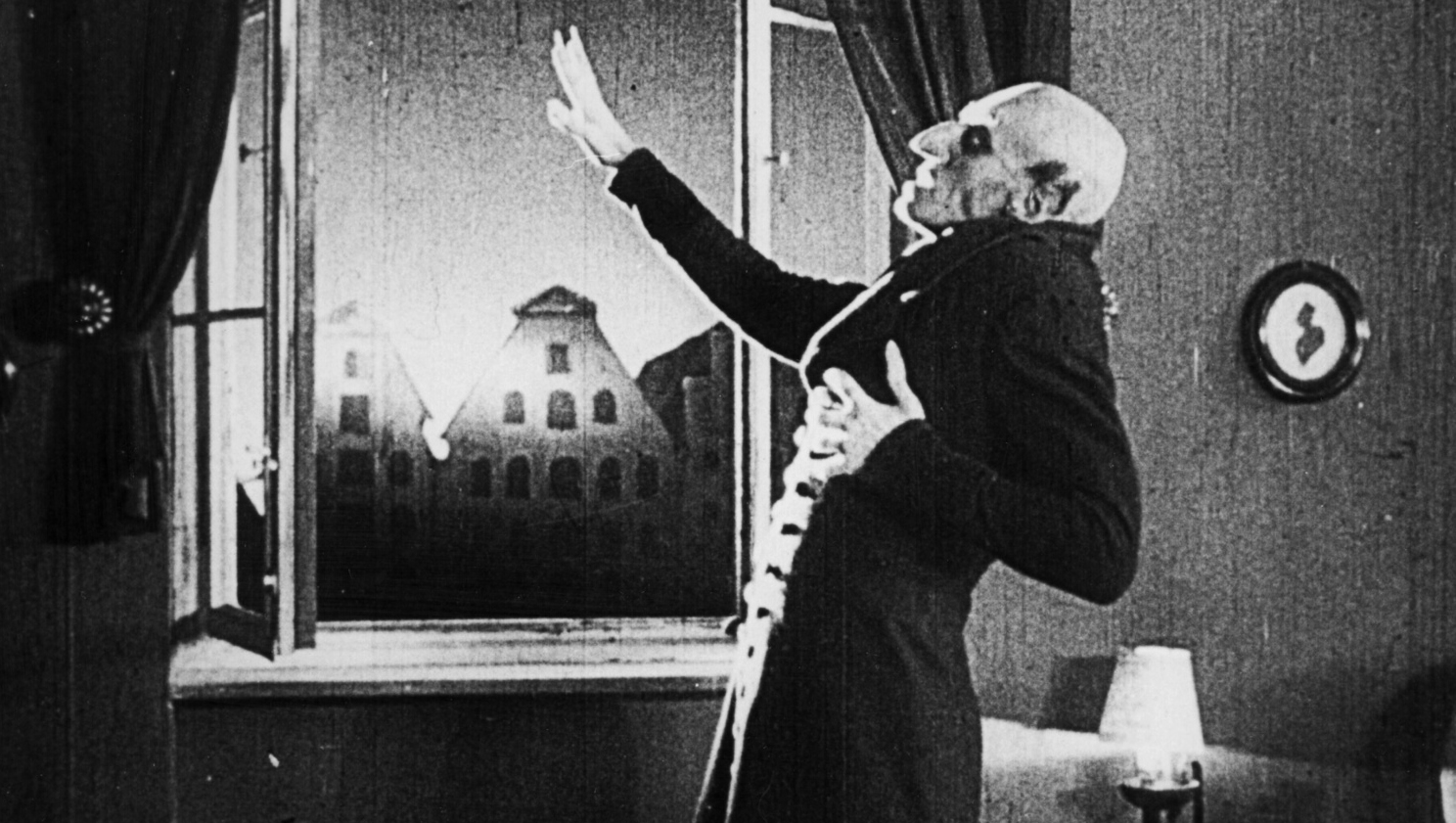
One more point is significant. If we assume Olalla is a vampire, she hovers between the Nosferatu genre of German Expressionism and Dracula.

Like “Nosferatu” (The Bird of Death), she bites, but her victims simply die and do not become vampires themselves. This is a departure from the Stoker model that Jac Avila uses in Dead But Dreaming.

On the other hand, Nosferatu’s  “Count Orlok” is linked to Dracula in one respect. nosferatu (1)He vanishes forever when caught in toxic sun light, whereas Dracula is only repelled by it. In either case, it’s a phenomenon that has no effect on Olalla.

So where does this leave us? Ofelia summarizes the film’s dilemma when she says to Bruno, “Olalla is a danger to all of us.”

Does this mean she is the only real vampire in the family? Or, is the brood afraid her habits will lead to the pitchfork crowd as happened with her mother?

One thing becomes painfully apparent as the film progresses. Olalla commits murder and will do it again.

Later when Ofelia interrupts her sister and Nathan watching Nosfertu, she furthers the vampire question with, “Modern vampires are sexier, don’t you think, Olalla?”

Nathan, Olalla, and Ofelia talk about vampires

Nathan, Olalla, and Ofelia talk about vampires

Nathan interjects that he and Olalla like the old version of the undead, whereupon Ofelia declares that those vampires always die “because they’re monsters who can’t control themselves.”

It’s a well-placed jab at her deviant sister.

There we have it. Olalla is like her family, caught in an in-between contradictory state (an “undead” purgatory, perhaps?) that is of the spirits and intangible and centers on evil rather than peace. And, in the end, we really don’t know if they are leftover Stoker sycophants, Count Orlok parasites struggling to survive, or simply blood freaks who are more than a little weird.

Or, perhaps they are a clan of murderers who will symbolically crucify Olalla on her bed to protect themselves . . .

OlaSc19_21_00012216

And that is exactly what links Amy Hesketh’s film to the classic enigma of Victorian literature and establishes its credentials for scholarly study.

Producers Amy Hesketh and Jac Avila

Amy Hesketh and Jac Avila are also Olalla’s producers.


*          *          *

By the way, my interpretation of this film is just one point of view. Everyone should check it out for themselves and reach their own conclusions.

In the next post, we’ll examine time as a motif in this film.

https://www.youtube.com/watch?v=tr4hIzWvgPs

Leave a comment

Filed under Uncategorized